TW in the CU Alumni Spotlight

Recently I was profiled on a sort of promotional page for Creighton University’s College of Art’s & Sciences, going over my background, some of my experiences while a grad student there, and my career since graduation. (Thanks to Rain Sissel for setting this up.) They have quite a few of these profiles up now–of current and past students, and faculty. As an alumnus these things are interesting, but maybe they’re not if you’re not. If you do like these sorts of profiles, check it out here.

I’d also like to point out that Creighton is now offering an MFA degree in Creative Writing, which is exciting news! (Read all about it here.) The new program starts this fall, and is accepting applications through July 15. If you know anyone who’s still looking for an MFA program to join in the immediate future, please pass along the link. In addition to being part of a great university in an increasingly hip city (one that’s still very livable with a low cost of living) the profile linked above can attest to the kinds of success CU can help set its students up for. Plus, they’re offering 5 fellowships to incoming students (3 of them with full tuition reimbursement and stipend)! Anyway, there’s no need for the sales pitch. It will be a good thing.

New Stories from the Midwest, 2012: Honorable Mention

I’m a little slow on the uptake here, but I should note that New Stories from the Midwest 2012 (aka Best of the Midwest) has been released from Indiana University Press and is ready for your consumption. While none of my work is included in this fine anthology, “The Approximate End of the World” (published by Boulevard of all places) is included as one of “Thirty Other Distinguished Stories.” Never let it be said that I wasn’t distinguished in defeat.

The anthology does include work from such luminaries as Dan Chaon, Charles Baxter, Anthony Doerr, Lee Martin, Christine Sneed, and Mark Wisniewski, among other great writers, and was guest edited by John McNally. According to the jacket copy, “The stories, written by Midwestern writers or focusing on the Midwest, demonstrate that the quality of fiction from and about the heart of the country rivals that of any other region.” Damn right!

Be sure to check it out if you’re interested. Jason Lee Brown and Shanie Latham do a great job putting this together, and it’s surely something Midwestern writers in particular should support.

Happy Book Birthday [Belated]: The Dark Corner

I’m checking in a little late here, but I still wanted to sincerely congratulate Mark Powell on the publication of his latest novel, The Dark Corner. Way to go, Mark!

Mark and I met in Key West last winter at the 2012 Key West Literary Seminar when we were part of the same Robert Stone-led workshop. (We also were housemates in this old pink house.) I very much enjoyed working with Mark then, and it’s no surprise that The Dark Corner is a great book.

Here’s the jacket copy:

A troubled Episcopal priest and would-be activist, Malcolm Walker has failed twice over—first in an effort to shock his New England congregants out of their complacency and second in an attempt at suicide. Discharged from the hospital and haunted by images of the Iraq War and Abu Ghraib, he heads home to the mountains of northwestern South Carolina, the state’s “dark corner,” where a gathering storm of private grief and public rage awaits him.
    Malcolm’s life soon converges with people as damaged in their own ways as he is: his older brother, Dallas, a onetime college football star who has made a comfortable living in real-estate development but is now being drawn ever more deeply into an extremist militia; his dying father, Elijah, still plagued by traumatic memories of Vietnam and the death of his wife; and Jordan Taylor, a young, drug-addicted woman who is being ruthlessly exploited by Dallas’s viperous business partner, Leighton Clatter. As Malcolm tries to restart his life, he enters into a relationship with Jordan that offers both of them fleeting glimpses of heaven, even as hellish realities continue to threaten them.

The Dark Corner is one of three books written by people I lived with and/or workshopped with at KWLS that came out last year. That I know of, anyway. (You should also check out Eric Sasson’s Margins of Tolerance and Jill Koenigsdorf’s Phoebe and the Ghost of Chagall.) Not too shabby. The folks down at the KWLS, in addition to bringing together a large group of talented writers, the famous and the yet-to-be-famous, always put on a great program. For 2014, the program is titled The Dark Side: Mystery, Crime & the Literary Thriller.

In the Spotlight

Midwestern Gothic interviewed me for the latest installment of their Contributor Spotlight series. Here’s a highlight:

How has the Midwest influenced your writing?
Almost all of my work is set in Nebraska, in the small towns and urban communities I’ve lived in or been to. I’m intrigued by the way geography and local history form the spirit of small communities—whether urban or rural—specifically from the lingering effect of historical trauma. So it’s become important to know local history, to recognize how different people identify themselves and others, and why this is so. Writing is mostly conjecture and projection, but, with my experience of living here my whole life, hopefully my work is an informed version of conjecture and projection.

Check out the full interview here.

And if you haven’t yet secured your copy of Midwestern Gothic 8, featuring my short story “The Mercy Killing of Harry Kleinhardt”, you should do so in either print or digital format, whatever’s your yen.

Thanks so much to Jeff and Robert for publishing this story, and now for featuring me in their blog spotlight as well.

“Mercy Killing” to Appear in Midwestern Gothic!

I’m pleased to announce that my short story “The Mercy Killing of Harry Kleinhardt” was accepted for publication in the great, and newish, literary journal Midwestern Gothic! The story will appear in their next issue, which I believe will be Issue 8, Winter 2013. More specifics will be forthcoming, no doubt.

Here’s an excerpt from “The Mercy Killing of Harry Kleinhardt”:

Aaron never actually knew his mother, not in any real way. When he was a boy he fantasized about her coming back to rescue him from Nebraska, to take him with her to LA, New York, Chicago, wherever she’d landed. Aaron knew so little about her that these dreams seemed like they could be real. His dad never told him what really happened to her. Harry would say, “She’s alive,” if Aaron pestered him enough. “That’s all you need to know. That woman you like to call your mom is still breathing somewhere.”

Aaron didn’t learn much about the world outside Jackson until later, but even as a boy it seemed pretty obvious that things were better elsewhere—and that this was the reason his mother left. There was an old joke about how Jackson was the only town in this free Union state to be named after a Confederate general, and that about summed up how out of step Jackson was with the rest of the planet, Aaron thought.

More than likely his mother met some men in Sioux City and took off from there. Maybe another woman hooked her into a hot lead for some quick money, some liquor or drugs, or a chance to work a back room at a horse track. Over the years, Aaron convinced himself of a thousand scenarios other than those that were likely. He dreamed, at different times, that she was a nomadic bounty-hunter in Texas, a piano teacher in Vienna, a pilot for the US Navy, an Amazon explorer, an African missionary. There was a long string of them. That she was the wife of an extraordinarily rich man was a recurring theme. They were ridiculous dreams. Aaron didn’t have much to work with in creating them.

There is plenty of overlap in this story with my other work. That’s always fun. For starters, the story is set in Jackson, Nebraska; the same Jackson County as is featured in my novel, The Uninitiated. (Read here for an explanation of how my Jackson, Neb. is different from the real Jackson, Neb; and how Sherwood Anderson’s Winesburg, OH differed from the real Winesburg, OH in similar ways.)

Most of the crossover, however, stems from the fact that “The Mercy Killing of Harry Kleinhardt” is part of my Bad Faith series of stories, all of which have been published now. The Aaron Kleinhardt of “Mercy Killing” is the same from “Kleinhardt’s Women” (Fogged Clarity, Dec 2010) and “On a Train from the Place Called Valentine” (Boulevard, Spring 2012), which shares characters with “The First Night of My Down-and-Out Sex Life” (Confrontation, Fall 2011) and “The Man Who Never Was” (Weekday, Summer 2010).

This is the first time I’ve written a series of connected stories so long–maybe testing my stamina before writing a novel?–and it’s exciting to see all of the stories find a home. But with so much murder, sex, drugs, alcoholism, adultery, betrayal, and deception in the cycle, it’s little wonder they’ve found an audience. Midwestern Gothic is a fitting end to this stage of the stories’ publishing life, and an apt home for “Mercy Killing.” I’m glad to have the story picked up, of course, and particularly glad that it was Midwestern Gothic who laid claim to it. Cheers!

of Love & Death

I’m not sure how I missed announcing this earlier–seeing as I did mention, last year, that a digital version of my “The Housekeeper” is for sale on Amazon as part of the Mixer Countdown–but, better late than never, it bears announcing that Mixer’s debut print anthology, of Love & Death: heartburn, headaches, and hangovers is now for sale on their website!

If you haven’t yet read “The Housekeeper”, or are looking for a print version, the anthology is a good one. Here’s more:

of Love & Death: heartburn, headaches, and hangovers features award-winning writers Kate Braverman, Kirstin Allio, Myfanwy Collins, Tom Bonfiglio, Danny Goodman, Sam Decker, Daniel Grandbois, and many, many more. Structured in three parts, the anthology first explores the joy and pain of early relationships, then marriage, and finally family. of Love & Death is subtle, profane, tragic, lewd, thrilling, insightful, sad, provocative, painful, hilarious, insane, occasionally murderous, and authentically powerful–capturing the beauty and ugly of real life in all its variations. 15 stories in three parts–a rare thematically structured anthology that can be read as a composite novel of life.

I’m usually better about announcing these sorts of things–so I apologize for being late to the party on this one. For more about “The Housekeeper” and its multivaried path to publication, check out what I wrote about the story here, here, and here.

[Ed. note: It looks like my review of Christopher Narozny’s novel Jonah Man is scheduled to go up on Kenyon Review Online on November 7. So forget all those annoying election post-mortems and instead opt for some timeless literary criticism.]

Sunrise, Sunset

It was on August 29 of last year that I finished a full first draft of my novel, then called The Hyphenates of Jackson County. At the time, I anticipated taking another 6-8 months to go through edits and arrive at a refined, fully-edited version of the novel. Maybe declaring Mission Accomplished! was a bit premature, as edits have taken nearly a full year instead, complete with a change in title to The Uninitiated. Overall, the process, starting at my beginning research, took three and half years to arrive at this point. Still, done is done. I finished putting in the final changes on Tuesday this week, and started the process of finding a new agent for the book this afternoon, querying my top four choices.

I ended up doing two more revisions after I felt the book was done, trying to put it under as much pressure as possible before sending it out, which will hopefully pay off. My dedicated panel of readers and conversants–Amber, Bill, Devin, Jenn, Marta, Nicole, and Shannon, em for moral support, the Lee Martin workshop at the Nebraska Summer Writers Conference, various others who happened to inquire after the status of the book–offered some great feedback. Thanks be to them!

Wish me luck and strength.

The Second Half: The Millions’ Preview and Harper Perennial’s Big Deal

The Millions dropped its Most Anticipated: The Great Second-Half 2012 Book Preview this week. In what’s becoming a biannual tradition, the list boasts a number of big-name authors, such as Zadie Smith, Junot Díaz, Michael Chabon, George Saunders, and David Foster Wallace. Not too shabby. Head over to The Millions for the full scoop, but here are some details on the books that look most interesting to me:

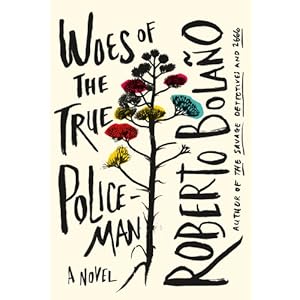
John Brandon‘s A Million Heavens focuses on an oddball cast that gathers around the hospital bed of a comatose piano prodigy.  …  Up-and-comer Charles Yu, who I saw in January at the Key West Literary Seminar, releases what’s been called a Vonnegut-esque short story collection, Sorry Please Thank You.  …  Jonathan Evison offers an interesting take on the road novel with The Revised Fundamentals of Caregiving, wherein a man takes off across the West with a boy suffering from Muscular Dystrophy who’s been entrusted in his care.  …  Zadie Smith gets back to fiction with NW, a class novel set in London.  …  Junot DíazThis is How You Lose Her arrives in September, a story collection that has apparently already been published piece by piece in the New Yorker.  …  America’s sweetheart, Emma Straub, breaks out with her first novel, Laura Lamont’s Life in Pictures. … Chris Ware collects his Building Stories comic strips in Building Stories.  …  Roberto Bolaño continues his impressive posthumous production with Woes of the True Policeman, which returns to the Northern Mexico city of Santa Teresa, featured in 2666. This is believed to be Bolaño’s final unpublished novel. We shall see.  …  Tenth of December is George Saunders‘ fourth humorous short story collection, many of which, I believe, were also already published in the New Yorker.

A lot to like there.

Meanwhile, Harper Perennial and One Story are partnering to offer the digital editions of some of their short story collections at the low price of $1.99.  Check out the details on Harper Perennial’s Facebook page. It’s no secret to readers of this blog that I’m a huge fan of Harper Perennial. In fact, of the books being offered in this promotion, I’ve reviewed Ben Greenman‘s What He’s Poised to Do, Lydia Peelle‘s Reasons for and Advantages of Breathing, Rahul Mehta‘s Quarantine, and Justin Taylor‘s Everything Here is the Best Thing Ever. You can find the reviews here, here, here, and here. No matter your digital device, check out a few of these titles. You won’t be disappointed. (As far as I know, they also work in print. The discount doesn’t, however.)

Down and Out at the NSWC

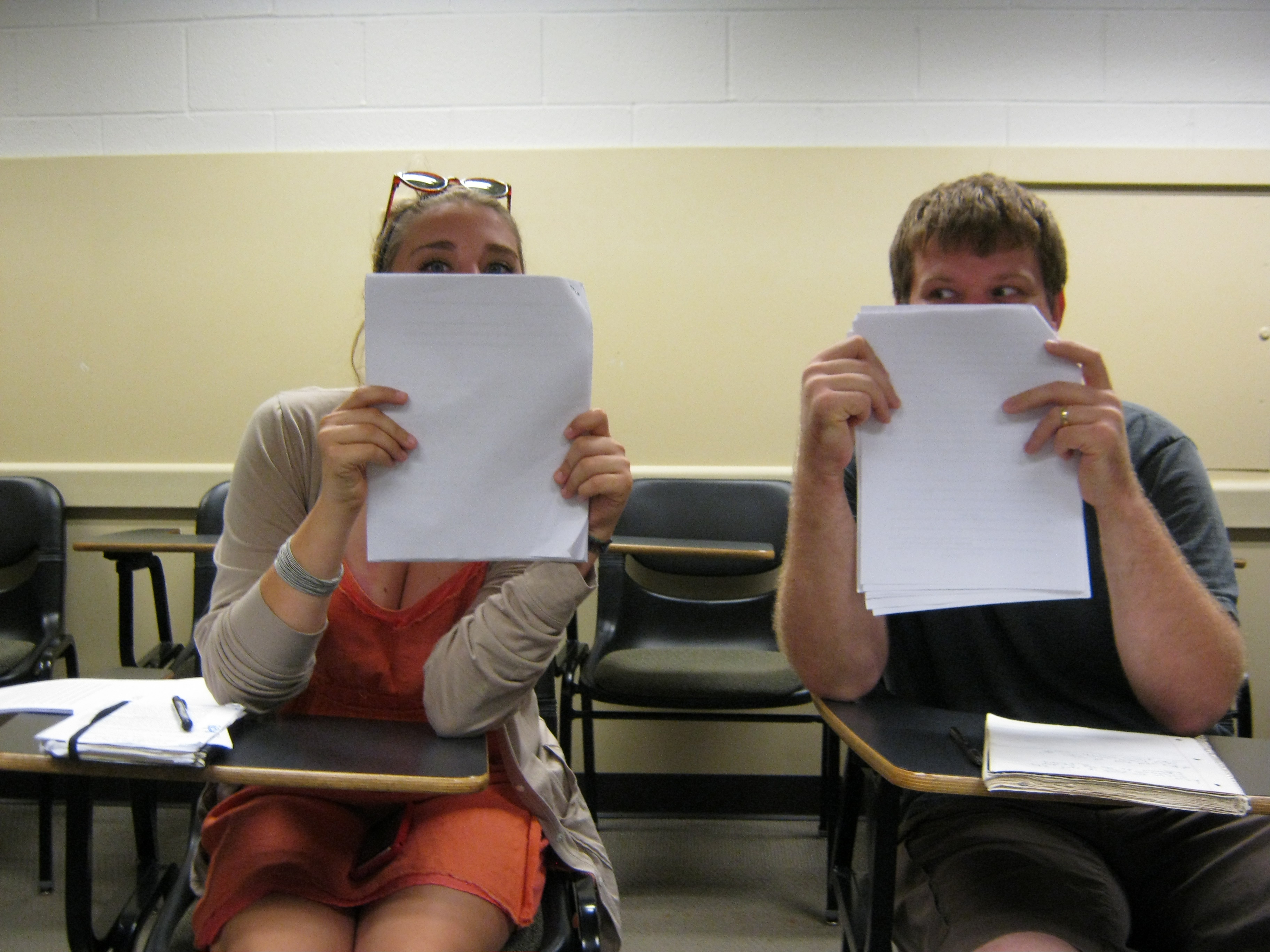
Demonstrating how to cultivate suspense with fellow workshopper Julia Lee McGill.

I was lucky to spend a week in workshop with Lee Martin earlier this month down in Lincoln at the Nebraska Summer Writers Conference. The workshop was great. It was a lot of fun and helped crystallize the main issue of what’s lacking in the first twenty pages of my novel. I’m excited to get to work on resolving that issue now and getting the manuscript out to agents by the end of the summer. I couldn’t have asked for more, really. The group I worked with was very giving; Martin is a skilled workshop leader. I won’t get into the details too much here–although a dispatch of my experience was published last week on the Prairie Schooner blog if you’re interested. Read Lee’s recap on his blog too while you’re at it.

A very nice experience it was. If you have the chance to attend the NWSC in the future, or work with Lee Martin, don’t pass it up. Many thanks to conference director Timothy Schaffert and his ace lieutenant, Sarah Chavez, for having me down there. It was worth the drive every morning, and then some.