A quick note that “Minstrel Show, or The Lynching of William Brown” is to be performed as a reading next Sunday, January 11, as part of the Douglas County Historical Society’s Second Sunday lecture and performance series. The play was written by DCHS researcher Max Sparber and takes for its subject the 1919 Courthouse Riot in Omaha. The play retells the events of the riot from the perspective of two itinerant performers.
Originally produced in 1998 by the Blue Barn Theater, and performed in the rotunda of the Douglas County Courthouse in addition to the Blue Barn, “Minstrel Show” has since been performed around the country to rave reviews. An actor from the Blue Barn will participate in the reading on Sunday, and Max Sparber will take questions afterwards.
(You must e-mail members(at)douclascohistory(dot)org for reservations. The event is free for members and costs $5 for non-members.)
—
Also, if you can’t make it to the performance, you can find video of a 2006 Blue Barn production of the play on YouTube here, here,here, here, and here.
There will be more of a formal announcement for all this soon, but I’ve been itching to share about a project I’ve been working on as part of my association with Akademie Schloss Solitude, so here you go.
This upcoming February I’ll return to Germany to participate with other fellows and guests of the Akademie in a two-day, cross-discipline workshop titled “Quotes and Appropriation.” I’m very excited to return to Stuttgart for this, as its a culmination and redirection of the book project I’ve been working on the past five years.
In addition to panels and workshops, there will be an opening night presentation called “Omaha Uninitiated: Music, Cultural Artifact, and Historical Event in the Recreation of Civic Trauma.” This project contains three elements–a set of readings from On the River, Down Where They Found Willy Brown, a novella based on events surrounding the Omaha Courthouse Lynching of 1919 (more on this below); a presentation of photographs and video that have been important to the creation of On the River, and my related full-length novel The Uninitiated; and a DJ performance by Darren Keen.
It will be amazing to bring five year’s worth of research and writing on this topic to Germany, and I’m particularly excited to see what Darren comes up with for the music component, what will be a mashup and cross-fertilization of music from the World War I era that was important to the creation of the novel (ragtime, propaganda music, American folk, jazz) mixed with music from Nebraska in the last fifteen years.
The final part of all this is publication of the aforementioned novella (On the River, Down Where They Found Willy Brown) by the Reihe Projektiv imprint of Edition Solitude. If you heard me read at the Key West Literary Seminar in January, Solitude Nacht in July, or last Friday at the Fair Use Reading Series in Benson, that is some of the same material. Todd Seabrook (editor/designer with The Cupboard) is working on the design and I’m pretty excited how it’s turning out.
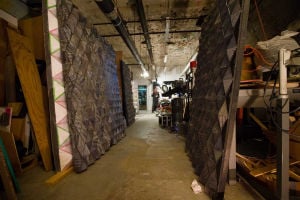
The Omaha World-Herald ran an interesting piece this week with Erin Golden’s “Life beneath the street: Downtown sidewalks conceal a hidden world underground.” The article details the condition and current use (or non-use) of several giant vaults that remain under the streets and sidewalks of downtown Omaha.
Per the article:
Some of the below-ground history is clear. The vaults were used for storing coal and merchandise, which could be dropped in through chutes or lowered through metal trap doors built into the sidewalks.
But there are other possibilities, too. In the late 1800s and early 1900s, spaces like Hawkins’ were directly below the heart of an area known as the Sporting District, where a crime boss ran bootlegging and prostitution operations.
My novel Kings of Broken Things contains several pivotal scenes in tunnels under the city–the crime boss ones–so this is pretty interesting to me. From what I’ve read, I don’t think vaults like the one pictured had much to do with criminal operations. Pimps and bootleggers were more concerned with secrecy and transportation, less so with storage, so narrow tunnels were favorable. As is fictionalized in my book, tunnels were used to connect hotels with brothels, so patrons could move discretely without being scene walking in the front door of the house where they took their pleasure. Several of Tom Dennison’s offices and saloons he ran were rumored to feature tunnels as well, to facilitate a quick get-away if necessary.
Society as a whole seemed to be obsessed with tunnels and secret underground vaults those days. Many people had them dug under their yards, to their garages, elsewhere. Big retail stores like the Brandeis had tunnels that connected from the bargain basement level to nearby banks–so customers didn’t have to go out into the weather should they need to make a withdrawal. “Tunneler” was a pretty common professional during these times too. As a dangerous job that demanded skill, I’m sure it paid well.
Thinking of this reminds me of the scenes in The Jungle when Jurgis Rudkus joins the project to dig the Chicago subway. Or, more recently, Colum McCann’s captivating portrayal of the sandhogs who tunneled under the East River to connect Manhattan and Brooklyn by rail in This Side of Brightness, my favorite McCann novel.
At any rate, I’m pretty jealous of Phil Hawkins, the artist whose kept a studio in one of these vaults the past few years. Not that I’d want to give up my cozy home office or anything, but that’s awesome.
While Five Chapters was serializing my work last week, some good news regarding another publication came through, as “Attend the Way” was accepted by Heavy Feather Review for their themed double issue this summer!
HFR has done some cool stuff for what’s a pretty new journal. Their web design and cover art are really interesting, for one thing. I’m excited to see how the issue comes together. And their call for submissions period on the theme “Vacancies” is still open, by the way. View the call here.
“Attend the Way” is a story I’ve been working on for a while, one from a series about the “neighborhood men” I used to come across when I walked to work from 33rd & Dewey. This is the second story to feature the Kellogg Rooming House too, for all you 24th Street connoisseurs out there.
Here’s an excerpt:
Most all he has now are clothes and most of them are ratty. Olive work pants the city gives him, a bunch of tee shirts. Rodney mows grass in parks and vacant lots, around abandoned houses. He has a hot plate in his room, on a table next to his bed because he likes to cook lying down. There’s a pine closet that sticks out from the wall by the door and his twin bed is angled so he can look out the window. His girl had a TV and paid for cable. Rodney kind of misses watching what was on each night, especially in the summer after mowing was finished. He misses lying on the couch with his girl too, even though he won’t let himself miss her. Most of the time it’s more comfortable to be alone, that’s how he sees it. Rodney’s legs are hot and he doesn’t like being shut up in a room with somebody else whose legs might also be hot.
Thanks to Jason and Nathan for selecting the stories, and to everyone who helped this story along. It’s nice to have another pub to look forward to this summer. “Shame Cycle” inGargoyle, and now “Attend the Way” in Heavy Feather Review. Prost!
The serialization of my story “Impertinent, Triumphant” on Five Chapters began tonight! Look for Part 2 on Tuesday, and so on, throughout the week. In lieu of making five posts, I’ll just update the links here. Let’s get started:
I wrote a bit more about the story back in November when it was accepted, and you can read that here if you’re interested.
It’s exciting to see this story go up on such an interesting and vital venue. Be sure to click around in their archives too while you’re there. 5c has really put out some remarkable work. Thanks again to David Daley for taking the story.
Big congrats today to Timothy Schaffert on the release of his latest novel, The Swan Gondola! The book has received quite a strong reception from critics. Publishers Weekly said “it’s easy to imagine this charming novel attaining Water for Elephants–like popularity with readers,” which is quite an endorsement.
The Omaha World-Herald has more on the book here and here, along with information on various local events this weekend to celebrate its publication.
It’s nice to see a Nebraska writer realize such success–particularly with a historical novel set in Omaha. It’s especially fitting for Timothy, as he does quite a lot to advocate for Nebraska authors–through his (downtown) Omaha Lit Fest, as interim editor of Prairie Schooner, and in thousands of smaller ways. All this couldn’t be happening for a better guy.
On the eve of the 1898 Omaha World’s Fair, Ferret Skerritt, ventriloquist by trade, con man by birth, isn’t quite sure how it will change him or his city. Omaha still has the marks of a filthy Wild West town, even as it attempts to achieve the grandeur and respectability of nearby Chicago. But when he crosses paths with the beautiful and enigmatic Cecily, his whole purpose shifts and the fair becomes the backdrop to their love affair.
One of a traveling troupe of actors that has descended on the city, Cecily works in the Midway’s Chamber of Horrors, where she loses her head hourly on a guillotine playing Marie Antoinette. And after closing, she rushes off, clinging protectively to a mysterious carpetbag, never giving Ferret a second glance. But a moonlit ride on the swan gondola, a boat on the lagoon of the New White City, changes everything, and the fair’s magic begins to take its effect.
I wanted to note the passing of Orville Menard. For long-time readers of the blog, Menard’s name should be a familiar one. I’ve mentioned his work on Tom Dennison and the history of political bossism in Omaha many times in this space, as its been a crucial source in researching my novel. I’m very thankful for his wide adnd varied contributions on the subject and was saddened by the news.
The Omaha World-Herald ran this profile of Menard last week, detailing Menard’s career as an academic, writer, family man, and mentor of, among others, Chuck Hagel.
No big news regarding the novel-writing at this point. I’ve been busy reworking the reworks. Tried half a dozen more ways to do the opening pages and feel like I’m getting closer on that. For a long time I leaned on having a sort of prologue opening, but decided to cut all but four pages of that, as it seemed to be more of a crutch for me as writer than anything that might interest a reader. Always a tricky business figuring out what actually needs to be on the page and what needed to be written for the writer only. Getting closer though.
There was some more tangible news related to The Uninitiated over the season though, as Boulevard published an excerpt of the novel in October, titled “River Ward, 1917.” This is the first bit of writing from the novel that’s been published, so definitely exciting news there.
Meanwhile, in December, another excerpt, “On the River, Down Where They Found Willy Brown,” brought home the Marianne Russo Award from the Key West Literary Seminar. Among the many benefits are free travel and lodging at this year’s seminar, the opportunity to read my work as part of the regular program at the seminar, and an 11-day stay in Key West. It will be sad to miss over a third of Nebraska’s January, but somehow I’ll soldier through.
These two things, along with a fellowship to Akademie Schloss Solitude, winning the Tarcher/Penguin Top Artist contest, a long-list notice in the Inkubate novel contest–all of which was based on work done for The Uninitiated–makes me hope I’m on the right track here.
“Tom thought it over as he paced the brick drive that led up to his house, two days after the vote. Bullet straight and tree-lined, the drive gave the impression of something fantastic as his house slipped into view, large and unreachable, a mirage. The house was wood-framed with finishes of granite at certain edges, the cellar and foundation limestone, highlights of plaster festoons above the front door. A few chimneys rose above beveled eaves. Off the second floor bedrooms were balconies as wide as the patios below, where a tiered-garden overlooked the industrial valley. There were pergolas holding grape vines, arbors abloom with creeping red ivy. Everything here was made for entertaining, for looking at, for admiring, but up close these spaces didn’t serve any purpose. This was an unpeopled luxury, a lonely glutton of riches in and of itself. If Tom was being honest, he had to admit this.
“Years before, an enemy left a bomb on the front doorstep. An ingenious design, the bomb, a simple wooden box with six sticks of dynamite and a pistol inside. A string was tacked to the porch and connected to the trigger of the pistol. If someone had lifted the box, his wife Ada or daughter Frances, the whole house would have been blasted clean off the earth, leaving only a rubbled crater. Frances found the box with a friend, and she told Tom about it. A smart girl, Frances didn’t touch the infernal device at all. Tom noticed the trip wire when she brought him to see. He had police dismantle the bomb. After that Tom closed the grounds. Bodyguards were kept outside around the clock. You had to be a close family friend, a known friend, if there was such a thing, or else you couldn’t get in. The bomb changed things. That’s when Tom put the machine gun across his lap in the car. That’s when everything here, all this bounty he’d won over the years, all of it, started being lonely.”
Just Finished
The 42nd Parallel by John Dos Passos. I’d always avoided the USA Trilogy for some reason. Dos Passos is so often only a foot-note to Hemingway among the great writers of the Lost Generation, although his novels are consistently lauded and canonized as well. I’d just never known anyone who actually read him, so there wasn’t much of a conversation to join, I guess. After reading this first third of the trilogy I can see why Dos Passos is still relevant. So much of his pro-labor and socialist message is probably lost to most contemporary readers–it’s similar to reading The Jungle at times–but the level of energy and innovation is very high here too. Very rich, poetic, and affecting.
The Rings of Saturn by W.G. Sebald. The way these conversational essays seem to be written more for effect–that your mind wanders with the flow of information, sometimes parallel to it, sometimes not–produces an interesting reading experience. I’d read about Sebald’s work a lot before I ever read it, so I kind of knew what to expect. At the same time, I’m still not really sure what to think.
The Assassination of Jesse James by the Coward Robert Ford by Ron Hansen. Really enjoyed this. A lot more than I thought I would, frankly. I met Ron when he visited Creighton University this fall, which is what prompted me to finally pull this off my “To Read” book shelf. The psychological depth of the novel is pretty astounding. Plenty of shoot-outs and train robberies too, of course.
The Castle by Franz Kafka. A monster of an unfinished novel. I was compelled to read this after watching Michael Haneke’s film adaptation, and really enjoyed both quite a lot. The idea of reading an unfinished novel always intrigues me, particularly ones of this class that could just as accurately be called “unfinishable” novels. It isn’t so much that the plot line is incomplete, more that the story could never finish. It’s not like K.’s going to find some sort of victory in the end, or defeat for that matter. The novel follows his string of embarrassments and slight advancements and eventually stops as he reaches the end of his inertia. I kind of wondered if the novel wasn’t finished after all.
Hide Island by Richard Burgin. A review I wrote of this collection of short stories will be appearing in Prairie Schooner‘s Briefly Noted online book review, probably in February.
Now Reading
A Constellation of Vital Phenomena by Anthony Marra. This has been pretty engaging so far, although the writing sometimes comes off as haphazard, particularly when it comes to POV. Maybe haphazard isn’t the right word, superfluous?, but I often question some of the strategies Marra uses here to tell the story. A good book nonetheless. I can certainly see why it made so many Best of lists this year, mostly because of the story of an orphaned little girl and two eccentric doctors in war-torn Chechnya is so remarkable.
An American Tragedy by Theodore Dreiser. I’ve been reading this off and on for a few years now. I come across some criticism about Dreiser a while ago that lumped him into a group of American novelists who have novels regarded as classics (Dreiser has two, of course, with Sister Carrie also showing impressive staying power) even though the writing itself isn’t really all that remarkable. I’d tend to agree with the assessment. Nobody is going to confuse Dreiser with Hemingway or Fitzgerald, as far as style and form go, although the story of his novels really is so quintessentially American (for its time, place, and class) that it’s hard to dispute the status of his novels as classics. Steinbeck was the other novelists lumped into this category, which seems to fit as well.
It was in the Chicago Convention in ’96 that the prizewinning boy orator, the minister’s son whose lips had never touched liquor, let out his silver voice so that it filled the gigantic hall, filled the ears of the plain people:
Mr. Chairman and gentlemen of the convention:
I would be presumptuous indeed to present myself against the distinguished gentleman to whom you have listened, if this were a mere measuring of abilities; but this is not a contests between persons. The humblest citizen in all the land, when clad in the armor of a righteous cause, is stronger than all the hosts of error.
I come to speak to you in defence of a cause as holy as the cause of Liberty…
a youngish bigmouthed man in a white tie
barnstormer, exhorter, evangelist,
his voice charmed the mortgageridden farmers of the great plains, rang through weatherboarded schoolhouses in the Missouri Valley, was sweet in the ears of small storekeepers hungry for easy credit, melted men’s innards like the song of a thrush or a mockin’ in the gray quiet before sunup, or a sudden soar in winter wheat or a bugler playing taps and the flag flying;
silver tongue of the plain people;
…the man who is employed for wages is as much a businessman as his employer;
the attorney in a country town is as much a businessman as the corporation counsel in a giant metropolis;
the merchant in a crossroads store is as much a businessman as the merchant of New York;
William Jennings Bryan
the farmer who goes forth in the morning and toils all day, who begins in the spring and toils all summer, and who by the application of brain and muscle to the natural resources of the country creates wealth, is as much a businessman as the man who goes upon the board of trade and bets upon the price of grain;
the miners who go down a thousand feet in the earth or climb two thousand feet upon the cliffs and bring forth from their hidingplaces the precious metals to be poured in the channels of trade, are as much businessmen as the few financial magnates who in a back room corner the money of the world.
The hired man and the country attorney sat up and listened,
this was big talk for the farmer who’d mortgaged his crop to buy fertilizer, big talk for the smalltown hardware man, groceryman, feed and corn merchant, undertaker, truckgardener…
Having behind us the producing masses of this nation and the world, supported by the commercial interests, the laboring interests, and the toilers everywhere, we will answer their demand for a gold standard by saying to them:
You shall not press down upon the brow of labor this crown of thorns, you shall not crucify mankind upon a cross of gold.
They roared their lungs out (crown of thorns and cross of gold)
carried him round the hall on their shoulders, hugged him, loved him, named their children after him, nominated him for President,
boy orator of the Platte, silver tongue of the plain people.
But McArthur and Forrest, two Scotchmen in the Rand, had invented the cyanide process for extracting gold from ore, South Africa flooded the gold market; there was no need for a prophet of silver.
The silver tongue chanted on out of the big mouth, chanting Pacifism, Prohibition, Fundamentalism,
nibbling radishes on the lecture platform, drinking grapejuice and water, gorging big cornbelt meals;
Bryan grew gray in the hot air Chautauqua tents, in the applause, the handshakes, the backpattings, the cigarsmoky air of committeerooms at Democratic conventions, a silver tongue in a big mouth.
John Dos Passos reading to his wife, Katy.
In Dayton he dreamed of turning the trick again, of setting back the clocks for the plain people, branding, flaying, making a big joke of Darwinism and the unbelieving outlook of city folks, scientists, foreigners with beards and monkey morals.
In Florida he’d spoken every day at noon on a float under an awning selling lots for Coral Gables…he had to speak, to feel the drawling voices hush, feel the tense approving ears, the gust of handclaps.
Why not campaign again through the length and breadth to set up again the tottering word for the plain people who wanted the plain word of God?
(crown of thorns and cross of gold)
the plain prosperous comfortable word of God
the plain prosperous comfortable midamerican folks?
He was a big eater. It was hot. A stroke killed him.
Three days later down in Florida the company delivered the electric horse he’d ordered to exercise on when he’d seen the electric horse the President exercised on in the White House.





 Theodore Wheeler