“Kleinhardt’s Women” Goes Up

Fogged Clarity is now featuring my piece “Kleinhardt’s Women” in their current December 2010 issue! And as mentioned before, you can hear me reading the piece on the site as well. It’s pretty cool. I like the format, with the podcasting option.

There’s also an interview with Andre Dubus III in the issue, in which he discusses watching Batman with Kurt Vonnegut. It’s a pretty great interview on writing about dark characters and understanding “bad” people through fiction.

Weeks of Nov 8 – Dec 5, 2010

So, as of my last post, “The Housekeeper” was a finalist for the 2010 Flatmancrooked Fiction Prize, but I hadn’t yet learned if it had won or not. It did not win, but the story will be featured as an online feature and in the forthcoming anthology Flatmancrooked 4. With this acceptance and with “Kleinhardt’s Women” appearing soon on Fogged Clarity, I’m up to thirteen short stories that have been published or are forthcoming. Pretty sweet! It’s also the sixth time I’ve received honorable mention in a contest.

The seed for this story came from reading about how famous B-move director Ed Wood died. I’d seen the Tim Burton biopic many times and, wanting to learn more, came across the story of how Ed died, in which he supposedly lay in bed screaming for help for ninety minutes before his wife came and found him dead. (Of course, he’d been known to fake heart attacks on many occasions before, so it makes all the sense in the world that his wife would doubt him, tragically.) Anyway, this interested me and I tucked the idea away that I could use this in a story some day—a writer of lurid outré novels and other kinds of smut who ends up so isolated from his loved ones that he would die in a similar fashion as Ed Wood did. Nearly a year later Nicole brought to my attention a series of classified ads that was running in the Omaha World-Herald, all placed by a woman who was trying to start up this giant Christian charity based out of her house. She was advertising things like petting zoos, silent auctions, cherub choirs, parades. It was all very bizarre. She created her own system of currency for her enterprise (CC Bucks) and ultimately wanted to host a rally at the Qwest Center that would feature Sly Stallone. God told her to do all this in a vision. Once I saw these ads, I knew that I’d found a match for the Ed Wood character that I’d already sketched out.

-Also, do take a listen to Myfanwy Collins receiving the good news from FMC editor Elijah Jenkins. It’s always tricky accepting good news over the phone, I think, but Myfanwy does it exceptionally well. I always sound like a phony in those situations, unable verbalize my excitement and gratitude. Myfanwy and I have known each other, in an internet sense, for a number of years now. As an undergrad I often participated in the Zoetrope Virtual Studio, and had the pleasure of trading reviews with Myfanwy on several occasions. We both had stories in FMC’s 2009 anthology, Great New Writing Done During an Economic Depression, and our nominated stories will both be in the upcoming Flatmancrooked 4, due out late in 2011. Anyway, there are few people out there more deserving than Myfanwy Collins and I’m very excited for her victory here. If anyone was going to take the prize over me, I’m glad it’s her.

Dispatch from “The Housekeeper”

“Scott was a rational person, after all. It was just that being home made him panic. He’d moved on, he’d left the weirdness of his youth behind. It wasn’t fair that his co-workers might discover these things about him in the newspaper. If they knew his mother claimed to have visions of God it would ruin all of the cachet Scott had built in life, in his real life, the one that started the very second he moved out of this house. And if his friends knew about Peggy, it would only be a matter of time before they found out about Frank, the weirdo writer, the dishonorably discharged fairy who spent most of his bizarre life locked in an upstairs bedroom committing his wet dreams to paper. And if his friends at work knew about his father—if his church somehow found out—then it would be all over for Scott. All he wanted was to have his own life, to go on without being weighed down by the oddity of others, to be of and from nothing and no one.”

Personal Rejection Notes, Requests for More, and Other Nice Versions of No Thanks

Michigan Quarterly Review for “On a Train from the Place Called Valentine” and Alaska Quarterly Review for “The First Night of My Down-and-Out Sex Life.”

Now Reading

Rivers Last Longer by Richard Burgin.

More Hot Pub Action!

My nice run continues, as my short story “Kleinhardt’s Women” has been accepted for publication by Fogged Clarity!

Fogged Clarity is a mostly online journal that features work by musicians, artists, and scholars in addition to fiction and poetry. They have some pretty cool stuff–including, this month, an acoustic session with matt pond PA–and I’m very excited that my work will be included.

They also include audio files of the literary work published on the site, so you all can read along with the story when it’s published. I’ll be headed over to my friend J.J. Idt’s this week to record a performance of “Kleinhardt’s Women.” It’s been a long time since I’ve read to an audience–and even longer since J.J. has recorded me, filming zapruder fans, are you out there?–so wish me luck. It will be an interesting format for this piece especially.

Weeks of Oct 10 – Nov 7, 2010

-For my birthday this week, Nicole took me to the National World War I Museum in Kansas City. We had a pretty engaging afternoon there and really enjoyed the experience. None of the exhibits had a ton of specific relevancy to the novel I’m working on—besides general period details—but it’s always nice to be immersed in the subjects and obsessions of the era. And for someone who loves history, it’s an awesome way to spend an afternoon.

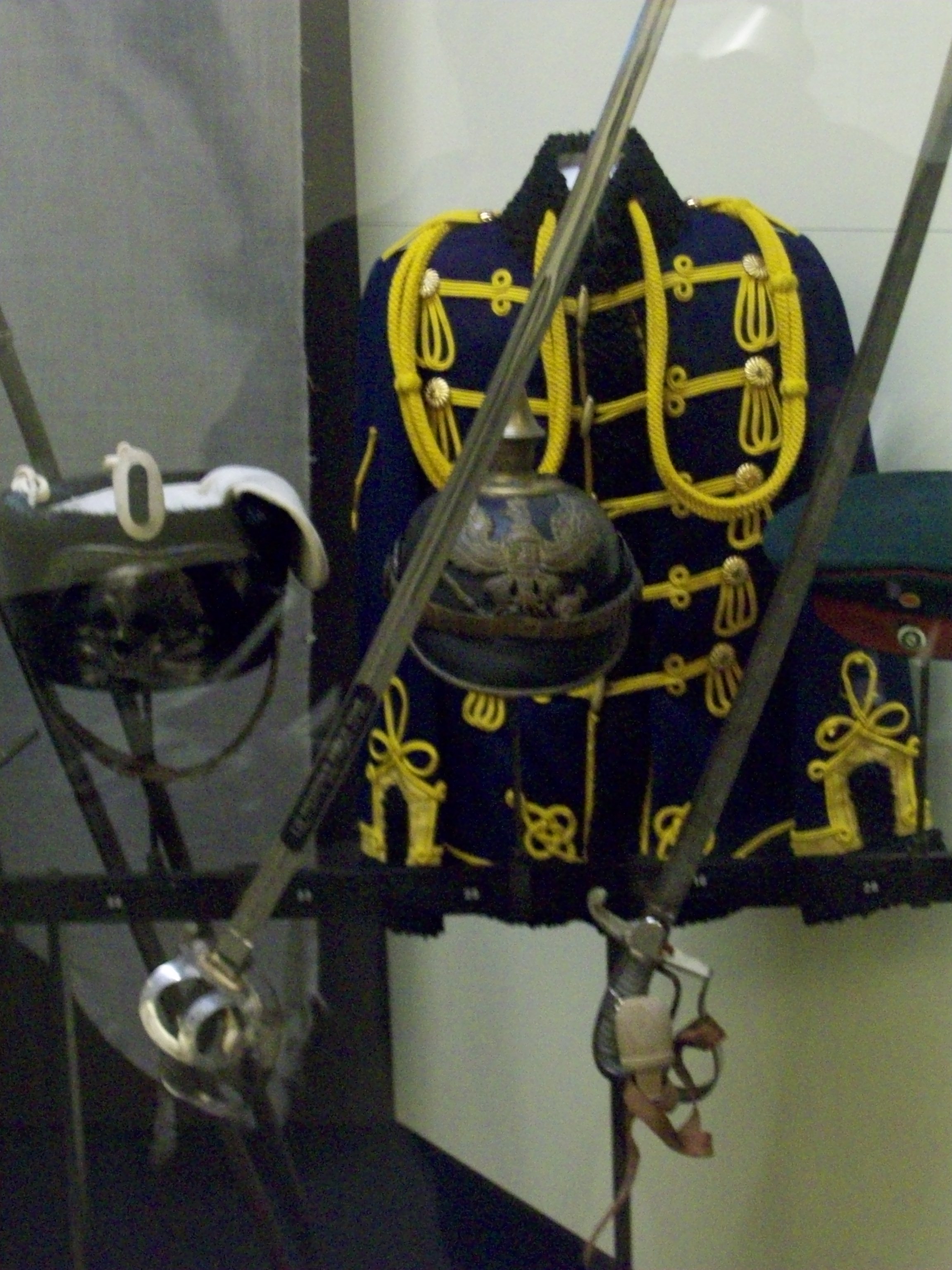
Prussian field helmets and swords. The skull-and-crossbones one is pretty badass. A model of it was not, unfortunately, available for purchase in the museum gift shop.

The museum itself is pretty interactive for what is still largely an objects-behind-glass arrangement. There are life-size models of multiple trench scenes, from a well-engineered German one of concrete and lumber, to a French one of mostly sticks collapsing in the mud; a steady soundtrack plays in the background of what it would sound like in the trenches; and a walk-through crater show the devastation caused after a 17-inch howitzer shell explodes on a French farmhouse. There is also a special exhibit on display now regarding the experience of German soldiers in the war, which was interesting. In general, the museum is noteworthy for presenting a more balanced perspective on the war years—rather than tilting too strongly toward an Allies-centric point of view—and this is something I really appreciated. For anyone interested in the era, I highly recommend visiting the museum. And for anyone interested in antique elevators, the ride up in the Liberty Memorial is not to be missed!

A military uniform for belligerent children.

-One of the more pleasantly surprising parts of the museum was finding the Willa Cather novel One of Ours (1922) in the gift shop. For a long time I’ve been looking for sources that depicted the time and place I’m writing about in my novel, and for the most part coming up empty. For some reason it never occurred to me that Cather would have given some treatment to the Great War in her writing. And not only did she write a novel about a family of Nebraskans during the war years, but the surname of the book’s protagonist is Wheeler! Beyond that, I feel pretty stupid for not knowing more about this novel, as Cather won a Pulitzer for it too. I’ve read a few Cather books and some of her short stories–but have always suspected that this wasn’t nearly enough, and that my ignorance would come back to haunt me some day. I better get to work rectifying that.

Nicole and I outside the National World War I Museum in Kansas City, Mo. It was very bright.

Further: what other novels am I’m not thinking of that are set in Nebraska in the years 1916-1920?

-I’ve been meaning to post a reflective piece on here regarding my story “The Housekeeper” being selected for publication in the forthcoming Flatmancrooked 4 anthology. However, the story is still a finalist in their current fiction contest and I’m waiting on the results before posting anything more about it.

Dispatch from The Hyphenates of Jackson County

“Jacob knew all the stops would be pulled here on the River Ward in the pursuit of a margin big enough to overcome the rest of the city. They had to win by a landslide here because the other districts were going to swing the other way. There could be no parity in this district that Dennison controlled. Voters on the payroll of the Pendergast machine in Kansas City would arrive throughout the morning to cast their ballots, along with others recruited for this purpose from towns in Iowa like Red Oak, Glenwood, Griswold, and Walnut. Every barroom in the Ward was rented and stocked with liquor. Bootleggers who owed their survival to Dennison saw to these private parties. The booze was reserved for those who held both a slip that proved they’d voted and a card printed with the names of the Square Seven. It was all about mobilization and efficiency, making sure that each and every favor handed down over the past three years was called in during polling hours. If a family received coal over the winter, if their grocery bill or bar tab was covered, if they were granted leniency from a judge—then a car would appear outside their home on Election Day to shuttle them to a poll.

Maddie before pre-school one morning this fall. She wears all pink, as often as possible.

“It was up to Jacob to oversee the operation on Clandish from a polling station in the basement of Mecklenburg’s Saloon. When he returned from Iowa, the barroom was already half full of voters and more were coming in all the time. Mecklenburg’s would be packed by 6am; nickel beer was discounted down to a penny. It was an amazing operation to watch, its controlled chaos exhilarating. Trucks lined up at the curb, back from Iowa in the middle of the night with two dozen voters packed on their hay-strewn flatbeds. The street cars were running already too, full of Pendergast’s men from the train stations, recent arrivals from Kansas City. Johann and Reinhold lined them up inside and meted out the booze. His suitcase still in hand, Jacob stood back and watched it all until it was time to instruct the voters. In groups of ten, Reinhold escorted them to the basement of Mecklenburg’s. Jacob and Johann followed them down the steps, into the dug out space under the barroom. There were two rooms separated by a narrow doorway. The basement had been an afterthought, one dug out roughly and bricked in. Jacob recognized the work, a former tunneler himself. A light hung from a rafter, its wire snaked in from a hole drilled in the barroom floor above them.”

Personal Rejection Notes, Requests for More, and Other Nice Versions of No Thanks

Cream City Review for “Attend the Way”; Painted Bride for “The First Night of My Down-and-Out Sex Life”; n+1 for “Shame Cycle”; and Barnstorm and Camera Obscura for “You Know That I Loved You.” Florida Review and Harvard Review also sent nice notes along after I withdrew manuscripts that had been accepted elsewhere, which is very much appreciated. Plus, “The Housekeeper” was selected as a finalist in the Flatmancrooked Fiction Contest, and will appear in the anthology Flatmancrooked 4, and my review of Nadifa Mohamed’s debut novel Black Mamba Boy was selected to appear in a future edition of Prairie Schooner.

Just Finished

Death is Not an Option by Suzanne Rivecca. A very strong collection. I plan on writing a review of this very soon.

Now Reading

One of Ours by Willa Cather.

Up Next

Rivers Last Longer by Richard Burgin.

Review News

Prairie Schooner has accepted my review of Nadifa Mohamed’s debut novel Black Mamba Boy! I’d imagine it will run in the Summer or Fall issue next year.

This will be my fifth published review, and the second in Prairie Schooner, where I’m also in my second year as a senior fiction reader.

Contest Mania!

The good news continues! My short story “The Housekeeper” was today named a finalist for the 2010 Flatmancrooked Fiction Prize!

The prize winner and runner up will be announced later this month–wish me luck–but all ten finalist stories will be published in the forthcoming anthology Flatmancrooked 4. Benjamin Percy will judge.

So double good news with the possibility of more to follow. Not bad for a Columbus Day.

Weeks of Sept 11 – Oct 10, 2010

I promised more on the Cincinnati Review Schiff Prize, so here you go.

First, let’s do the numbers.

This is my 11th short story selected for publication.

…the 13th short story publication.

…the 17th publication overall, counting four reviews.

…the 2nd contest won.

“Attend the Way” is the 5th honorable mention in a contest.

Of all the contests I’ve entered, 4% of the stories have won.

…12% have received some sort of recognition.

Also, the very nice editors of the Cincinnati Review asked me to pen a commentary piece for their blog about the process of writing “The Current State of the Universe.” Fiction Editor Michael Griffith has this to say about the story:

The piece is a fantastic example of a high-concept story that manages to do wonderfully playful, inventive things without ever feeling like a riff or a vehicle for an author who’s showing off his chops. Wheeler perfectly and poignantly balances the psychological plight of his protagonist with the high-wire act of the story’s conceit.

The only thing I’d add to the linked commentary is to mention that “Current State” has gone through quite a few incarnations over the past few years. One early morning in the fall of 2007 I woke suddenly with the first few lines of the story and somehow convinced myself to rise before dawn and start up my laptop—which was a fifteen minute ordeal of loading and errors at that point. I’m not a morning person, so I didn’t write for long, probably less than an hour. As mentioned in the TCR blog, this was a story I’d been kicking around for a while and was just something I wanted to play around with. I did come up with a three or four page vignette that I thought was kind of funny and quirky. It wasn’t really something I thought would turn into a whole story though. The following spring, for the first night of a Susan Aizenberg-led graduate workshop at Creighton University, we were directed to bring in a short piece of our work as a means of introducing ourselves to the group. I brought the vignette because it was funny—plus it’s better to save the dark, rape-and-stabbing-filled material for later in the semester, as to gain some sense of normalcy in the minds of fellow workshoppers before trying to scare them later on with insights of mankind’s dark side. (That’s just a joke, I never actually did anything like that.) To my surprise, the small start I had received a very warm reception. So I kept at it.

This was also the semester when Maddie Annie was born, so this story has some larger significance for me. There were more than a few nights spent in the nursery chair with my laptop working on this story all night, listening to our newborn sleep. There are so many pleasant memories of those wonderful and difficult months: the blue luminescence of her jaundice-fighting lights, playing The Freewheelin’ Bob Dylan on repeat because Maddie would sleep if it was on, and being dead tired all the time but having the will to fight through it and work past what used to be the point of no return.

Dispatch from “The Current State of the Universe

“The real trouble started after I left for college. A string of MIPs and DUIs followed my initiation into a fraternity and occasioned my expulsion from the same institution. My grades were adequate but my moral certitude was flagging. My father was a strong believer of so-called ‘small town values.’ He believed in the agrarian movement and intimated that maybe the Capital City, or a libertine school, wasn’t the best place for me. But I didn’t agree and was eighteen years old. It was important I learned to stay out of trouble on my own, I insisted, then remained in school because it wasn’t his decision.

“It wasn’t until eight years later that I saw my father again. He bulged around the middle, but the rest of him was sickly, thin and weak from worry. He was bald then, with just a few whispers of red hair that still hung around the sides of his head and failing mustache. He’d heard a rumor from one of his parishioners about a McCook girl who was forced by circumstance to drop out of college and move back to her parents’ house. This gossip had the stain of sexual misdeed.  A freshman coed tricked into dangerous situations by an older man, tempted with alcohol, and, eventually, shuttled to an abortion clinic. I’ve forgotten some of the things they accused me of but they were all true. She was a student at Wesleyan, a confused thing when I found her. A hippie redneck invested in tie-dye tee shirts, hemp purses and cowboy hats. I never saw her again after the termination.

“When he cornered me on it, I told my father that I would never embarrass him again, something neither of us believed.”

Personal Rejection Notes, Requests for More, and Other Nice Versions of No Thanks

Colorado Review and Hunger Mountain for “Attend the Way” and Slice for “The Housekeeper.” Of course, “The Current State of the Universe” was first-prize in the Cincinnati Review’s Robert and Adele Schiff Prize for Prose, and “Attend the Way” received honorable mention in the same contest.

Just Finished

All Quiet on the Western Front by Erich Maria Remarque. This is really a great book. Sometimes you read a classic and kind of wonder why it enjoys a lasting reputation of high standing, and I must admit that I’ve long been dubious of All Quiet—in no small part owing to the fact that Ernest Borgnine and Richard “John-Boy” Thomas are featured on the cover of my paperback edition, which was released after a CBS “Hallmark Hall of Fame” adaptation. But the book does not disappoint. Pretty powerful stuff.

German Workers’ Culture in the United States, 1850 to 1920 edited by Hartmut Keil. This is mostly about Labor movements in Nineteenth Century Chicago and New York, but there were more than a couple things I can probably use in my book.

Now Reading

Death is Not an Option by Suzanne Rivecca.

Up Next

Sister Carrie by Theodore Dreiser.