I wanted to note the passing of Orville Menard. For long-time readers of the blog, Menard’s name should be a familiar one. I’ve mentioned his work on Tom Dennison and the history of political bossism in Omaha many times in this space, as its been a crucial source in researching my novel. I’m very thankful for his wide adnd varied contributions on the subject and was saddened by the news.
The Omaha World-Herald ran this profile of Menard last week, detailing Menard’s career as an academic, writer, family man, and mentor of, among others, Chuck Hagel.
The Millions published their highly-anticipated “Most Anticipated: The 2014 Book Preview” today! As I’m generally out of the loop, this preview is something I look forward to. There are always a few books that were already on my radar and more than a few that I didn’t know I should be anticipating yet. You should check out the feature for yourself, but here are a few of the titles that caught my eye:
February: We celebrated Valentine’s Day for the last time in our old Benson home and prepared to move across midtown to Dundee.March: My novel excerpt “River Ward, 1917” was accepted for publication in Boulevard; “The Approximate End of the World,” which was previously published in Boulevard, was noted in the Thirty Other Distinguished Stories section of New Stories from the Midwest 2012.April: While a freak snowstorm hit Omaha, Nicole and I were off in Los Angeles soaking up the sun in Echo Park; another excerpt from the novel, “The Hyphenates of Jackson County,” was a finalist in the Summer Literary Seminars Unified Literary Contest, but did not take home a prize.May: The list of upcoming fellows at Akademie Schloss Solitude was announced, which means a good chunk of my 2014 will be spent in Stuttgart, Germany; I was also profiled in Creighton University’s Alumni Spotlight feature, since, you know, I’m so distinguished and what not.June: A short story, “Shame Cycle,” was accepted for publication by Gargoyle, which should be out in June 2014; the novel-in-progress was long-listed for Inkubate’s Literary Blockbuster Challenge; I offered some summer reading recommendations via The Kenyon Review.July/August: Things slowed down midsummer, but we piloted a pontoon boat around the Ozarks and went to a baseball game in Kansas City.September: A trip to Chicago with the girls; began taking some writing classes at the new MFA program of Creighton University.November: “Impertinent, Triumphant” was accepted for publication by Five Chapters–look for that in March; I won the Marianne Russo Award from the Key West Literary Seminar and will be there for eleven days next month.Happy holidays! Here’s hoping everyone has a rewarding and profitable 2014. And that we’ll hold everything together during what promises to be a busy, stressful, lonely, and amazing year.
No big news regarding the novel-writing at this point. I’ve been busy reworking the reworks. Tried half a dozen more ways to do the opening pages and feel like I’m getting closer on that. For a long time I leaned on having a sort of prologue opening, but decided to cut all but four pages of that, as it seemed to be more of a crutch for me as writer than anything that might interest a reader. Always a tricky business figuring out what actually needs to be on the page and what needed to be written for the writer only. Getting closer though.
There was some more tangible news related to The Uninitiated over the season though, as Boulevard published an excerpt of the novel in October, titled “River Ward, 1917.” This is the first bit of writing from the novel that’s been published, so definitely exciting news there.
Meanwhile, in December, another excerpt, “On the River, Down Where They Found Willy Brown,” brought home the Marianne Russo Award from the Key West Literary Seminar. Among the many benefits are free travel and lodging at this year’s seminar, the opportunity to read my work as part of the regular program at the seminar, and an 11-day stay in Key West. It will be sad to miss over a third of Nebraska’s January, but somehow I’ll soldier through.
These two things, along with a fellowship to Akademie Schloss Solitude, winning the Tarcher/Penguin Top Artist contest, a long-list notice in the Inkubate novel contest–all of which was based on work done for The Uninitiated–makes me hope I’m on the right track here.
“Tom thought it over as he paced the brick drive that led up to his house, two days after the vote. Bullet straight and tree-lined, the drive gave the impression of something fantastic as his house slipped into view, large and unreachable, a mirage. The house was wood-framed with finishes of granite at certain edges, the cellar and foundation limestone, highlights of plaster festoons above the front door. A few chimneys rose above beveled eaves. Off the second floor bedrooms were balconies as wide as the patios below, where a tiered-garden overlooked the industrial valley. There were pergolas holding grape vines, arbors abloom with creeping red ivy. Everything here was made for entertaining, for looking at, for admiring, but up close these spaces didn’t serve any purpose. This was an unpeopled luxury, a lonely glutton of riches in and of itself. If Tom was being honest, he had to admit this.
“Years before, an enemy left a bomb on the front doorstep. An ingenious design, the bomb, a simple wooden box with six sticks of dynamite and a pistol inside. A string was tacked to the porch and connected to the trigger of the pistol. If someone had lifted the box, his wife Ada or daughter Frances, the whole house would have been blasted clean off the earth, leaving only a rubbled crater. Frances found the box with a friend, and she told Tom about it. A smart girl, Frances didn’t touch the infernal device at all. Tom noticed the trip wire when she brought him to see. He had police dismantle the bomb. After that Tom closed the grounds. Bodyguards were kept outside around the clock. You had to be a close family friend, a known friend, if there was such a thing, or else you couldn’t get in. The bomb changed things. That’s when Tom put the machine gun across his lap in the car. That’s when everything here, all this bounty he’d won over the years, all of it, started being lonely.”
Just Finished
The 42nd Parallel by John Dos Passos. I’d always avoided the USA Trilogy for some reason. Dos Passos is so often only a foot-note to Hemingway among the great writers of the Lost Generation, although his novels are consistently lauded and canonized as well. I’d just never known anyone who actually read him, so there wasn’t much of a conversation to join, I guess. After reading this first third of the trilogy I can see why Dos Passos is still relevant. So much of his pro-labor and socialist message is probably lost to most contemporary readers–it’s similar to reading The Jungle at times–but the level of energy and innovation is very high here too. Very rich, poetic, and affecting.
The Rings of Saturn by W.G. Sebald. The way these conversational essays seem to be written more for effect–that your mind wanders with the flow of information, sometimes parallel to it, sometimes not–produces an interesting reading experience. I’d read about Sebald’s work a lot before I ever read it, so I kind of knew what to expect. At the same time, I’m still not really sure what to think.
The Assassination of Jesse James by the Coward Robert Ford by Ron Hansen. Really enjoyed this. A lot more than I thought I would, frankly. I met Ron when he visited Creighton University this fall, which is what prompted me to finally pull this off my “To Read” book shelf. The psychological depth of the novel is pretty astounding. Plenty of shoot-outs and train robberies too, of course.
The Castle by Franz Kafka. A monster of an unfinished novel. I was compelled to read this after watching Michael Haneke’s film adaptation, and really enjoyed both quite a lot. The idea of reading an unfinished novel always intrigues me, particularly ones of this class that could just as accurately be called “unfinishable” novels. It isn’t so much that the plot line is incomplete, more that the story could never finish. It’s not like K.’s going to find some sort of victory in the end, or defeat for that matter. The novel follows his string of embarrassments and slight advancements and eventually stops as he reaches the end of his inertia. I kind of wondered if the novel wasn’t finished after all.
Hide Island by Richard Burgin. A review I wrote of this collection of short stories will be appearing in Prairie Schooner‘s Briefly Noted online book review, probably in February.
Now Reading
A Constellation of Vital Phenomena by Anthony Marra. This has been pretty engaging so far, although the writing sometimes comes off as haphazard, particularly when it comes to POV. Maybe haphazard isn’t the right word, superfluous?, but I often question some of the strategies Marra uses here to tell the story. A good book nonetheless. I can certainly see why it made so many Best of lists this year, mostly because of the story of an orphaned little girl and two eccentric doctors in war-torn Chechnya is so remarkable.
An American Tragedy by Theodore Dreiser. I’ve been reading this off and on for a few years now. I come across some criticism about Dreiser a while ago that lumped him into a group of American novelists who have novels regarded as classics (Dreiser has two, of course, with Sister Carrie also showing impressive staying power) even though the writing itself isn’t really all that remarkable. I’d tend to agree with the assessment. Nobody is going to confuse Dreiser with Hemingway or Fitzgerald, as far as style and form go, although the story of his novels really is so quintessentially American (for its time, place, and class) that it’s hard to dispute the status of his novels as classics. Steinbeck was the other novelists lumped into this category, which seems to fit as well.
It was in the Chicago Convention in ’96 that the prizewinning boy orator, the minister’s son whose lips had never touched liquor, let out his silver voice so that it filled the gigantic hall, filled the ears of the plain people:
Mr. Chairman and gentlemen of the convention:
I would be presumptuous indeed to present myself against the distinguished gentleman to whom you have listened, if this were a mere measuring of abilities; but this is not a contests between persons. The humblest citizen in all the land, when clad in the armor of a righteous cause, is stronger than all the hosts of error.
I come to speak to you in defence of a cause as holy as the cause of Liberty…
a youngish bigmouthed man in a white tie
barnstormer, exhorter, evangelist,
his voice charmed the mortgageridden farmers of the great plains, rang through weatherboarded schoolhouses in the Missouri Valley, was sweet in the ears of small storekeepers hungry for easy credit, melted men’s innards like the song of a thrush or a mockin’ in the gray quiet before sunup, or a sudden soar in winter wheat or a bugler playing taps and the flag flying;
silver tongue of the plain people;
…the man who is employed for wages is as much a businessman as his employer;
the attorney in a country town is as much a businessman as the corporation counsel in a giant metropolis;
the merchant in a crossroads store is as much a businessman as the merchant of New York;
William Jennings Bryan
the farmer who goes forth in the morning and toils all day, who begins in the spring and toils all summer, and who by the application of brain and muscle to the natural resources of the country creates wealth, is as much a businessman as the man who goes upon the board of trade and bets upon the price of grain;
the miners who go down a thousand feet in the earth or climb two thousand feet upon the cliffs and bring forth from their hidingplaces the precious metals to be poured in the channels of trade, are as much businessmen as the few financial magnates who in a back room corner the money of the world.
The hired man and the country attorney sat up and listened,
this was big talk for the farmer who’d mortgaged his crop to buy fertilizer, big talk for the smalltown hardware man, groceryman, feed and corn merchant, undertaker, truckgardener…
Having behind us the producing masses of this nation and the world, supported by the commercial interests, the laboring interests, and the toilers everywhere, we will answer their demand for a gold standard by saying to them:
You shall not press down upon the brow of labor this crown of thorns, you shall not crucify mankind upon a cross of gold.
They roared their lungs out (crown of thorns and cross of gold)
carried him round the hall on their shoulders, hugged him, loved him, named their children after him, nominated him for President,
boy orator of the Platte, silver tongue of the plain people.
But McArthur and Forrest, two Scotchmen in the Rand, had invented the cyanide process for extracting gold from ore, South Africa flooded the gold market; there was no need for a prophet of silver.
The silver tongue chanted on out of the big mouth, chanting Pacifism, Prohibition, Fundamentalism,
nibbling radishes on the lecture platform, drinking grapejuice and water, gorging big cornbelt meals;
Bryan grew gray in the hot air Chautauqua tents, in the applause, the handshakes, the backpattings, the cigarsmoky air of committeerooms at Democratic conventions, a silver tongue in a big mouth.
John Dos Passos reading to his wife, Katy.
In Dayton he dreamed of turning the trick again, of setting back the clocks for the plain people, branding, flaying, making a big joke of Darwinism and the unbelieving outlook of city folks, scientists, foreigners with beards and monkey morals.
In Florida he’d spoken every day at noon on a float under an awning selling lots for Coral Gables…he had to speak, to feel the drawling voices hush, feel the tense approving ears, the gust of handclaps.
Why not campaign again through the length and breadth to set up again the tottering word for the plain people who wanted the plain word of God?
(crown of thorns and cross of gold)
the plain prosperous comfortable word of God
the plain prosperous comfortable midamerican folks?
He was a big eater. It was hot. A stroke killed him.
Three days later down in Florida the company delivered the electric horse he’d ordered to exercise on when he’d seen the electric horse the President exercised on in the White House.
Some more Tom Dennison content to share, as Matthew Hansen’s column in yesterday’s Omaha World-Herald gives an overview of Dennison’s forty year career as political boss in Omaha. The column focuses on the 1932 Prohibition trial of Tom and his associates, and features a few quotes from Dennison expert Orville Menard, whose book River City Empire was recently reissued.
While the article doesn’t really offer a whole lot of new information, it’s certainly worth a read. Here’s a highlight:
Tom Dennison, the dapper Irishman who strode to the witness box in November 1932, had for all intents and purposes run Omaha for nearly four decades. He had never been mayor, and, in fact, he never ran for political office. Instead, he got mayors, city councilmen, judges and even congressmen elected — or defeated — based on how willing they were to bend to his will. Neither was Dennison a reputable big-business man, the equivalent of a modern-day Fortune 500 CEO. It’s a tad difficult to fit in with the black-tie crowd when you are dogged by accusations that you had murdered rivals, robbed trains and become the Capone of the Cornhusker State. Not that the man on the witness stand was hurting for cash. He moved rivers of liquor during Prohibition, ran several wildly profitable illegal casinos, controlled and profited from the city’s 2,500 prostitutes and collected cash from every business — both reputable and underworld — that needed his protection. He also tampered with juries, stuffed ballot boxes, bought off the Omaha police, installed relatives and cronies into made-up city jobs, allegedly ordered the murder of one of Omaha’s biggest businessmen and may have purposely inflamed the racial tension that led to the 1919 race riot and lynching of a black man. A Chamber of Commerce stalwart he was not. But Tom Dennison was something else. He was untouchable.
From the sounds of things, Hansen will be devoting more of his column space to Tom Dennison in the future–the gangland murder of Harry Lapidus in particular–so that’s something to look forward to. Hansen has really done a great job since taking over as a columnist earlier this year. Some of his stuff has been pretty compelling, in both goof-ball and more touching ways, so I’m excited he’s turned his attention to this era of Omaha history.
Carlos Manuel de Céspedes, hero of Cuban independence and a familiar sight to the guests and patrons of the Key West Literary Seminar.
[Please excuse any and all verbal cheersing-myself that may occur in the following.]
More great news to share, as I’ve been awarded the Marianne Russo Award by the Key West Literary Seminar!
Here’s the official announcement on Littoral, the seminar’s blog. (Also, you can read more about the KWLS scholarship program here if you’re interested in applying next year, and you should be. No entry fee=no worries.) As if ten days in Key West during January wasn’t enough, the prize includes tuition to both sessions of seminars and workshop programs, airfare to and lodging in Key West, and some spending cash, along with the opportunity to present a reading of my work during the conference (on Sunday, January 19, at 11:40am, to be exact, if you happen to be in the neighborhood). It’s really a very generous award and a great opportunity. I’m thrilled to be headed back, this time with a little hardware waiting for me.
I feel like I’m telling people all the time what a great experience KWLS is. It truly is the best there is and an indispensable part of our American literary culture, as far as I’m concerned. Thanks so much to Miles Frieden (Executive Director of KWLS) and Arlo Haskell (Associate Director), who do such a great job every year. This will be my third trip to KWLS. (Here’s what happened last time I was there.) My first seminar dealt with historical fiction, the second with speculative fiction. This time the theme is “The Dark Side: Mystery, Crime & the Literary Thriller.”
I’ll be reading my work here in January. Eek.
The schedule includes events with Robert Stone, Percival Everett, Joyce Carol Oates, William Gibson, Carl Hiaasen, John Banville, among many others. I’m not really all that familiar with crime writing, frankly, and that makes this even more exciting. I wasn’t really all that interested in historical fiction when I attended my first KWLS–and certainly didn’t anticipate ever spending half a decade writing a historical novel myself.
While odd-numbered years can often be a cruel mistress, 2013 has without a doubt been good to me. There have been contest wins, publications (here, here) and acceptances (here, here), honorable mentions (here, here, here), an international fellowship to summer abroad, travel (here, here), along with the fact that we moved into a new house and love living in Dundee. I’ve enjoyed myself quite a lot this year and am not exactly looking forward to a new calendar, knowing how things tend to turn around. The party has to end sometime, right? Luckily, some more good luck has come along that guarantees, if nothing else, my 2014 will begin in style.
I’ve come across a few cool pages lately that show World War I in living color. The Prague Revue presents WWI in Color, including the impressive combat footage in the video below. From the looks of things, those are French-built trenches in the video. And Time recently posted over a dozen very cool images in Rare Color Photographs from the Trenches of World War I. (Several are graphic, fyi.) So many of these are great, particularly the non-combat images that kind of reveal the style-within-war that seems to be a major part of the era.
One that really caught my eye is featured here on the right, of the Messine Ridge in Flanders. For months British miners tunneled under trenches and No Man’s Land in order to dig mines under German trenches and pack them with explosives. Over 10,000 German soldiers were killed when the TNT was detonated–and you can see what a crater the explosion caused. According the the caption in the article, this was one of the largest “non-nuclear” blasts in history, and could be heard in London and Dublin. So, yeah. This is something that’s mentioned in my novel, so it was of particular interest to me. Amazing stuff.
Some cool stuff. I’m hopeful, that with the centenary of the war coming upon us very soon, a ton more of stuff like this will be coming out. It’s fascinating.
“…drugged with heat I lay in the brown grass of the forest, half in the shade of a fir, while Jakob pulled the horses evenly, and something from inside me suddenly asked Is it true Jakob about the concentration camps? days I’ve never been able to think of as: yesterday, and tomorrow it will have been the day before yesterday, or: that was ten years ago; in the meantime, I’ve learned much more about monopoly capitalism as a form of imperialism and can look at the past with the eyes of today. Those days never pass. Every minute I’m thirteen years old before Jakob’s wide-spaced motionless face with the half-closed lids, and I hear him say Yes it’s true. Impossible to live with that. It’s useless. How can you answer for that? How does it fit with the wet rustling beech leaves under our feet, with the swaying circling fir tops overhead against the gray night sky, with my wretched life, with Jakob whom I can’t see in this black high-walled ravine, he shouldn’t walk so fast, is this how I wanted it? that’s how I wanted it. That’s what is worth wishing. What had it to do with Jerichow that was lying at our feet as we emerged from the thicket on top of the hill and halted, Jakob and I standing silently side by side: a somber lump in the hollow, its church tower pointing and a light on in my father’s house: what did I want in my father’s house?”
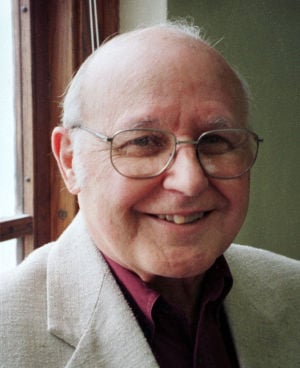 I wanted to note the passing of Orville Menard. For long-time readers of the blog, Menard’s name should be a familiar one. I’ve mentioned his work on Tom Dennison and the history of political bossism in Omaha many times in this space, as its been a crucial source in researching my novel. I’m very thankful for his wide adnd varied contributions on the subject and was saddened by the news.





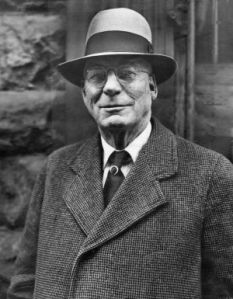


 Theodore Wheeler