Weeks of Aug 22 – Sept 10, 2010

I’ve finished a first draft of Part II of The Hyphenates of Jackson County this week. It’s pretty exciting to be 2/3 finished with a novel. It’s almost unbelievable, but I guess that’s what eighteen months of work will get you.

This section, now sitting at 161-pages, was pretty close to be done back in late spring. (That should come down to around 125-pages soon.) However, as discussed in my previous update, there was quite a bit of research that I needed to plow through before I could finish the draft. Even now I’m not so sure that I know quite as much as I should, but that seems to be the nature of historical research. Once you learn something that is truly helpful, it opens another half-dozen related subjects that can be explored—and sometimes seem like they should or must be explored. Even just browsing through a works cited page can be set off a new chain. This being said, it’s becoming important to find a stopping point in the research, I think. At least for the moment.

Andrea Barrett spoke about her methods quite a bit when I saw her at the Key West Literary Seminars in 2009, talking about how she feels compelled to read everything she can on a subject before she even begins writing a historical novel or story. It’s a compulsion for her, as she explained it, something she can’t help. Then you have historical novelists like E.L. Doctorow and Edward P. Jones, both of whom did famously little research for Ragtime and The Known World, respectively.

This, in many ways, has to do with comfort level, I believe. Have I done enough? Do I know enough? Will I be exposed? And, by this, I don’t mean to imply that Barrett is insecure and that Doctorow isn’t. These are just different strategies they use. Barrett achieves authority through exhaustive research, while Doctorow uses more a general literary technique to express a sense of authority. That is, as his characters feel real to us, as we are drawn to their narratives, we can’t help but become convinced that their “historical” stories are real, even if they aren’t completely accurate. (Of course, Barrett does this too. It’s the magic of all good fiction.)

This kind of dichotomy–the part about not being completely accurate but still writing with authority–didn’t seem like it would be okay with Barrett when I saw her speak, as she has background in the sciences. And while I often feel that way too—being that I have faith in the process of research to reveal things as they’re needed, if the work is put in—history is so complex that too much accuracy can weigh down a book. It’s hard to strike that balance, but I suppose that is the definition of the job, for any writer, to take something complex and make it comprehensible without having to state all the facts.

Thinking of it this way, maybe I do have enough information for now. And it’s more a matter of distillation. We’ll see. The self-reading and revision begins in earnest on Monday.

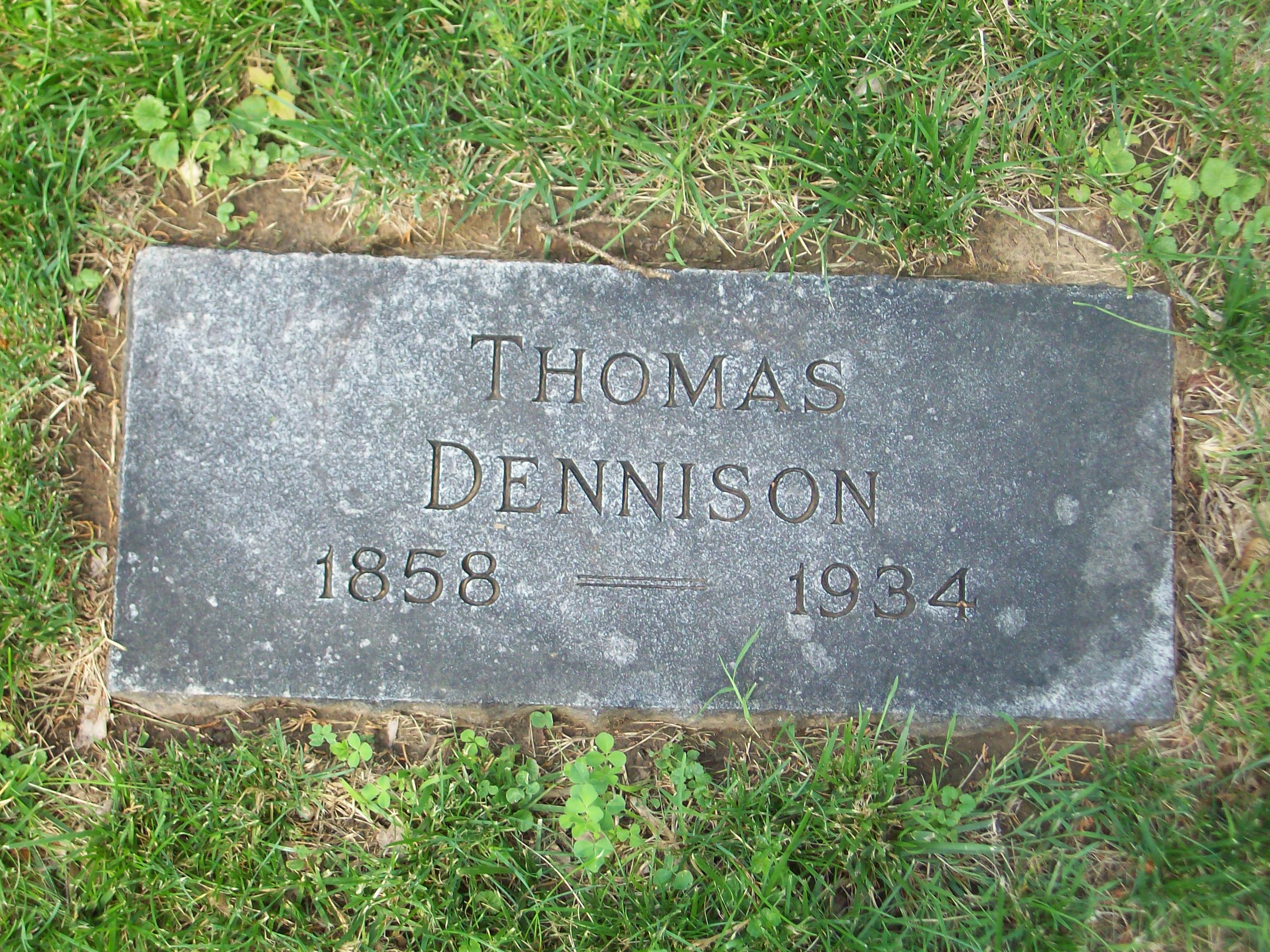
-Speaking of research. Reading through some old news articles, I may have found some explanation for why Dennison’s family gravesite is so modest—as discussed earlier this year in this post. As stated by an Omaha World-Herald retrospective from Sunday, May 9, 1965:

If [Dennison] had accumulated great wealth, there was no trace of it after his death. The inventory of his estate […] listed 10 thousand dollars in promissory notes ranging from one hundred to 11 hundred dollars. Most of them represented loans to friends, and in many cases they were long past due. Also listed in the estate were two men’s watches and several diamonds.

His safety deposit box held “three empty wallets, a memorandum of trust set up for his daughter, a letter from an outstate man asking help in getting a job, some dust and several paper clips.” So maybe Dennison was broke by then, and that explains why he wasn’t interred in an ornate mausoleum like many of his Omaha contemporaries were.

I’m still a little skeptical of this theory, however. For one, his funeral was one of the largest in city history. But mostly, wouldn’t it make sense that a man who made his fortune in organized crime and graft would be able to hide his wealth from the government? Would you expect to find any trace of his wealth? It’s not entirely out of the realm of possibility–as Dennison certainly did give away much of his money to needy causes, almost always anonymously–but I’m a little dubious, let’s say.

-The review I did of Ben Greenman’s collection, What He’s Poised to Do, received a couple nice mentions in the last week. On the blog of pioneering literary journal One Story, and on From Your Desks.

Dispatch from The Hyphenates of Jackson County

“There was more traffic downtown but it was limited to the streets, cars full of young men driving in circles. They revved their motors and the barking noise of their mufflers echoed off the porticos of the buildings where their fathers worked. These were high school boys and girls out having fun, all of them Anglos, maybe some college men out to find a girl. Jacob always hated seeing rich kids out playing on a weeknight. He hated being reminded of the leisure they were afforded, these teenagers who drove new speedsters and roadsters of bright yellow and red. Warrens and Scotties and Johns and Toms racing off in ivory suits and straw skimmer hats to a private jazz club hidden in a clump of cottonwoods along the river, an all night juke joint where they could find illicit goods like fried chicken and cold beer. They liked to buy things for their girls with money they made clerking part-time at Daddy’s office. And their girls, you couldn’t help but notice them, the plumage of a rake’s hat. Prim and pretty ones with powdered faces and lips rubbed red with jelly bean guts. Jennifers, Mauds, Bernadettes, Carols. Girls who kept Mother’s flask of brandy in the fluff of a gauzy goldenrod dress and would cause a scandal that night when they came home late, hammered, and crashed into the maid’s room by mistake.”

Just Finished

Black Mamba Boy by Nadifa Mohamed. I’m going to review this. A good book.

Now Reading

All Quiet on the Western Front by Erich Maria Remarque.

Up Next

Death is Not an Option by Suzanne Rivecca.

Weeks of Aug 4 – Aug 21, 2010

-I made some progress on some of the peripheral research surrounding the novel in the last couple weeks. Notably, Sister Joy, an archivist with the Servite Sisters, supplied a very informative response to my guess that Tom Dennison’s mansion might have been turned into one of the buildings that now make up the campus of Marian High School. (In the comments of this post.) However, as Sister Joy illuminated, this was not the case. I’m still not sure where the Dennison estate stood, but the land where Our Lady of Sorrow Convent would be built was purchased in 1920, and mass first celebrated in the building in 1925. Dennison was still active in Omaha at the point, and would be for nearly another decade. So my shot in the dark was wrong. I’ve narrowed it down to either the southwest or southeast quadrant of the intersection, though. And that’s something.

I’ve also been trying to find out more about Dennison’s grave site, but Forest Lawn Cemetery has not been as forthcoming as Sister Joy, unfortunately.

-After nearly a month of research, I jumped back into finishing up the drafting of Part II of Hyphenates this week. Even though I’m a little further behind now than I’d hoped to be, it was my goal to finish drafting by the end of the summer and will still meet that soft, self-imposed deadline. Hyphenates Part II has been somewhat more difficult to write than Part I was, with the principal reason being that I’m now working more intimately with the real life characters than I did in the first 125 pages. It’s one thing to just search around and make up some backstory for Jacob Bressler—my lead character, who isn’t a historical figure, and is only a composite of real people—but it’s completely different to do so for Tom Dennison, a well-known figure in regards to political machines and local history, or Josie Washburn, a turn-of-the-century prostitute and madam in Omaha who published one of the initial first-hand account of life in an American brothel. I’m not really comfortable just making it up when it comes to real people, so I needed to go back and get a handle on the history before I moved on.

That being said, it almost always amazes me how consistently research pays off—and this has been one of the most heartening things in writing a historical novel. Whenever there’s a gap in the story I’m telling, or some inconsistency in character, there’s usually something to be found in an old newspaper or biography or diary that satisfies the gap and shows how the story—both mine and the composite historical record—both makes sense and is fascinating. I won’t get into too many specifics, but, in the case of Washburn, I was able to write a scene wherein she gives an anti-Dennison speech in a Little Italy meeting hall at a critical juncture of the story. It’s pretty awesome.

-As a consequence of said research needs, I’ve been spending some quality time in the microfilm room at the downtown Omaha library reading newspapers of 1917 and 1918. This also happens to be the golden age of comics–which leads to many distractions, of course, but also some really great cartoons. Two of the best, and most affecting, are posted. Both are from the Evening World-Herald.

Dispatch from The Hyphenates of Jackson County

“Jacob walked down Pacific with his crew, where traffic had been cut off by the crowds, and he tried to ignore the coalitions around him. Every word spoken by a stranger sounded like an insult to Jacob, some vindictive joke that cut close to his heart. A dozen Russian warehouse workers rested against the hall to eat a quick dinner and they seemed to be talking about Jacob, laughing at him in their native cackle. They wore overalls and denim jackets, floppy felt caps made heavy with sweat and dust. They bit at sandwiches wrapped in newspaper, hunks of cheese and onion pressed between slices of cottage white with black smears of soot rubbed in from their fingers. A tin cup sat between each of their thighs, brimming over with the sudsy head of a beer. Some boy dug into his parents’ secret supply to flit along with a frosted clay jug hugged to his belly, making wisecracks to the men. These were thick-chest serfs whose mouths closed in satisfaction over their food, wiry ones whose clothes puffed over sinewy bodies. The lean ones looked the meanest, lips curling venomously under blood-shot eyes. Jacob thought this as he glanced at them. They were sizing him up, he could tell this. They imagined how much it would take to claim a win in a fight with Jacob and his men. And when one of them whispered something to another, when they leered at Jacob and laughed, he too dreamed how it would go down in a brawl.”

Just Finished

Political Bossism in Mid-America by Orville Menard.


Now Reading

Black Mamba Boy by Nadifa Mohamed.

Up Next

Death is Not an Option by Suzanne Rivecca.

Weeks of Apr 21 – Jun 6, 2010 (Memorial Day Edition)

Last week on Memorial Day, on the way home from a Schneider family reunion in East Iowa Amish country (Nicole’s side), we stopped at Forest Lawn Cemetery in north Omaha. For a long while now I’ve been meaning to find the grave of Tom Dennison, who plays a major role in my historical novel-in-progress, The Hyphenates of Jackson County.

Tom Dennison with his second wife, Nevajo Truman.

The Forest Lawn website has an awesome database that helped immensely with this. (There’s also a walking tour of the cemetery, for anyone interested in Omaha history.) Of course, when we followed a whim and decided to stop after a day’s driving, we didn’t have any of the necessary information, but it didn’t really matter. We found it anyway, after an hour of walking and deductive reasoning. (Nicole is especially adept at graveyard searches. We usually end up in cemeteries on our vacations and are seldom disappointed. Some of our favorites include the Cimètiere Notre Dame-des-Neiges in Montreal (in a snow storm!), the Key West Cemetery, and many of the solitary headstones we came across while on our fern-thick honeymoon in the Green Mountains of Vermont.)

Over the months anticipating a visit to Dennison’s grave, I had these ideas in my head of a massive tomb, or an iron-doored, stained-glass mausoleum. As the longtime Boss of a wide-reaching political machine, Dennison was massively wealthy, so it stood to reason that he would have erected a memorial to celebrate himself. Forest Lawn, as the final resting place to many of Omaha’s founding fathers and first families, is home to many extravagant mausoleums and statues. I’d even worked up this day-dream where people would go to Dennison’s grave and take a shot of bourbon in some archaic ceremony of patronage. The reality, however, was much different from what I’d expected, as there is merely a large family headstone denoting the Dennison name, and then three smaller markers for Tom, his first wife Ada, and one shared by two sons who, presumably, died in their infancy. It was all very simple. No last words, no statues, no inscriptions.

I’d like to find out more about this, as there seems to be a story here. On the one hand, Dennison typically dressed simply, he came from very humble beginnings and was by most accounts a quiet, private man. So it isn’t out of the realm of possibilities that he would eschew a flamboyant mausoleum. But on the other hand, there were over a hundred cars in his funeral procession, a fact suggesting that his interment was anything but quiet and private. I hypothesized that perhaps the original gravestones were damaged, destroyed or vandalized—and the simple markers were replacements—but I have no evidence to support this. It was strange, too, that none of his children who survived to adulthood were buried there either, which goes against much of what I’ve learned about his private life. Maybe they’d moved away from the area by then. If anyone knows about this, I’d love to hear from you.

Dispatch from The Hyphenates of Jackson County

“Word among those hanging on along the streets, afterwards, was that Tom Dennison had summoned the enforcers to reestablish control after the uprising, and that he’d been slow to give the order because he was vacationing in California and had to be wired with the news. They said that he was on a yacht off the coast of San Diego and they had to wait until he returned to harbor. Johann didn’t believe these stories, he speculated that Dennison was probably in his office downtown, or his mansion west of Benson, that he’d tried to keep things in control but couldn’t. Johann interpreted the delay as yet another breach in the Old Man’s armor—and, after what they’d witnessed from the bathroom window of the Potsdamer, more than a few of their friends agreed with him.”

Personal Rejection Notes, Requests for More, and Other Nice Versions of No Thanks

New England Review for “The Current State of the Universe”; Mid-American Review, West Branch, and Yale Review for “Attend the Way.”

Just Finished

By Night in Chile by Roberto Bolaño. If you like the following things, this book is probably not for you: quotation marks, paragraph breaks, chapter breaks, short simple sentences. Otherwise, this is really an engrossing read. Some great sections involving European priests who use falconry as a means to stop pigeons from defecating on cathedrals and on the intersection of artistic patronage and military authoritarianism in Chile.

Netherland by Joseph O’Neill. This is one of my favorite books, now, and I highly recommend it. The best writing about cricket I’ve ever encountered, which makes this sound like a lesser accomplishment than it really is, since I don’t recall reading about cricket ever before. There was a lot of talk about this being a post-9/11 novel with echoes of The Great Gatsby, but I didn’t really find these elements that central to the story.

Now Reading

Roscoe by William Kennedy.

Up Next

The Lonely Polygamist by Brady Udall.