A quick note that I’ll be at the Douglas County Historical Society’s “Pages from Our Past” event on Tuesday, June 23 to read from my chapbook On the River, Down Where They Found Willy Brown. We’ll discuss the elements of Omaha history that went into the writing of the book–and probably a few elements that didn’t.
If you missed the local launch party at Pageturners and my reading at Indigo Bridge Books, here’s your chance. Come meet the author!
See below for all this info:
Tuesday, June 23. 530-630pm.
Douglas County Historical Society / Library Archives Center
Douglas County Historical Society will feature Nebraska author Theodore Wheeler’s novella On the River, Down Where They Found Willy Brown at our June 23rd Page from Our Past author event taking place from 5:30 p.m. to 6:30 p.m. at the DCHS Library Archives Center. The program focuses on history-based authors, both of fiction and non-fiction, and is held the fourth Tuesday of each month in the evening. A Page from Our Past is a casual and intimate roundtable discussion, where the audience has the opportunity to get up close and personal with the authors. Each program concludes with a book signing and time to meet one-on-one with the featured author.
On the River, Down Where They Found Willy Brown is the story of an immigrant boy who’s caught up in a race riot and lynching, based on events surrounding the Omaha Race Riot of 1919. While trying to find a safe place in the world after being exiled from his home during a global war, Karel Miihlstein is caught in a singular historical moment and one of America’s most tragic episodes.
Theodore Wheeler lives in Omaha with his wife and two daughters, where he is a legal reporter covering the civil courts of Nebraska.
Cost to participate in these discussions is $5 for members and $10 for non-members. Pre-registration is required and seating will be limited to 20 participants. To register, email members@douglascohistory.org or call 402-455-9990, ext. 101.
Hear below–me reading from my new chapbook On the River, Down Where They Found Willy Brownon the Platte River Sampler radio show (KZUM, 89.3 in Lincoln, Nebraska) and being interviewed by host Phil Schupbach. This was a lot of fun and turned out pretty well, I’d say. Thanks so much to Phil and KZUM for having me.
In hand: the proof for On the River, Down Where They Found Willy Brown.
A few updates on events surrounding the release of my chapbook (On the River, Down Where They Found Willy Brown) and some info on how to obtain a copy for yourself, if you’re so inclined:
– The e-book version is available right now on Amazon for the bargain price of 99 cents. If you’re a Kindle user, check it out here.
– I’ve confirmed that the paper pamphlet version will be sold through the online store of Edition Solitude–which you can find here. Well, you can’t find it there now–unless you’re reading this in the future–but it will be there soon. Probably in March.
– If you’re a Goodreads user, check out the chapbook here.
– Promotional materials are starting to come out for the “Quotes & Appropriation” event Darren Keen and I (and many others) will be a part of at Akademie Schloss Solitude later this month. There’s more information on the event here and here and here, if you’re interested. Here’s the flyer for the event.
– A chapbook release party has been organized, and the good news is you’re all invited! The other good news is that I talked Darren into stopping by Omaha on his way to SXSW, so we’ll have our entire reading/music/film/photography presentation ready to share to a local audience too, which is important. Join us on Wednesday, March 11, at Pageturners Lounge (5004 Dodge Street/Omaha). Here’s a link to the Facebook event page, with all the details. This will be the easiest way to obtain a copy of the paper version if you’re in the Omaha-area, as we’ll have copies for sale at the event, with all proceeds benefiting the Urban League of Nebraska.
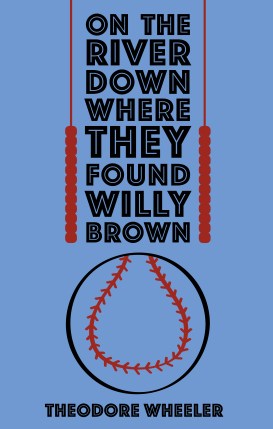
Here’s the cover image for my forthcoming chapbook (“On the River, Down Where They Found Willy Brown”) that will be published by Reihe Projektiv/Edition Solitude later this winter, in late February, to be exact.
This will be the first writing I’ve had published about the Omaha Race Riot of 1919 and the lynching of Will Brown at the Douglas County Courthouse. I’ve posted here many times on the subject, one I’ve been researching and writing fiction about for over five years now. I’m both excited and nervous to finally be sharing this work with audiences. Hopefully it’s found to be pertinent and well-considered work.
The chapbook will be released in conjunction with my upcoming presentation at Akademie Schloss Solitude as part of their two-day, cross-discipline workshop titled “Quotes and Appropriation.” DJ Darren Keen and I have been hard at work on our opening night event that will feature readings from the chapbook and a DJ set from a melange of music that was important to the writing of the chapbook, plus a presentation of photographs and film from my research. It will be a good time.
If you heard me read at the Key West Literary Seminar in January, Solitude Nacht in July, or in December at the Fair Use Reading Series in Benson, this is some of the same material. It includes what I read then and quite a bit more.
If you’re interested in acquiring a copy of the book, the best way would be to just stop in at Akademie Schloss Solitude in February and pick up a copy at the event. If Stuttgart is a little far afield, other options will be available thereafter, hopefully in both hardcopy and digital editions. More on that to come.
Many thanks to Todd Seabrook (editor/designer with The Cupboard) for his work on the cover and book design. He’s great. If you’re looking for someone to work with on a chapbook project, he’s your guy.
A quick note that “Minstrel Show, or The Lynching of William Brown” is to be performed as a reading next Sunday, January 11, as part of the Douglas County Historical Society’s Second Sunday lecture and performance series. The play was written by DCHS researcher Max Sparber and takes for its subject the 1919 Courthouse Riot in Omaha. The play retells the events of the riot from the perspective of two itinerant performers.
Originally produced in 1998 by the Blue Barn Theater, and performed in the rotunda of the Douglas County Courthouse in addition to the Blue Barn, “Minstrel Show” has since been performed around the country to rave reviews. An actor from the Blue Barn will participate in the reading on Sunday, and Max Sparber will take questions afterwards.
(You must e-mail members(at)douclascohistory(dot)org for reservations. The event is free for members and costs $5 for non-members.)
—
Also, if you can’t make it to the performance, you can find video of a 2006 Blue Barn production of the play on YouTube here, here,here, here, and here.
There will be more of a formal announcement for all this soon, but I’ve been itching to share about a project I’ve been working on as part of my association with Akademie Schloss Solitude, so here you go.
This upcoming February I’ll return to Germany to participate with other fellows and guests of the Akademie in a two-day, cross-discipline workshop titled “Quotes and Appropriation.” I’m very excited to return to Stuttgart for this, as its a culmination and redirection of the book project I’ve been working on the past five years.
In addition to panels and workshops, there will be an opening night presentation called “Omaha Uninitiated: Music, Cultural Artifact, and Historical Event in the Recreation of Civic Trauma.” This project contains three elements–a set of readings from On the River, Down Where They Found Willy Brown, a novella based on events surrounding the Omaha Courthouse Lynching of 1919 (more on this below); a presentation of photographs and video that have been important to the creation of On the River, and my related full-length novel The Uninitiated; and a DJ performance by Darren Keen.
It will be amazing to bring five year’s worth of research and writing on this topic to Germany, and I’m particularly excited to see what Darren comes up with for the music component, what will be a mashup and cross-fertilization of music from the World War I era that was important to the creation of the novel (ragtime, propaganda music, American folk, jazz) mixed with music from Nebraska in the last fifteen years.
The final part of all this is publication of the aforementioned novella (On the River, Down Where They Found Willy Brown) by the Reihe Projektiv imprint of Edition Solitude. If you heard me read at the Key West Literary Seminar in January, Solitude Nacht in July, or last Friday at the Fair Use Reading Series in Benson, that is some of the same material. Todd Seabrook (editor/designer with The Cupboard) is working on the design and I’m pretty excited how it’s turning out.
It took a while, but I was finally able to track down the exact address (and approximate location) of Tom Dennison’s estate house! More accurately, Gary Rosenberg, Douglas County Historical Society archivist, was able to track it down. Thanks, Gary and the DCHS!
Tom Dennison was first listed as living in the house in 1931, just three years before he died. He didn’t live there long, and his involvement in Omaha politics and crime was all but through by then. This was his retirement home. He raised wire-haired terriers on the back acres. He lived there with his daughter, Frances, and her husband, Vernon Ragan. This was during Prohibition. The house was surrounded by cyclone fencing, there were security guards, Dennison kept a sub-machine gun under a blanket on the seat next to him in his car. (It’s fascinating how Prohibition transformed the political machines of the early 20th Century (which mostly focused on gambling, prostitution, and government-centered rackets) into deadly criminal syndicates. In earlier decades, Dennison lived in the city (at 1507 Yates, among other places). He stood on the sidewalk and fed pigeons in the morning. They did a lot of bad things in those days too, but the machine never engaged in gangland killings until Prohibition. The Omaha Race Riot of 1919 is potentially a different matter altogether.)
Dennison remarried late in life, but his young wife, Nevajo Truman, never lived in the same house as Tom. She lived at 2201 Country Club Avenue with her mother. Tom would come by and visit most every day, but that’s as far as that went. Such a strange and sad sounding relationship.
Tom Dennison with his second wife, Navajo Truman.
Last year I hypothesized that Dennison’s house was put to new use as part of Marian High School–specifically the convent–but was disabused of that notion by Sister Joy (another devoted archivist, this time with the Servite Sisters). I wasn’t too far off, however. As told by my sister-in-law and Marian alumna, Sara Magnuson West, the house was still on the Marian campus until recently, although she didn’t remember if it served a purpose there. She remembers that it was back by the motherhouse, where the nuns live. Maybe it was torn down when the soccer field and athletic complex was built? Gary Rosenberg tells me that the building was demolished in 2006, approximately.
I’d greatly appreciate it if you could share any information, stories, memories, or rumors you might have of the building. Do you know what it was used for, if anything, by Marian? Do you know anything about the history of the house? Do you have friends or family who went to Marian, or taught there? Maybe they know something? In the picture above, the house appears to have been kept in good shape, there were security lights installed, the windows were maintained. I’d imagine this effort wasn’t for nothing.
If you know something about this house, please pass it along.
Here's where the novel draft stands now. There's a whole book in there somewhere.
Just in case you missed it, here’s what happened on here in September:
-I took a few weeks off from working on the novel–using the time to clean up a few new short stories for submission–but am now reading and editing my first complete draft. It’s a lot of fun to read so far, seeing how things come together, and where they don’t.
-My review of Rahul Mehta’s Quarantinewas accepted for publication by The Iowa Review Online, and will appear shortly in the month of October.
-My review of David Philip Mullins’ Greetings from Below—previously accepted for publication by Prairie Schooner—has been scheduled to run in the Spring 2012.
Dispatch from The Hyphenates of Jackson County
“The noise was so frightening that Jacob couldn’t stand still. He had to move his feet, around in the crowd, or he felt like someone was going to take a shot at him. A block over there was a nervous cop who sprayed shotgun fire into the air whenever someone approached the car he guarded. The cascading noise of tumbling glass was punctuated by the fraught screams of woman in jeopardy. Or maybe that wasn’t it at all, what Jacob thought he heard. Maybe that was the sound of a woman’s prurient cheer as government windows were smashed to shards. There was the roar of voices, people fighting and being hurt. The flash of small arms erupting. The police sirens, their barking orders. The steam valve had been blown clean off and Jacob couldn’t stay where he was. He had to run into it, into the noise and fighting. He had to see everything, to document it in his mind. Speeding cars rushed into the crowds. Young men jumped on the sideboards of cars to swing around to where the action was. There were cars with Sicilians, Lithuanians, Greeks, Serbians. Once word of the melee spread, anyone who wanted to take a swing at a cop made a bee-line to Scandal Flats. A gang hijacked a streetcar and plowed into the mess, clanging the bell to announce their audacity. Teenage boys and musky husbands rushed out of houses with whatever hammer or club or bat they could lay hands on, and then hopped in a taxi to get there fast. A mechanical rumble filled the atmosphere. Roadsters and jalopies, homemade in Little Italy garages, swung recklessly around the blocks. They swerved to miss people and each other. Jacob couldn’t always see the cars but he could hear their pop-pop motors hammering at full throttle a block away, spreading echoes between buildings, echoes that bounced back from the high-rises of downtown. Trucks, commissioned or otherwise, hopped hot over the pavement to load up with furniture or produce or women’s clothes. Taxis slumped cockeyed and labored up the hills, packed full inside, passengers on the footboards.
Sixteenth & Harney Streets, circa 1919.
“People shouted out to groups of strangers any news they heard. There was lots of talk in the mob about the smutty details of the rape—conjecture about Will Brown’s body in relation to the girl’s. They made him out to be huge, a towering man, arms like a gorilla’s, legs like a mule’s. They talked about Agnes Loebeck as if she was a little girl, pious and pure, like she only ever wore little white Sunday dresses, like she picked berries in a pristine field, like she’d never even heard of anything like a dick before.”
Personal Rejection Notes, Requests for More, and Other Nice Versions of No Thanks
My Antonia by Willa Cather. I really enjoyed this book, and can see why it’s often noted as Cather’s finest. I was surprised at how Modernist this novel is, it’s really quite innovative, as I’d always thought it was more of a Victorian, continental-style book for young women than anything. I stand corrected. A masterful work.
What’s interesting about My Antonia is how it manages to function as a perfectly inviting story for young readers, and how an adult willing to revisit it with a more developed critical eye can appreciate it for the subtly sophisticated narrative it truly is. In this regard, it’s not unlike a wildly different book, Alice in Wonderland. Great fun for kids, psychologically captivating for grownups.
-Some good news came along–announced in September, technically–as I’ve been awarded a scholarship to attend the 2012 Key West Literary Seminar and will participate in a workshop with the legendary Robert Stone.
-I announced in the same post that “These Things That Save Us” will appear in the premier issue of Conversations Across Borders.
“Lots of doughboys were in the crowd. This wasn’t all that surprising, as there were two forts nearby—Fort Crook and Fort Omaha. Jacob saw them around a lot then, in the year after the armistice—the doughboys come home, displaced from their jobs. There were plenty along the streets of the River Ward, husky kids still in uniform, their long green socks and puffy breeches, like football players lost from afield. An awful lot of them had what was called war neurosis. Some twitched, or struggled to keep their eyes open. Some had to constantly skim the palms of their hands over their faces and fuzzy, shaved skulls, like a cat preening itself. So many shuffled along in a painful, halting gait, or like they were slipping on ice, their whole bodies in spastic shaking. You didn’t want to think about what those suffering doughboys had seen or heard over there to make them out this way. The constant bombardments, the nerve gas, horses disemboweled on barbed wire barricades, the still-moving charred grist of a man caught by a flame thrower. There were doughboys who’d been buried alive when the man next to them stepped on a landmine, or in mortar fire, trapped when the four tons of earth thrown up in the explosion landed. There were the flyboys, crazy-eyed, sun-dazed, whose hands curled and shook, forever gripped on the timorous controls of their bi-plane’s yoke and machine gun trigger.”
Personal Rejection Notes, Requests for More, and Other Nice Versions of No Thanks
Electric Literature for “Shame Cycle.”
Just Finished
A Sport and a Pastime by James Salter. Often touted in recent publications as having the sexiest depictions of sex of any novel. It’s sexy, but not very erotic, if that makes sense. A good novel, though.
Winesburg, Ohio by Sherwood Anderson. A classic that I love to reread. The stories “Godliness,” “The Strength of God,” and “Death” just really can’t be beat. Simply amazing work from who is really the father of the American short form.
 A quick note that I’ll be at the Douglas County Historical Society’s “Pages from Our Past” event on Tuesday, June 23 to read from my chapbook On the River, Down Where They Found Willy Brown. We’ll discuss the elements of Omaha history that went into the writing of the book–and probably a few elements that didn’t.
 m both excited and nervous to finally be sharing this work with audiences. Hopefully it’s found to be pertinent and well-considered work.