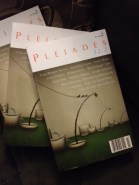
 The summer issue of Pleiades arrived in the mail today, which means my review of Yannick Murphy’s The Call was published in the Pleiades Book Review!
They accuse me of being a poet in the contributors notes, but I guess I’ll let it slide.
 Word arrived today that my unpublished novel, The Uninitiated, is one of ten finalists for Tarcher/Penguin’s Tarcher Top Artist competition!
You can read more at Tarcher Top Artist. Here’s some of what the web site says: “The competition consists of two parts – writing and drawing […] entries will be judged on their technical merit as well as their artistic expression.” (Fyi, I’m a finalist for the writing portion, not the drawing.) Finalists were selected based on 10-page samples; the winner will be selected on the basis of a full-length novel, novella, or non-fiction manuscript. (Tarcher is generally a non-fiction imprint, whatever that says about my chances of winning. Also, it was for writers ages 14 and older, which is strange. It’s going to be depressing when I lose out to an eighth grader.) The competition is for unpublished works only.
The winner of the writing portion will be announced in August, and receive $5000 and a manuscript consultation with an editor from Penguin Group. There’s no publication associated with the prize, but getting prize money and retaining the rights to my work isn’t so bad either. Wish me luck.
 If you haven’t already, please check out the first issue of PS: Briefly Noted on the blog of Prairie Schooner‘s website. This is a feature that Claire Harlan-Orsi (Blog and Social Networking Editor for PS) and I have been developing for the past couple months–a book review in brief, with short reviews written by the staff of Prairie Schooner.
It’s really exciting to put something like this out there. Brent Spencer and Jonis Agee (two of my beloved writing professors and mentors, who also happen to be married to each other) instilled a strong emphasis on contributing to the community of writers, principally by teaching, creating opportunities for writers to read their work publicly, and reviewing. PS:BN isn’t all that fancy, but hopefully it gives back to a community that has given so much to me.
Plus, not only am I Co-Editor and Co-Founder of the feature–but I also contributed two reviews of excellent books! Specifically, there are reviews I penned of Richard Burgin’s Shadow Traffic and Ron Rash’s The Cove. Claire will be compiling the reviews for next month’s edition; she’s already limited me to only one review (Roberto Bolaño’s The Third Reich) which is kind of bullshit.
Let me know you think of PS:BN. I’m excited to see where it goes.
 Congrats to Eric Sasson, whose book Margins of Tolerance is officially available today from Livingston Press!
Here’s more about the book
Margins of Tolerance focuses on gay men in flux traveling, in transit, or at a crossroads in their lives, seeking to understand their place in the ever-changing landscape of gay identity. This collection also focuses on loyalty and betrayal: between gay lovers, among the gay community itself, and lastly between the gay community and the at-large heterosexual community.
You can read more about Eric, his work, and how his book came to be, at his blog, All Things Sassy.
Way to go, Eric! Congrats!
Incoming: my book review of Christopher Narozny’s Jonah Man has been accepted for publication by The Kenyon Review!
Contracts are still pending, so I’m not sure when the review will appear. Very excited about the new review pub though.
This will be my second appearance with the journal. My short story, “How to Die Young in a Nebraska Winter”, was in their Spring 2011 issue. It’s a pleasure to work with such genuinely nice people who are so enthusiastic about literature.
Jonah Man is new this month from Ig Publishing, a small press to watch out of Brooklyn. In addition to a stellar lineup of literary fiction and noir, their Best Dive Bars series looks like a winner to me.

The following are from Omaha: a Guide to the City and Environs, written and Compiled by The Federal Writers’ Project, Works Progress Administration, State of Nebraska, in 1935. It was part of the American Guide Series.
–
Rudyard Kipling (1889)
“[In Omaha, Kipling] was shocked at the tricks of the embalming trade, the caskets with plate-glass windows, and the burial garments exhibited to him by the obliging undertaker. ‘Bury me,’ he explained, ‘cased in canvas like a fishing-rod, in the deep sea; burn me on a back-water of the Highli with damp wood and no oil; pin me under a Pullman car and let the lighted stove do its worst; sizzle me with a fallen electric wire or whelm me in the sludge of a broken river dam; but may I never go down to the Pit grinning out of a plate-glass window, in a backless dress-coat, and the front half of a black stuff dressing-gown; not though I were ‘held’ against the ravage of the grave for ever and ever. Amen!'”
Mark Twain
“In 1902 the Omaha Public Library banned Mark Twain’s Huckleberry Finn from the juvenile department in the library on the grounds that the book was bad for the impressionable minds of small boys. […] In response to a telegram sent by the Omaha World-Herald regarding the ban, Mark Twain wrote, “I am tearfully afraid this noise is doing much harm. It has started a number of hitherto spotless people to reading Huck Finn, out of a natural human curiosity to learn what this is all about—people who had not heard of him before; people whose morals will go to wreck and ruin now. The publishers are glad but it makes me want to borrow a handkerchief and cry. I should be sorry to think it was the publishers themselves that got up this entire little flutter to enable them to unload a book that was taking too much room in their cellars, but you never can tell what a publisher will do. I have been one myself.”
Bret Harte (1874, to his wife)
“As I rode into Omaha this morning the streets were dumb with snow, and winter, savage and pale, looked into the windows of the cars. […] Imagine a hotel as large and finely appointed as the Occidental in San Francisco, and think of there being such a one in Omaha. Yet here I am—in a very pretty furnished parlor of the ‘Grand Central’ on the very outpost of the West, the cars of the Union Pacific starting on their long overland trip but a few blocks away. […] Verily the West is wonderful.”
Carl Sandburg
Omaha (1920)
Red barns and red heiffers spot the green
grass circles around Omaha–the farmers
haul tanks of cream and wagon-loads of
cheese.
Shale hogbacks across the river at Council
Bluffs–and shanties hang by an eyelash to
the hill slants back around Omaha.
A span of steel ties up the kin of Iowa and
Nebraska across the yellow, big-hoofed Missouri
River.
Omaha, the roughneck, feeds armies,
Eats and swears from a dirty face.
Omaha works to get the world a breakfast.
–
Sunset from Omaha Hotel Window (1918)
Into the blue river hills
The red sun runners go
And the long sand changes
And to-day is a goner
And to-day is not worth haggling over.
Here in Omaha
The gloaming is bitter
As in Chicago
Or Kenosha.
The long sand changes.
To-day is a goner.
Time knocks in another brass nail.
Another yellow plunger shoots the dark.
Constellations
Wheeling over Omaha
As in Chicago
Or Kenosha.
The long sand is gone
and all the talk is stars.
They circle in a dome over Nebraska.
 Theodore Wheeler