I’m still a little bit in awe of the moment. I have always hoped something like this could happen, of course, though the process seemed so random, the prospects so miniscule that it felt ridiculous to even mention the possibility. But here we are!
Traveling around the country over the last two months, getting such a warm reception from readers and booksellers alike, has been an amazing experience in itself. This is just the cherry on top.
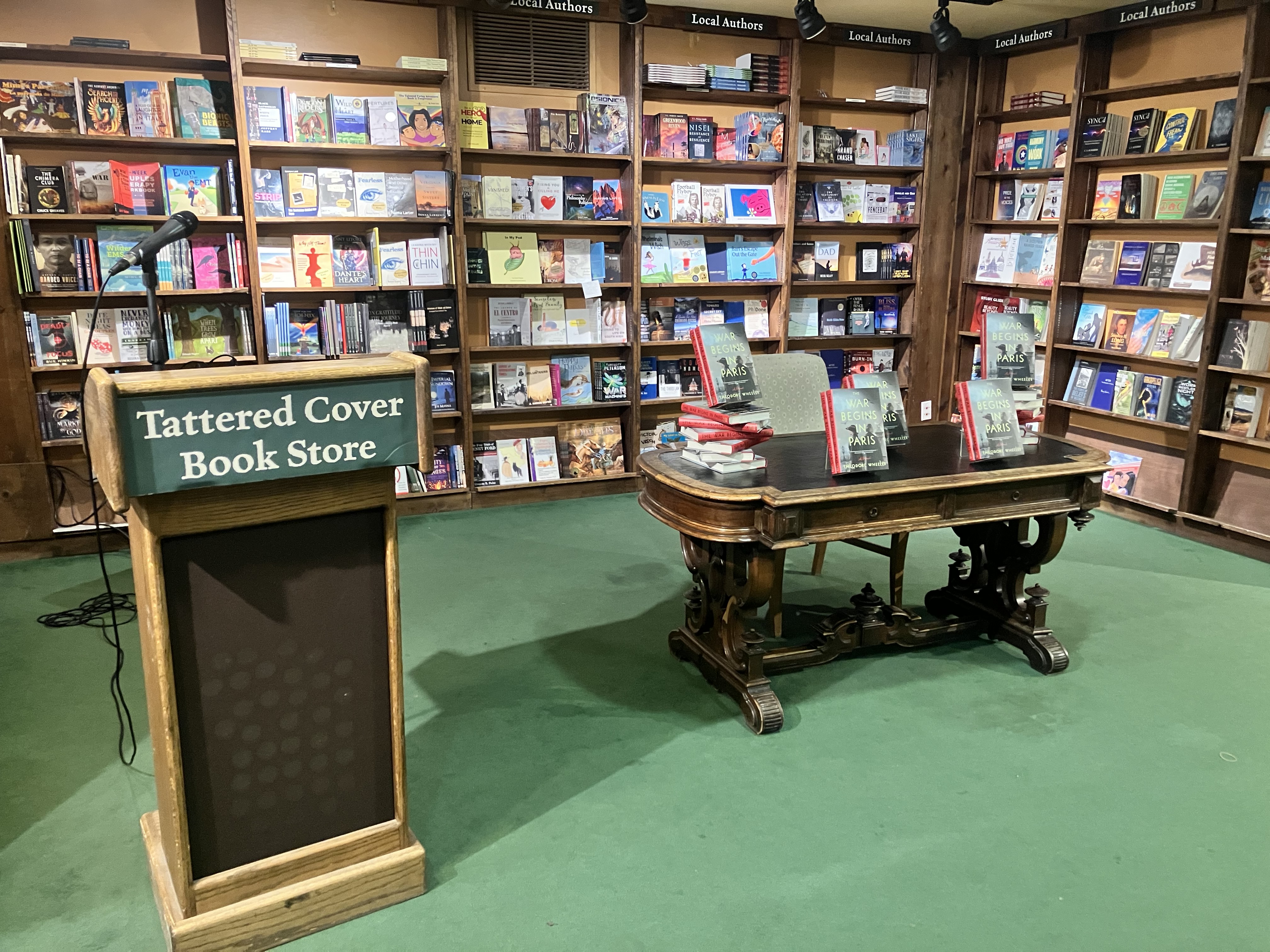
The War Begins in Paris is officially a national bestseller. Cheers!
I was recently lucky to be interviewed by one of my favorite writers, and favorite people, in the world: Amina Gautier. Today, on Necessary Fiction, the interview went live!
We go deep on all three of my novels, the craft of writing about real things, and the challenges of being a journalist/novelist/professor. I really like these kinds of conversations that get more into the craft and experience of writing rather than focusing solely on the story of a specific book. I like them all, to be clear, but this kind comes my way less often. There’s still plenty about The War Begins in Paris too.
Thanks so much to Amina for her great questions and finding a platform. Amina has a new book out this month too, btw, The Best That You Can Do. You should go get it!
“Wheeler’s latest novel The War Begins in Paris follows Mielle aka Marthe Hess, a quiet, unobtrusive journalist living abroad in Paris. Having left her Iowa home and her Mennonite community she finds herself struggling to fit in with the gaggle of journalists, reporters, and correspondents in Paris. While others are there to cover the disturbing rise of Nazism and Fascism, she writes uncredited fashion and style columns for midwestern housewives. Raised to be meek, to dress plainly, to never raise her voice, Mielle goes unnoticed, invisible among her cadre of reporters, never quite fitting in until she strikes an unlikely friendship with the notorious Jane, whose influence drags Mielle into the war’s dark center.”
I’ll be headed down to Georgia in February for the Savannah Book Festival. SBF is one of the best book fests in the country, and it’s known for taking great care of it’s authors. I can’t wait!
What’s the strangest thing you had to do to create this story?
In order to better understand what it was like to be Mielle, I ended up buying a pair of brogan shoes and a long canvas jacket like one that she wears in the novel. Wearing her shoes and clothes helped a lot to feel what she would have felt, even though I was walking around Omaha and she was walking around Paris. Thinking about writing this novel during the Covid pandemic feels strange too, when put in comparison with what foreign correspondents experienced in 1938, on the edge of the war starting. That sense of looming catastrophe; the uncertainty and chaos; even having been personally rushed out of Paris. The details don’t match up, of course, but there was a lot of experiential overlap that helped get me in character.
My favorite part is below, but you should click through to read the review in its entirety.
The War Begins In Paris possesses the hypnotic combination of meticulous research and readable, comfortable, beautiful prose. So often, writers of period fiction pull their punches to entice a few more readers, only to do a disservice to both history and their own writing. Wheeler sacrifices nothing, steadily growing his plot toward its own ends.
There are moments in which Mielle’s life in 1938 holds an uncanny similarity to my own today: watching friends grow steadily into strangers as ideologies morph, seeing anger fed by injustice transform into bigotry as an ugly matter of course. There are striking insights into how trauma changes us and one sad, perfect quote about the life of a writer, “I will never understand you journalists. What good does it do to make enemies all the time? And then to sign your name at the top! How terrible.”
This book is necessary at this moment in time. And it’s an important work to hold close for those of us looking for hope to find us on the flip side of worry.
I’m excited to share this new essay that I published on on Lit Hub last month–“Natasha, Pierre, and Surviving Together”–about listening to musicals with my daughters during Covid lockdown.
One of my favorite moments from our road trips to nowhere happened on a gravel road outside Brownville, Nebraska. We were a bit lost out in the middle of cornfields, at a time of late summer when the corn was high. On either side there were only walls of corn stalks. We could only see ahead because dust clouds blocked the view behind us. Since we couldn’t turn, the only choice was by what speed we moved forward. At that moment, we decided to go fast.
Anne queued up the theme song of crazed troika driver Balaga, an up-tempo, comical ensemble singalong that comes right before an attempted elopement. This is the point in the musical when audience members had been encouraged to use their egg-shaped shakers. There’s chanting, soaring clarinets. It was the perfect “hold onto your seats” kind of song.
So off we flew, outside Brownville, banging out percussion by punching the roof of the car, bounding over the rolling hills, leaving a column of dust in our wake. Even adrenaline-hungry Lynne called from the backseat to me slow down at the moment in the song when Balaga brags that he has, more than once, jumped my troika right into the air!
After months of being exercising an abundance of caution in every aspect of our lives, how good it felt to mash the pedal to the floor, to shout with abandon out an open window.
Thanks so much to Erin Duerr for interviewing me on The Book Drop, the podcast of the Omaha Public Library. In addition to talking about my new novel, The War Begins in Paris, we talk about Omaha’s literary community and Dundee Book Company, my family’s tiny independent bookshop.











 Theodore Wheeler