Necessary Fiction Interview

(Photo by Nicole Wheeler)

I was recently lucky to be interviewed by one of my favorite writers, and favorite people, in the world: Amina Gautier. Today, on Necessary Fiction, the interview went live!

We go deep on all three of my novels, the craft of writing about real things, and the challenges of being a journalist/novelist/professor. I really like these kinds of conversations that get more into the craft and experience of writing rather than focusing solely on the story of a specific book. I like them all, to be clear, but this kind comes my way less often. There’s still plenty about The War Begins in Paris too.

Thanks so much to Amina for her great questions and finding a platform. Amina has a new book out this month too, btw, The Best That You Can Do. You should go get it!

In the meantime, read the interview here.

“Wheeler’s latest novel The War Begins in Paris follows Mielle aka Marthe Hess, a quiet, unobtrusive journalist living abroad in Paris. Having left her Iowa home and her Mennonite community she finds herself struggling to fit in with the gaggle of journalists, reporters, and correspondents in Paris. While others are there to cover the disturbing rise of Nazism and Fascism, she writes uncredited fashion and style columns for midwestern housewives. Raised to be meek, to dress plainly, to never raise her voice, Mielle goes unnoticed, invisible among her cadre of reporters, never quite fitting in until she strikes an unlikely friendship with the notorious Jane, whose influence drags Mielle into the war’s dark center.”

Book Notions Interview

Check out this Q&A that I did with Book Notions last week. Thanks, Bianca, for having me on your platform!

Q: What is your advice to anyone on writing great historical fiction?

A:  The thing I love about writing historical fiction is seeing how the real-life elements come together with the fictional characters. It’s more than just plot points—characters should come out of the story as well—otherwise the project will feel shallow, like it’s only set in a period for fashion. Figuring out how all the elements can fit together as something new is really exciting. 

The hardest thing for me to learn, however, was about voice. Don’t forget that your audience is contemporary and modern, no matter when your story is set. With this in mind, your narrator should be engaging and dynamic in a way that meets the expectations of modern readers. 

Ten Things About the Color Blue

Winter BabyThis morning Lit Hub published a personal essay I wrote that they titled “Writing and Confronting Terror in the Form of a Color: Theodore Wheeler’s Notes on Blue.” (I’d titled it the much pithier and more mysterious “Ten Things About the Color Blue,” but I digress.) The essay delves into the many ways I’ve tried writing about creating art while being a parent and, in particular, trying to work through the trauma we experienced when our second daughter turned blue in the delivery room shortly after being born.

In the years since, I’ve written several short stories, a novel, and now an essay that uses the color blue as a leitmotif. There’s some discussion about the real life stuff that is behind my new novel In Our Other Lives, but mostly it focuses on the healing process and why this became such an obsession for me.

Read it on Lit Hub today!

An hour after my second daughter was born, she turned blue in my arms.

The first time it happened I didn’t say anything. Her skin tinted bluish, just a little, but she pinkened right away and that was all fine. She was healthy and large, we were happy. Minutes later, my wife holding her this time, her skin blued again and my stomach sank. “Do you see that?” I asked my wife. “Does she look a little blue?” But Cee was apparently breathing; her chest rising and falling. “Should we ask a nurse?”

When the nurse answered our call, she immediately slapped a button on the wall that announced a code blue over the entire floor. Cee was snatched from our arms by a dozen doctors and nurses and taken to an incubator across the hall. Although her chest was rising, Cee was not taking enough oxygen to stay alive. In less than an hour she would be moved downstairs to the neonatal intensive care unit, then would undergo a spinal tap to make sure she didn’t have meningitis. There were alarms that chimed when her oxygen levels dipped too low, something that happened over and over her first hours. There were a lot of things that happened over the next four days, too many to mention. We stayed in the NICU until her lungs cleared and we could take her home. And then she was fine. After she learned, Cee has never forgotten how to breathe.

In Our Other Lives is Published!


89042619_1763063827158047_2402504520975253504_n

It’s publication day for my new novel, In Our Other Lives!!! ‬Writing this book took me to Stuttgart for three months, Lisbon, Jaipur, New Delhi, many times to Chicago, and to new places with my writing in creative and personal ways I doubted were possible. It’s always strangely bittersweet to publish a new book—but I’m excited for you all to read the story and hopefully love it at least a tenth as much as I do.

This is the book I began while on fellowship at Akademie Schloss Solitude, writing around 200 pages of the first draft over an intense seven-week period. Special thanks to Maxi Obexer and Jean-Baptiste Joly for bringing me there. Also, to the creative writing department at Creighton University, where I was an MFA student during this period and was encouraged to experiment with voice, perspective, and other ways to manipulate reader experience. Also, to the emergency department at the University of Nebraska Medical Center for letting me shadow ER nurses and doctors for a day. This was a fun one to research.

If you’re inclined to purchase a copy, my sincerest thanks. For bargain hunters, order here, or support local booksellers here. For a signed copy, order here.

Cheers!

Book Deal!!!

deal
The listing in Publishers Marketplace!

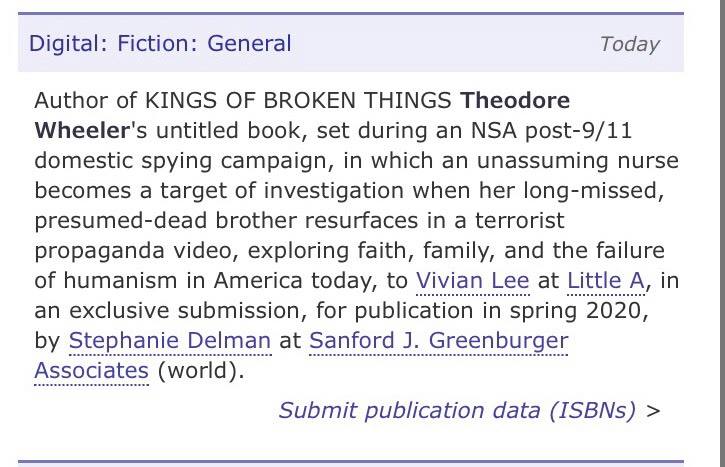
I’m very excited to share that my next novel will be coming out with Little A in the Spring of 2020! It’s a pleasure and a privilege to again work with editor Vivian Lee on the book.

This is the novel I started working on in 2014 when on fellowship that summer at Akademie Schloss Solitude. I began with the basic idea that I wanted to tell a story from the perspective of an NSA spying investigation after reading about how government contractors became so acquainted with some targets of surveillance that it became like a reality TV show for them, except surreptitiously through a web cam, and without consent. And not just the vulgar things they witnessed, but when relationships started and ended, when siblings or children died, jobs were lost, etc. I’d just read Uwe Johnson’s Speculations About Jakob, a novel that features a Stasi detective who becomes enmeshed with the lives of the East German family that’s the object of his surveillance, and the premise seemed so alive and relevant that I had to try my hand at the contemporary American equivalent. My novel didn’t exactly end up like Johnson’s, and it was turned by dozens of additional influences, but Speculations made for an invigorating model, particularly as I wrote that first draft of the book in Germany.

A much-deserved thanks goes to my agent Stephanie Delman for her tireless work in helping me get to the heart of this story and working out a deal to have the book published with Little A, my second with them, of course, after Kings of Broken Things. Many thanks to those who helped this book along with notes and emotional support, including Nicole Wheeler, Amy O’Reilly, Drew Justice, Kassandra Montag, CCB, Ryan Borchers, Felicity White, Bob Churchill, Ryan Norris, Doug Rice, Jean-Baptiste Joly, Jeff Alessandrelli, Trey Moody, Brent Spencer, Dave Mullins, the creative writing program at Creighton University, and many others I’m surely forgetting. More soon!

“Little Me” Published on Narrative Magazine!

yhr2daup_400x400It has been a while since I’ve published an honest-to-God real short story (as opposed to an excerpt from my novel) so it’s feels great to get back in the saddle and share that my story “Little Me” is now up as the Story of the Week on Narrative Magazine!

“Little Me” was a finalist for the Narrative’s 2017 Fall Writing Contest and I’m very pleased that they wanted to publish the story.  After a few near misses as finalist for the Disquiet Literary Prize and the Summer Literary Seminar’s Fiction Contest, it’s great to have the story out in the world.

Read online here. (You will need to create a free account to read the whole story, fyi.) In the meantime, here’s a taste:

YOU SHOULD KNOW that I didn’t own the house on Brentwood. I was only staying there, like a house sitter. So when Teddy rang the bell and stepped inside the foyer, I hesitated, I didn’t tell him to get lost like I wanted to. He was just as much inside the house as I was, if that makes sense—uninvited, without a word of welcome. All existence was tentative those days, the month I lived on Brentwood, so what else could I do but let him in.

Teddy was eleven years old. He was stocky, chubby, his cheeks so fat his eyes closed when he smiled and barely slit open even when he wasn’t smiling. His hair had been buzzed some time before and sprouted in mutinous blond wings off the sides of his head, like he’d slept on it and hadn’t showered. We sized each other up in the foyer. He in jean shorts and a too-tight T-shirt; me cinching the sash of a monogrammed silk robe I’d found upstairs, a robe I wore most all night and day over my own shorts and T-shirt. Teddy must have been a familiar sight to the people who owned the house. The Sinclairs were family friends, and that month they were touring Tuscany. They’d mentioned their travel plans during a party my parents had hosted a few weeks prior. I let myself in through an unlocked patio door when they were gone because I needed a place to stay.

You see how it was. I had no standing to refuse entry to Teddy.

He was probably a neighbor kid anyway, or a nephew dropping by to get the mail, so I should be nice. Then again, maybe neither of us belonged there. We were both a little strange.

“What’s your name?” I asked.

“Teddy.”

“That’s my name too,” I said. “I’m Ted.”

Teddy nodded, smiled politely, then gazed into the house, inhaling in heavy, rapid breaths through his pug nose, like he’d run up the hill to the door. He went up the stairs to the living room, and I let him. I shrank away so our arms didn’t bump. I didn’t want to be near Teddy, not when he snooped around the living room, the dining room, not when he went to the kitchen, got a Pepsi, and downed the whole can in frantic gulps that were interrupted only when the fridge door swung into his back.

“How about we call you Little Ted and we call me Big Ted? How about that?”

I could tell he was against the idea. He smiled, a grimace-smile. He wouldn’t look me in the eye. “Then what do you suggest?”

“My name is Teddy,” he said, still not looking at me. He was so quiet I could barely hear him. “We can call you Hans.”

“Hans?”

“Yes.”

“I don’t get it. Why should I be Hans?”

“I made it up.”

“I’m Hans?” I asked him.

He called me that from then on.


Interview with the Persnickety Proofer

Check out this interview about my new book and a range of other topics that Creighton MFA alumna Meredith Allison Lea was kind enough to post on her blog this evening!

3) What challenges did you face writing not only historical fiction, but also about this topic in particular?

Depicting the riot was the biggest challenge, on craft and personal levels. In a practical sense, it was difficult to write a series of scenes that depicts an over 10,000-person riot that took place over twelve hours and nearly destroyed downtown Omaha, with the struggle being to let the riot be as big as it was without swallowing up the book’s characters in the process. I like to think about telling a story as building a house, and the ending should be contained within the structure without blowing the roof off. Just by its nature, the riot kept blowing the roof off the house I was trying to build in the rest of the book. 

Q&A with the Omaha Public Library

logoWith pub day for Kings of Broken Things rapidly approaching (tomorrow!) a few more interviews and reviews should be coming out this week–including this Q&A I did with the Omaha Public Library for their blog.
Thanks to librarian Erin Duerr for the great questions and for helping to promote my book!

OPL: Kings of Broken Things is set during the Omaha Race Riot of 1919. What drew you to this time in Omaha’s history?

TW: For the last 10 years, I’ve worked as a reporter for a news service and covered a beat at the Douglas County courthouse, which, of course, was the site of the race riot and lynching. I’d first heard of the riot when I was in fourth grade, growing up in Lincoln, and it has stuck in my mind ever since. Spending so much time at the courthouse, it was something I thought about almost every day while walking the halls, stairs, and surrounding neighborhood. Beyond that, it was such a chaotic and inventive age, notably in art, technology, and transportation. The grief over World War I was experienced over this backdrop in such an expansive way–this notion of the “war to end all wars,” that it was so abominable that it couldn’t be repeated. This feeling was echoed in Omaha after the lynching of Will Brown, by the way, that the tragedy would spur society to improve and never repeat its mistakes. Given that context, it’s troubling to think that the U.S. has been at war my entire adult life. Following World War I, you see a lot of intense examination of the psychic damage war causes. These similarities in the art and culture of the era are attractive to me and my art, and the time is still recognizably Modern in other ways too. Like most historical fiction, it’s a convenient way to think about our own times.

“Folding Nebraska into fiction” from the OWH

58e8eeebf4180-imageCheck out this article from last month in the Omaha World-Herald by Micah Mertes that explores how Nebraska has been used as a setting by contemporary novelists.

The article focuses mostly on Dan Chaon and his new book, with some choice quotes from Stephen King, Jonis Agee, Timothy Schaffert, Rainbow Rowell, and a hot young new-comer named Wheeler with a new novel coming out this summer. It’s a fun article, and an honor to have my thoughts included with the titans above.

Here’s the full article if you’re interested, and a quote for now:

Depending on the writer’s aim, that emptiness can yield horror, despair or loneliness. It can yield solitude, serenity, God. It can yield mystery.

“And mystery,” said Omaha author Theodore Wheeler, “is what drives almost all fiction in one way or another. Every story needs something to solve, I guess.”

Wheeler’s next novel will explore a different kind of the unknown, and one closer to home: the immigrant culture of Omaha in the 1910s. “Kings of Broken Things,” on sale Aug. 1, casts fictional characters amid precise historical detail and real-life events — like the Omaha race riot of 1919.