Ma Vie à Stuttgart: Solitude Nacht, Landstuhl, Stuttgart

solitude 8
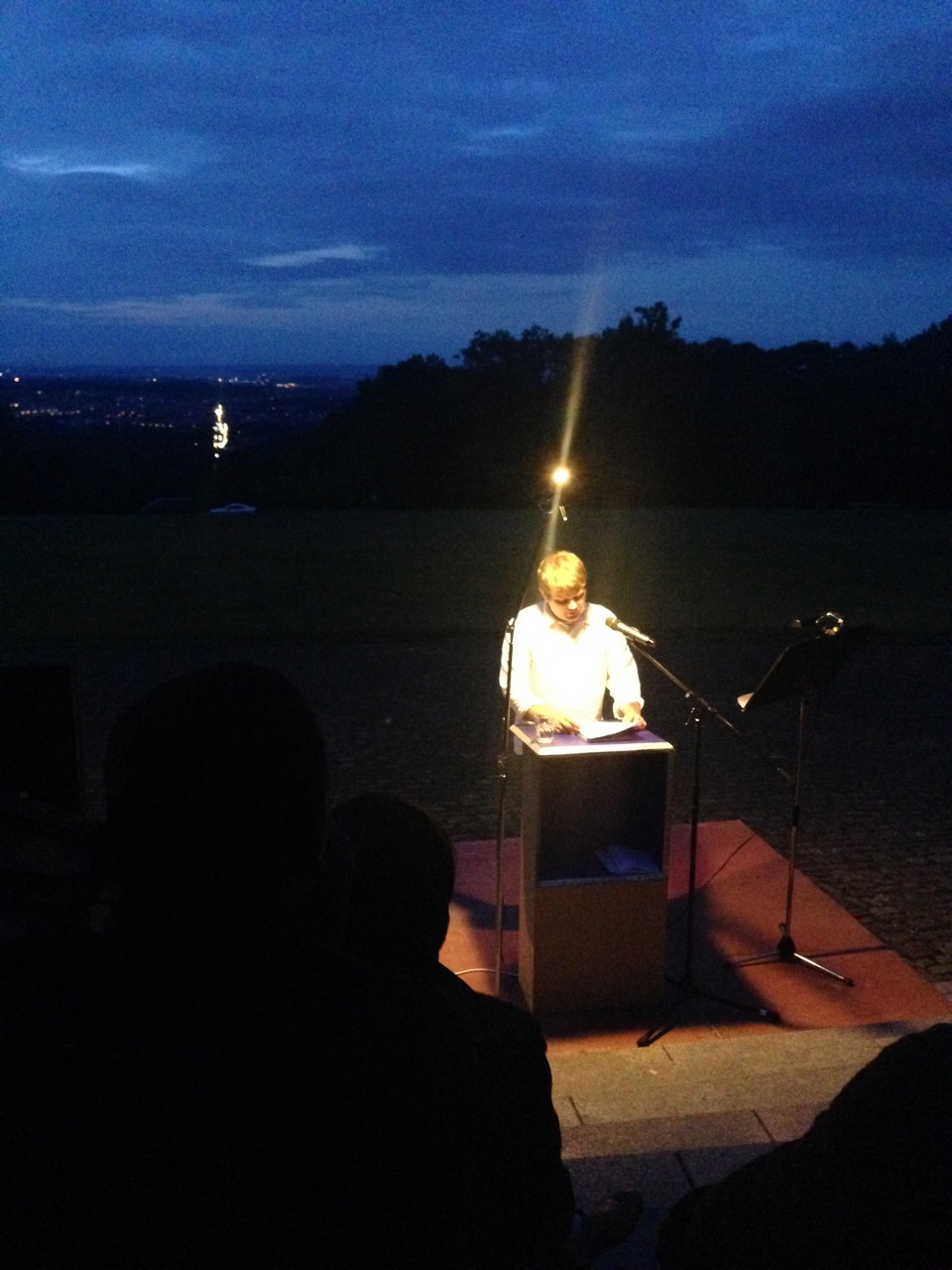
Reading on the steps of the castle during Solitude Night. (Photo by Kai Linke.)

A few highlights from the past couple weeks:

-A big one being that I read as part of Solitude Night here at the Akademie on July 5. The experience was a pretty cool one, not the least because my literature compatriots–Irish poet Annemarie Ní Churreáin and German playwright Anne Habermehl–shared their outstanding work. Also, the stage was built on the steps of die Schloss, with the reader facing the castle and the audience seated on the steps, facing the valley. I read from two pieces, some of “On the River, Down Where They Found Willy Brown” and the opening of the new novel I’ve been working on here. It was kind of nerve-wracking to present work that was written only a few weeks ago, but I feel like it went over okay. A number of people have told me they enjoyed the reading–and since they’re passing on good news, I have no reason to doubt them.

Thanks so much to Claudia Gehre for setting up the reading so beautifully and introducing us readers. And thanks to Akademie Director Jean-Baptiste Joly for selecting me to read on the big night.

-Also, if you haven’t seen, Akademie Schloss Solitude is now accepting applications for its next cycle of fellows, with residencies from 2015 to 2017. Residencies are typically pretty long, 6-8 months or so, sometimes longer, sometimes shorter. Stipends, lodging, and studio space are provided, along with some travel and project expenses. Writers, artists, dancers, musicians, mathematicians, chess players, art administrators, philosophers–it’s a pretty big tent out here. I’ll vouch that Akademie Schloss Solitude is certainly an amazing place to write and create, and hike, and is pretty centrally located if you’d want to do some sideline travel while in Europe. The deadline is Oct 31, 2014. Here’s a list of conditions and benefits for the fellowship. Check it out.

-After Jordan I didn’t do much traveling the past two weeks. Explored more of Stuttgart on foot, found new areas of the forest to hike, managed to turn a two hour leisurely walk to the bank into a five hour power-hike after I took a wrong turn in Wildpark. Oops.

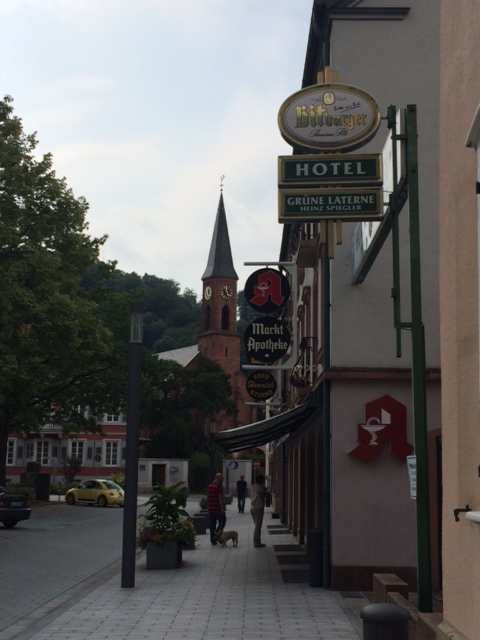
-Today I did venture out of Stuttgart again with a trip up to Landstuhl. There really isn’t too much there, except the Landstuhl Regional Medical Center, with Ramstein Air Base also in the area, so it has certain significance to recent US military history–and more to the point, a character in my new novel (Jim Allen from my story “Welcome Home” is a big character in the book) is sent to the medical center for a brief time. So it was kind of research for the novel, kind of just being curious to see what a US military town in Germany is like. I wasn’t sure if I should still go up there. There are a million other places to visit here that offer more in the way of culture and sights. The trip itself was longish, about three hours each way by train, although a lot of that was through the scenic Rhineland area, so not much to complain about there. So I went.
landstuhl
Landstuhl, stadtmitte.

This morning I was surprisingly emotional about going to Landstuhl. The medical center served as the primary hospital to treat injuries suffered in both the wars in Iraq and Afghanistan, so it’s seen a lot of traffic in the last decade. I read last night that the hospital was for several years among the world’s most active hubs for organ donations. A sort of benign fact on its face, but devastating in its implication. This really stuck with me this morning.

I didn’t do much while there. Walked up to the medical center and around its gates. Everything is secured so there really wasn’t much to see besides dozens of signs promising that bad things will happen if you take any pictures of the facility. (Note: I really admire those who live by the edict that when someone tells you to stop filming, that’s the most important time to be filming. Further note: I’m not one of those people.) So nothing profound, but I’m glad I went. Like a lot of things, the process of getting somewhere is most of the trip. And I did get a few details that will make it into the first draft of the novel.

-Arriving back into Stuttgart was pretty interesting this evening. There was a big Palestinian demonstration going on all along Königstraße, a pedestrian drag through the main tourist and cultural part of the city. A little different from what I expected walking out of Hauptbahnhof train station. Lots of flag waving, some chanting, many head scarfs, a few burqas. Polizei in full-on paramilitary gear, berets, rifles, some with riot gear handy, just in case. (I’m assuming a lot of the police presence was just in case a group of fascist, anti-immigrant thugs showed up for a confrontation–something becoming more common in some places–but I’m not really sure.) Meanwhile, the Schlossplatz (castle square) is hosting its annual week of free jazz performances. So, while the the protest wraps up, there’s a jazz quintet on a bandstand playing “Everybody wants to be a Cat” from Disney’s The Aristocats (you couldn’t make this stuff up if you tried) with a bunch of hipster swing kids strutting their stuff. Kind of a strange dynamic. And a nice little microcosm for how this whole trip has gone.


Happy Book Birthday: Train Shots by Vanessa Blakeslee

Congrats are in order for Vanessa Blakeslee, whose collection of short stories, Train Shots, was released today by Burrow Press!

Vanessa is one of the great writers I met in Key West during KWLS 2012. It’s exciting to see so many of the crew from that year with books out. This is the fourth, I believe, if I haven’t missed anyone, with Eric Sasson having a novel forthcoming too. Truly exceptional work.

Here’s the jacket copy for Train Shots:

A single mother rents a fundamentalist preacher’s carriage house. A pop star contemplates suicide in the hotel where Janis Joplin died. A philandering ex-pat doctor gets hooked on morphine while reeling from his wife’s death. And in the title story, a train engineer, after running over a young girl on his tracks, grapples with the pervasive question–what propels a life toward such a disastrous end? Rendered in a style both generous and intelligent, the men and women at the center of these subtle stories are driven by their unusual predicaments and preoccupations. Rife with dark humor, Vanessa Blakeslee’s debut story collection illuminates the idiosyncratic and the mundane in energetic, bristling prose that marks the arrival of a powerful new voice.

Congrats, Vanessa!

Tom Dennison Exhibit & River City Empire

Nicole and I were in Portland last week–so I missed this–but a friend of the blog let me know about a couple recent Tom Dennison news items. First, a new permanent exhibit opened last week at the Roman L. Hruska Federal Courthouse in downtown Omaha that relates the intrigue surrounding the 1932 trial of Tom Dennison, and fifty-eight other members of his syndicate, for alleged Prohibition violations. The exhibit touts this landmark trial as it “brought national attention to the methods used by criminal syndicates of that era to promote bootlegging, gambling, prostitution, money-laundering, extortion, election fraud, jury-rigging, bribery, and political corruption.”

ORDER KINGS OF BROKEN THINGS, A NEW NOVEL ABOUT DENNISON-ERA OMAHA!

Although Tom Dennison was indicted and tried over the course of two months, the trial ended in a hung jury, and  Dennison would never be convicted. Still, this pretty much spelled the end of the Dennison machine. Tom suffered a stroke in early in 1932, and the damage from this was said to show visibly throughout the trial. Later in the year he came down with pneumonia, would be divorced from his teenage bride, and within two years of the trial’s end would be dead. Despite a few attempts to find an heir-apparent Dennison was never able to establish a line of succession and the machine fell apart once he wasn’t there to keep it running.

Pretty interesting stuff. KETV seems to have the story of record here about the exhibit.

Also of note is that Orville D. Menard has a new book coming out in early November from Bison Books. Menard’s Political Bossism in Mid-America, essentially a biography of Tom Dennison that was first published in 1989, is the go-to authority on all matters Dennison. His new book, River City Empire, appears to be a reissue of his previous work, particularly since the page counts only differ by ten, and a foreword has been added. In any event, Menard has mentioned in talks before that he’s still been working on the material since his first came out, so I’m interested to check out the new book. More than anything it’s great to see renewed interest in this fascinating figure of Omaha history–one who just happens to be a main character in my novel!

The Last of the Doughboys

Here’s a great story that ran on NPR’s All Things Considered last month about Richard Rubin’s search for the last living American soldiers who served in World War I. It’s pretty fascinating to hear some of these stories, with the best part being the audio recordings of the old doughboys themselves telling stories about things they haven’t mentioned in many decades, some in over seventy years. Very touching.

Give it a listen! Or read Rubin’s book. The Last of the Doughboys looks pretty interesting too.

Winter in Review

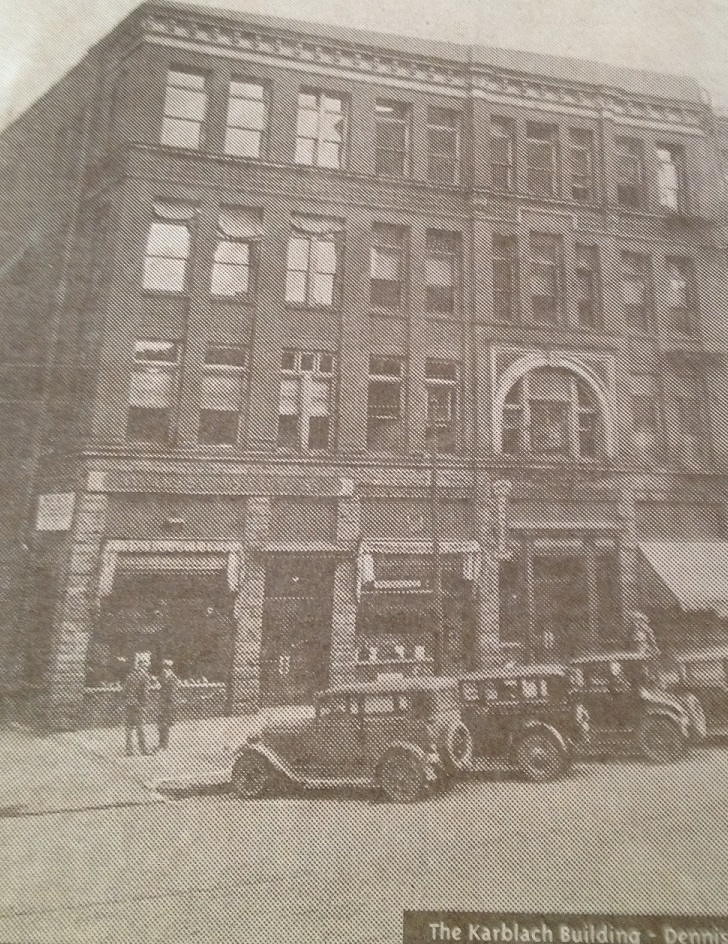
Karbach block
The Karbach Block in downtown Omaha, where Tom Dennison’s office was located after the Budweiser Saloon closed down.

I suppose it is spring now, technically. Although Nebraska has been in its meteorological spring for a few weeks already and that hasn’t seemed to make much of a difference in the weather. Things have been pretty slow on this space for some time, and while the weather has nothing to do with that, we’ll have to do better. The main reason for this lag is that in January/February/March we sold our old house, bought a new one and moved. Pretty heady stuff for a couple with two little kids who usually have their heads buried in computers something like twelve hours a day anyway. It wasn’t so bad though. We moved from the Benson neighborhood of midtown Omaha all the way over to the Dundee neighborhood of midtown Omaha. A little over three miles. It’s been nice. The schools are better, no small concern with Maddie off to kindergarten in the fall, the sidewalks more plentiful. We traded in the Pizza Shoppe and Baxters for La Casa and Pitch, Jake’s for the Dell, Krug Park for Pageturners, dog fights for dog walkers, Benson Days for Dundee Days. It’s a whole new world. Also, the new house is quite a bit bigger, so my office is no longer a toyroom/office. That’s pretty big news in itself. Also, there’s a cemetery a block down from us, with an obstructed view of headstones from my desk, and Maddie is convinced that Jesus is buried there. We may be in for a dicey Easter this year.

Meanwhile things have been plugging along on the agent front. Nothing to really report yet, but there’s been pretty steady interest, a couple exclusives to bigger agencies, a few nibbles here and there. I always take things pretty slow, so it shouldn’t be a surprise that this process will have to run its full course.

While that’s been going on I’ve been rewriting the novel from the point of views of some side characters, mostly out of curiosity and to keep occupied. I suppose, if no one is interested in the book as written, the process could take long enough for me to rewrite the whole novel in a way that’s more than an academic exercise. Not a bad contingency plan, I guess.

In other news:

-As announced yesterday, an excerpt from The Uninitiated (“River Ward, 1917”) was selected for publication by Boulevard. Also, I failed to mention that Boulevard nominated my story “On a Train from the Place Called Valentine” for  a Pushcart Prize. The story was first printed in their Spring 2012 issue. This is a great honor and one I’m pleased to have received. Boulevard rules, by the way. Subscribe to them.

-The big news of the season was that my novel The Uninitiated won Tarcher/Penguin’s Top Artist Writing Contest. Read breakdowns here and here.

-My story “The Mercy Killing of Harry Kleinhardt” was published by Midwestern Gothic in their Winter issue. (Kindle editions of the issue are currently on sale for $1, and print for $6.) I was also interviewed by MG as part of their Contributor Spotlight series. Check out the interview here.

-This weekend we’ll celebrate Clara’s first birthday. She’s been such a healthy and happy baby that it’s almost hard to remember spending her first week in the NICU, huddled around watching her O2 levels on the monitor, and how joyful it was when she came home. Happy birthday, baby!

Dispatch from The Uninitiated

Miihlstein started right away when they arrived in Omaha. In fact, there was work waiting for him in the attic, what the dead man had been toiling over when he died. Miihlstein looked taller than he really was. He was lanky, with long arms, and this made him appear tall. He preferred striped neckties held flat by a now rusty tin pin he’d made himself. He was a happy man, if distant. He was in his workshop most of the day, singing to himself or playing the violin he was working on. He had a thin mustache that was often stained by coffee and what he’d had for lunch. He hummed as he measured string and reinforced the wooden necks of the violas he was charged with reviving. He squeezed the wood with his hands to put it under stress, to find the reason it didn’t sound right anymore. Karel watched his father’s performance daily, called over, at times, if his father remembered him, to see it in detail. A red felt carpet rolled out over the worktable. Even if it was a small job, a restringing, Karel’s father pulled out all the tools in his kit. Slowly he examined them, lost in the smell of that toolkit when it was opened. Little cans of lacquer and thinner placed on the felt. Tools pulled from their nooks and leather slots. Waffled metal files, awls and emery cloth, spools of white string, spare pegs, clamps, chisels, a skinny little metal hammer. Soon wood shavings popped from the block plane as he revealed new fingerboard, then sanded it round. Notches were filed and awled for the strings. It was painted an ebullient, shiny black, endless and distinguished. Herr Miihlstein’s wire-framed glasses rode down his nose on a bead of sweat. He bit his upper lip, sucking the prickles of his mustache into his mouth to concentrate.

To Karel, it shouldn’t take so long to restring an instrument. But his father could remain occupied with a single instrument for a day or more, stretching and tuning, and playing, humming along as he plucked and bowed. Until: “Perfection!”

Karel and Anna waited for this moment: they could help with a delivery and get out of the attic. Otherwise they occupied themselves with some docile and melancholy game as Miihlstein worked. Their games often involved the war. One of Karel’s favorites was to play army surgeon with Anna’s ragdoll. She allowed this. There was great commotion in Karel’s mind as the doll was rushed from an open battlefield, the middle of a circular woven rug strewn with sock garters and newspaper crumpled into balls, and under the great bed where all four Miihlstein kids slept. Once under the bed the real fun began, their legs stuck out opposite sides. Anna was adept at enumerating injuries. She described to Karel what resulted in the field, a simple shrapnel wound in the arm that luckily avoided bone. But then. Then the ambulance was hit by mortar fire. It overturned on the road, the poor souls inside tossed over each other, compounding their maladies. Broken bones now too, fractures, splinters of glass in the wounds. A gash on the head. The driver died instantly, tragically, for he was greatly loved by his family. By the time a second ambulance had come, the poor soul that ragdoll had become was in real trouble. Anna had a nicely dark mind for these details she savored. Karel pinned the doll to the floorboards with his hands as she explained what needed to be done, an amputation. The doll’s dress was lifted to reveal the yellow cloth of its skin.
As Anna finished her treasury, Karel began. Quickly he worked, sawing with the edge of his index finger, and tucking, as if Anna wouldn’t notice, the doll’s arm into the dress. The doll’s dress was back in place, the sleeve folded up. If the poor soul was saved, he’d be pulled out from the operating theater under the bed and slid under the blankets atop the bed. “You’re in luck,” the poor soul would be told. Nothing but orange juice and nurses for a year. If the poor soul couldn’t be saved, Karel and Anna might enclose the ragdoll in a white paperboard box, take it out back of the Eigler house and bury it in the dirt. Then, into the kitchen to find some lunch.

Just Finished

East of Eden by John Steinbeck. A little disappointed (and intrigued) that James Dean’s “Say hello to your mother!” line is only in the Elia Kazan film version. A classic for good reason, nonetheless. The long tracts on the creation of the Salinas Valley and its early settlers are pretty fascinating to a guy like me, along with the more familiar sections filled with high drama and teenage angst.

The Face of a Naked Lady by Michael Rips. Part family history, part treasury of modern Omaha folk lore, Rips presents a pretty compelling story about growing up in Omaha amid racial strife, organized crime, and suburban flight while his mysterious father rose to prominence and then lost his mind. Also, it’s also an interesting treatise on the philosophical and psychological development of the American suburb as emotional landscape for those who couldn’t cope with the city. Very interesting.

Now Reading

The Slippage by Ben Greenman. I haven’t been doing many book reviews lately, but I made sure to secure an advanced copy of Greenman’s latest, which comes out late April.

Up Next

The Art of Fielding by Chad Harbach.

Happy Book Release Day [Belated]: Phoebe and the Ghost of Chagall

Congratulations are in order for Jill Koenigsdorf on the publication of her debut novel, Phoebe and the Ghost of Chagall. Way to go, Jill!

Jill and I had the pleasure of being in the Robert Stone workshop together this past January at the Key West Literary Seminar. (Here’s the recap of my experience down at KWLS 2012, just in case you’re interested.) In fact, Jill received word that her book had been picked up by MacAdam/Cage while we were down there, so it’s exciting to see it emerge now.

Here’s the jacket copy:

Phoebe is an artist making very little money designing wine labels for a winery in Sonoma. Her house is in foreclosure, she’s divorced, turning forty, and beleaguered on every front. Enter Marc Chagall s ghost, visible only to her, who appears to help her retrieve one of his own paintings that Phoebe s father found during the liberation of France. Meant for Phoebe and her mother, the painting never made it into their hands. In this debut comic novel, Phoebe and Chagall hunt down the painting in the South of France with help from a cast of characters including two sisters who are witches, a San Francisco Art dealer, and a misguided French innkeeper. Their snooping also leads Chagall to a few out of the hundred paintings that went missing during his lifetime. With skill and tension this book pits characters who appreciate art for its beauty against black market art dealers, evil collectors, and the mysterious German pawn hired to deliver the goods.

Check it out!

Summer in Review (2012)

It’s been quite a while since I last offered up a review of my activities. All the way back in April! A few things have gone down since then, such as…

-I finished a draft of my novel, The Uninitiated, that I’m very happy with and sent it off to agents for consideration. (Read here about the finishing.) So far I’ve heard back from two of my top five choices that were queried, with one passing and another asking for full manuscripts on both my novel and short story collection! Who knows if anything will come of this–as the one who requested the fulls did so despite not technically considering new clients at the moment–is that a good or bad thing?–but I’ll take good news when I can get it. We’ll be heading off to New York for a few days in October, and it would be nice if I had a couple meetings/interviews to add to the itinerary by then. We’ll see.

-Not a lot of travel over the summer months. A trip to Niobrara for a few days, a weekend in Kansas City for my mom’s graduation from seminary school and Clara’s first Royals game, a week of commuting to Lincoln for the Nebraska Summer Writers Conference. The fall should offer a bit more excitement. NYC, El Salvador. (!!!)

-I was tipped off recently that my story “Welcome Home” from Best New American Voices 2009 and Boulevard was taught at Southern Connecticut State University this fall. I know of three other colleges where the story has been taught–Penn, Drexel, and City College of San Francisco as part of a program for returning veterans–in addition to a high school in Illinois. This is so cool, and delights me to no end.

-My novel was also named a finalist for Tarcher/Penguin’s Tarcher Top Artist writing competition. I haven’t seen or heard anything about a winner being named, so I guess it still is a finalist.

-I left Prairie Schooner after four years plus of service. See post-mortems here and here.

-My book review of Shira Nayman’s A Mind of Winter can be found here, and of Roberto Bolaño’s The Third Reich here, or Richard Burgin’s Shadow Traffic and Ron Rash’s The Cove here. My review of Yannick Murphy’s The Call is in the current issue of Pleiades.

Sporting: As the final couple weeks of regular season major league baseball wind down, the KC Royals look to have a solid hold on third place in the AL Central division. They’re still pretty mediocre (owing to long stretches of horrible play in April and July) but at least haven’t been nearly as disappointing as the Indians and Twins have been for their fans. Or for Tigers’ fans, for that matter. That’s something, I guess. Life in the AL Central isn’t so much about winning games, it’s about being less miserable than your rivals.

Notre Dame is off to a rousing 3-0 start, their best on the gridiron since Ty Willingham’s 8-0 start in 2002. With a home game against Michigan tomorrow night, and with Stanford, @Oklahoma, and @USC still on the schedule, this team could still easily go into the tank. That being said, I’ll still predict an Irish victory over the Wolverines this weekend. I’d feel a little better if ND had a few mini-Ditkas on the team, but I’ll stick with my gut here. Notre Dame 87, Michigan 2.

Dispatch from The Uninitiated

“Fred was the one who found him face down in the creek, over on the other side of their claim. He drank horse cleaner. That’s how he did it. It must have hurt horribly. His eyes lost their pigment. Hair fell from his head. Fred came and got Jacob. He showed their father unmoving in the creek. They wrapped his body in a blanket and brought it to the barn. They didn’t dare bring it in the house. Neither said this, but they both understood. The body stayed in the barn until the Pfarrer came out with the J.P. to get it.”

Just Finished

The Wilding by Benjamin Percy. A readable and well-done book. Nice suspense. I really didn’t like the epilogue, although I pretty much never like epilogues. A good book, though, certainly.

Let the Great World Spin by Colum McCann. This book had been hyped so much before I read it that it couldn’t quite live up to everything I’d heard about it. It was good, but I think This Side of Brightness was better.

A Mind of Winter by Shira Nayman. A post-war mystery set mostly in Shanghai, Long Island, and London in the 1950s, A Mind of Winter offers plenty in the way of sex and drugs, mistaken identity, and ill-fated love affairs. These are characters who believe, explicitly or not, that the rules of society do not apply to them.

Train Dreams by Denis Johnson. A compelling novella about the life of a rambler and the struggle to tame Idaho in the early parts of the last century.

Now Reading

Tree of Smoke by Denis Johnson. Loving this so far. It’s been a long while since I had time to tackle a broad, long novel like this.

Up Next

The Dark Corner by Mark Powell. Not yet released, but I’m looking forward to it.

Sunrise, Sunset

It was on August 29 of last year that I finished a full first draft of my novel, then called The Hyphenates of Jackson County. At the time, I anticipated taking another 6-8 months to go through edits and arrive at a refined, fully-edited version of the novel. Maybe declaring Mission Accomplished! was a bit premature, as edits have taken nearly a full year instead, complete with a change in title to The Uninitiated. Overall, the process, starting at my beginning research, took three and half years to arrive at this point. Still, done is done. I finished putting in the final changes on Tuesday this week, and started the process of finding a new agent for the book this afternoon, querying my top four choices.

I ended up doing two more revisions after I felt the book was done, trying to put it under as much pressure as possible before sending it out, which will hopefully pay off. My dedicated panel of readers and conversants–Amber, Bill, Devin, Jenn, Marta, Nicole, and Shannon, em for moral support, the Lee Martin workshop at the Nebraska Summer Writers Conference, various others who happened to inquire after the status of the book–offered some great feedback. Thanks be to them!

Wish me luck and strength.

April in Review (2012)

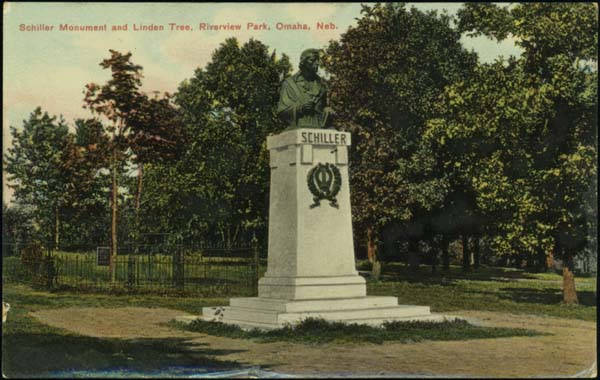
The old von Schiller monument in Riverview Park. This was placed near where the main gates of Henry Doorly Zoo are now. The statue was thrown in a ditch for the duration of World War I (thanks angry mob) but was later pulled out and put back. I'm not sure what happened to it when the zoo expanded, or where it is now. Any guesses?

-My novel (The Uninitiated, for the uninitiated of you reading this) has reached it’s newest stage of done! It’s off to my trusted cadre of readers for feedback and comment. Depending on how soon I hear back from them, I hope to be nearly done-done with the novel early this summer. Then the novel will be off to agents, hoping to find representation. Exciting stuff. I’m rather fond of the book and hope it does well. It’s very exciting to have it completed. Strangely, I kind of care less about publication now that it’s finished than I did when I hardly had any of it written. Maybe I still kind of doubted I could do it. It’s always easier to dream of publishing than it is to write.

-Not much else has been going on, writing-wise. I’ve been working on a few book reviews, and toiling day and night as Web Editor of Prairie Schooner. Some highlights: navigating a reformatting tangle to get our summer issue on Kindle, helping develop a mobile app, and launching (as co-editor with Claire Harlan-Orsi) a monthly book review on Prairie Schooner’s blog. Fun stuff.

-I’m also working on a few photo features for this blog. Mostly historical Omaha stuff, but also contemporary photos of spots where things in my novel happened. I’ll get on this soon.

-Clara has been around for a month now. We’re pretty fond of her as well.

-My grandpa Wheeler died. He was eighty. He was only able to meet Clara once, on Easter, but it was pretty nice. Shouldn’t have rushed around so much. We had four generations of ____ Lynn(e) Wheelers in the same room—Billy Lynn, Dennis Lynn, Theodore Lynn, Clara Lynne. We neglected to snap a photo. Unfortunately, that turned out to be our only opportunity.


Dispatch from The Uninitiated

“It used to be a common thing for a young man to light off secretly in the night, searching for a life different from the one he toiled through at home. Jacob Bressler became an exile in this way. He left under starlight and led his horse over the brawny shoals of what would be his brother’s farm from then on. He didn’t bother with a saddle but merely slid a bridle over the nag’s muzzle and walked out into the buggy paths of the river valley. Even in the dark he found the graveled highway that led to Omaha. There was no need to rush. He knew his brother wouldn’t follow him, not after what happened the week before. It was the kind of thing that happened a lot in Jackson County, and that’s why Jacob had to leave. He slid from his horse when he arrived on the River Ward, easing down to the pavement to land on one foot, the left one raised limp. His foot pulsed dully. He couldn’t worry about it, the Ward had his attention. It was a dark morning but he saw the dim hash marks of intersections on the hills beyond where sanitation wagons crept along knolls that slanted up from river to prairieland. There were tenements to the south, dirt-yard shacks he passed coming in from the north. The River Ward was pinned between the Missouri and downtown Omaha. It was mostly mills and warehouses, tar-topped and sturdy. There were other buildings too. Townhouses puzzled together from curb to curb, brownstones that had been fashionable once but were too close to the pig iron mills now, the constant hammering of steel and tails of factory smoke rising in the mucid morning ether. These were made extravagant, brownstone, sandstone, a blushing peach shade of brick. Jacob knew he would need money right away if he were going to survive. It hadn’t occurred to him in his rush to leave Jackson County. He was too concerned with making his life of great importance—with getting rich—that he forgot about practical things like having enough money for supper and a room. He would have to sell his horse.”

Just Finished

The Cove by Ron Rash. Set in WWI-era North Carolina, this novel deals with a German musician’s struggle to avoid anti-German violence in the rural south and a young woman’s difficulty living down the stigma of a birthmark in a superstitious town. An often beautiful and compelling novel.

The Missing of the Somme by Geoff Dyer. Really a must for anyone interested in the military history or the symbology of war.

Now Reading

Stay Awake by Dan Chaon.

Up Next

Flatscreen by Adam Wilson.