Weeks of Apr 21 – Jun 6, 2010 (Memorial Day Edition)

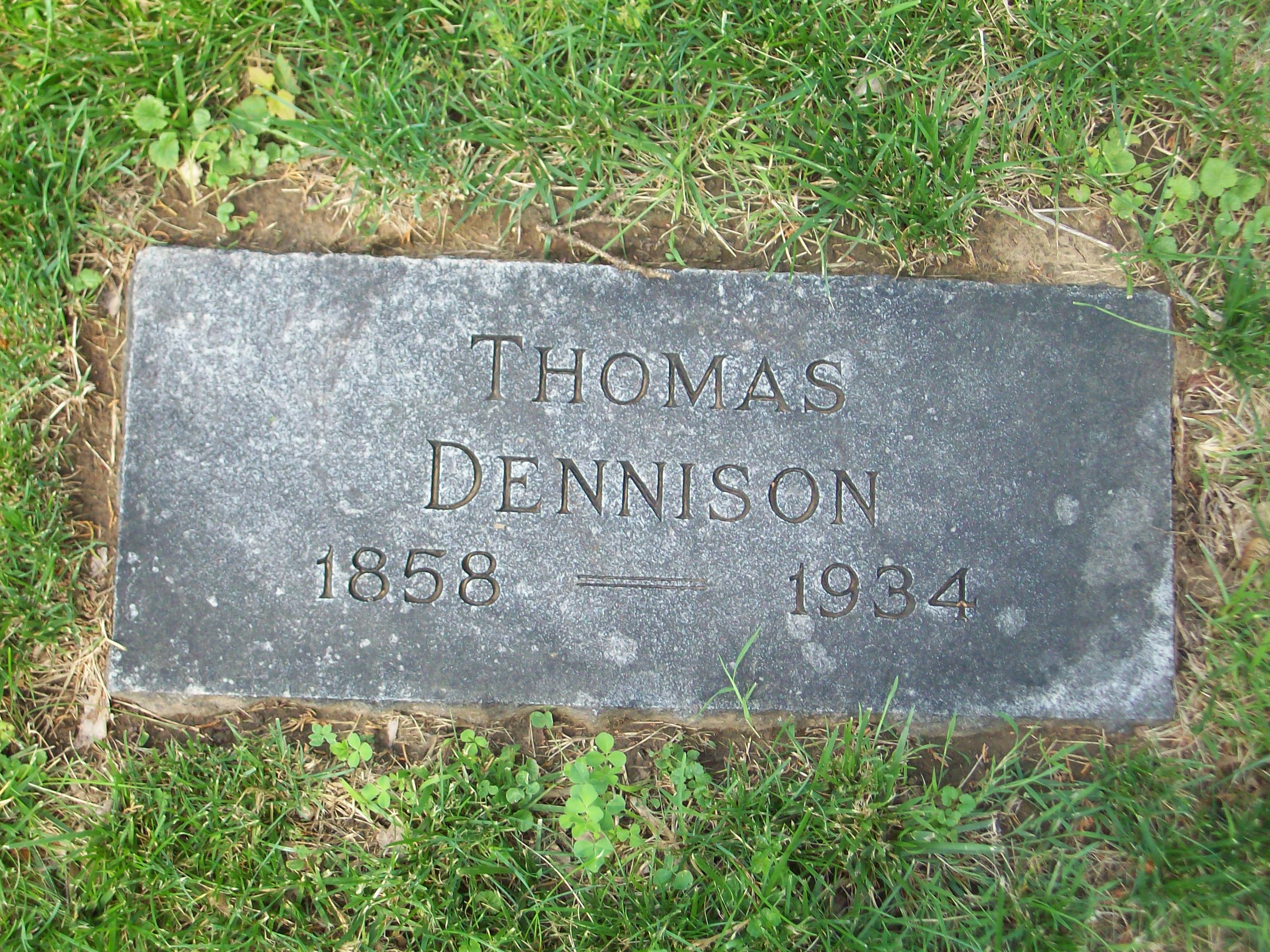
Last week on Memorial Day, on the way home from a Schneider family reunion in East Iowa Amish country (Nicole’s side), we stopped at Forest Lawn Cemetery in north Omaha. For a long while now I’ve been meaning to find the grave of Tom Dennison, who plays a major role in my historical novel-in-progress, The Hyphenates of Jackson County.

Tom Dennison with his second wife, Nevajo Truman.

The Forest Lawn website has an awesome database that helped immensely with this. (There’s also a walking tour of the cemetery, for anyone interested in Omaha history.) Of course, when we followed a whim and decided to stop after a day’s driving, we didn’t have any of the necessary information, but it didn’t really matter. We found it anyway, after an hour of walking and deductive reasoning. (Nicole is especially adept at graveyard searches. We usually end up in cemeteries on our vacations and are seldom disappointed. Some of our favorites include the Cimètiere Notre Dame-des-Neiges in Montreal (in a snow storm!), the Key West Cemetery, and many of the solitary headstones we came across while on our fern-thick honeymoon in the Green Mountains of Vermont.)

Over the months anticipating a visit to Dennison’s grave, I had these ideas in my head of a massive tomb, or an iron-doored, stained-glass mausoleum. As the longtime Boss of a wide-reaching political machine, Dennison was massively wealthy, so it stood to reason that he would have erected a memorial to celebrate himself. Forest Lawn, as the final resting place to many of Omaha’s founding fathers and first families, is home to many extravagant mausoleums and statues. I’d even worked up this day-dream where people would go to Dennison’s grave and take a shot of bourbon in some archaic ceremony of patronage. The reality, however, was much different from what I’d expected, as there is merely a large family headstone denoting the Dennison name, and then three smaller markers for Tom, his first wife Ada, and one shared by two sons who, presumably, died in their infancy. It was all very simple. No last words, no statues, no inscriptions.

I’d like to find out more about this, as there seems to be a story here. On the one hand, Dennison typically dressed simply, he came from very humble beginnings and was by most accounts a quiet, private man. So it isn’t out of the realm of possibilities that he would eschew a flamboyant mausoleum. But on the other hand, there were over a hundred cars in his funeral procession, a fact suggesting that his interment was anything but quiet and private. I hypothesized that perhaps the original gravestones were damaged, destroyed or vandalized—and the simple markers were replacements—but I have no evidence to support this. It was strange, too, that none of his children who survived to adulthood were buried there either, which goes against much of what I’ve learned about his private life. Maybe they’d moved away from the area by then. If anyone knows about this, I’d love to hear from you.

Dispatch from The Hyphenates of Jackson County

“Word among those hanging on along the streets, afterwards, was that Tom Dennison had summoned the enforcers to reestablish control after the uprising, and that he’d been slow to give the order because he was vacationing in California and had to be wired with the news. They said that he was on a yacht off the coast of San Diego and they had to wait until he returned to harbor. Johann didn’t believe these stories, he speculated that Dennison was probably in his office downtown, or his mansion west of Benson, that he’d tried to keep things in control but couldn’t. Johann interpreted the delay as yet another breach in the Old Man’s armor—and, after what they’d witnessed from the bathroom window of the Potsdamer, more than a few of their friends agreed with him.”

Personal Rejection Notes, Requests for More, and Other Nice Versions of No Thanks

New England Review for “The Current State of the Universe”; Mid-American Review, West Branch, and Yale Review for “Attend the Way.”

Just Finished

By Night in Chile by Roberto Bolaño. If you like the following things, this book is probably not for you: quotation marks, paragraph breaks, chapter breaks, short simple sentences. Otherwise, this is really an engrossing read. Some great sections involving European priests who use falconry as a means to stop pigeons from defecating on cathedrals and on the intersection of artistic patronage and military authoritarianism in Chile.
Netherland by Joseph O’Neill. This is one of my favorite books, now, and I highly recommend it. The best writing about cricket I’ve ever encountered, which makes this sound like a lesser accomplishment than it really is, since I don’t recall reading about cricket ever before. There was a lot of talk about this being a post-9/11 novel with echoes of The Great Gatsby, but I didn’t really find these elements that central to the story.

Now Reading

Roscoe by William Kennedy.

Up Next

The Lonely Polygamist by Brady Udall.
Kimmel Harding Nelson: Wrap Up

There isn’t a whole lot more to add to the writing processes I used and the experiences I had during my residency—as I more or less kept on track with my writing during the final days as I had in the beginning, and ate at the same restaurants—so I’d like to give a short overview of my residency. In all, my approximate volume for the ten and a half days I spent at Kimmel Harding Nelson came in at 24,637 words, which adds up to about 84 pages double-spaced.

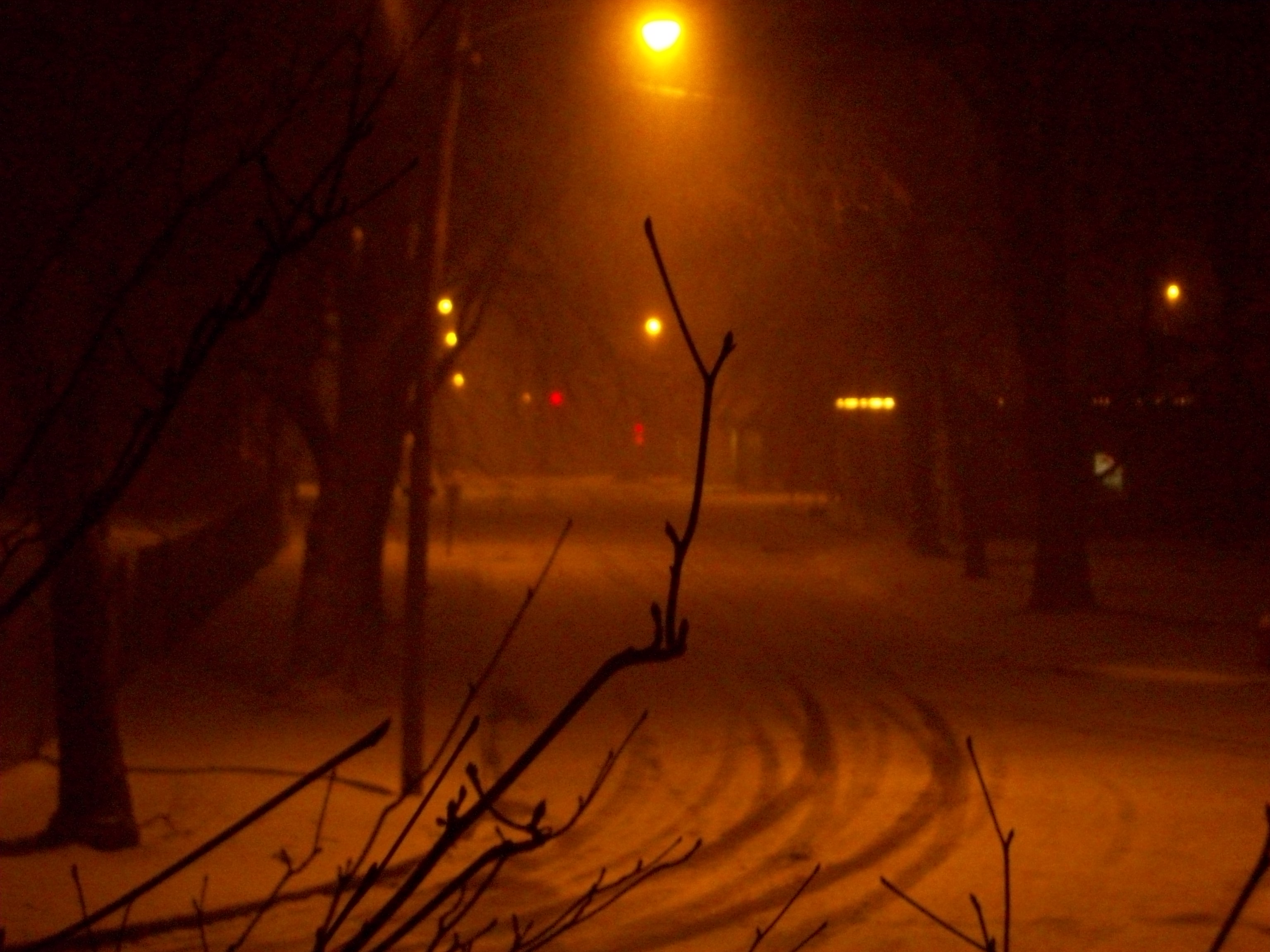
There was a blizzard I walked in for an hour one night. Here's what it looked like from my office window.

This is nearly twice the amount of work I expected to finish while in Nebraska City—the safe estimate I gave myself heading in—so it feels pretty awesome to produce this much work. The rough draft of Part II of my novel-in-progress The Hyphenates of Jackson County is nearly finished, which means that I’m over half done with the entire novel itself. In addition, I rewrote five scenes from Part I in first-person point of view in order to tie them more closely to my main character and polished off three blog posts for good measure.

It was a little difficult to work at a high level the final day, with the end in sight. It wasn’t exactly homesickness at this point, but more of a growing excitement to see my family again. So instead of sticking around for the final half day, I ended up driving back on Thursday night and sleeping in my own bed. Good for me, right?

The levies held!

I was off for four days in Denver at the AWP Conference less than two weeks later, so it was nice to half that little extra home time.

As a final word, I’d like to mention that the next deadline for Artist Residencies at the Kimmel Harding Nelson Center for the Arts is September 1, which is for residencies taking place in the January to June, 2011 period. KHN offers great facilities in a quiet setting, a stipend for expenses, and now even cab fare from the Omaha airport. I highly recommend it!

Weeks of Mar 18 – Apr 20, 2010 (Perseverance Edition)

There’s still one more recap post about my Kimmel Harding Nelson residency on the back burner, but I wanted to get a weeks in review post in here too. And since I had two stories accepted for publication last week, this seemed like a good time to do that.

On Tuesday of last week I learned that MARY Magazine will be putting “Let Your Hair Hang Low” in their summer edition. This is a story I’ve been working on since the fall of 2002 and am very glad to find a home for it. Then, on Wednesday, I received an email from the Kenyon Review letting me know that “How to Die Young in a Nebraska Winter” will be running in their Spring 2011 issue. This was another story I’ve had for a long time, starting it in the spring of 2005. It was originally written as a flash piece in the format of an actual step-by-step manual, basically what the title says it is, but I soon scrapped that idea and wrote it as more-or-less a traditional short story. I’m so excited for the opportunity of being in TKR. I’ve had a few big publications before—in Best New American Voices, twice in Boulevard—but adding the Kenyon Review to my credits feels like another breakthrough. It’s doing something with consistency, rather than isolated flourishes.

Needless to say, both of these stories have gone through countless drafts and rewrites, and have been in and out of the hands of editors for a long while. These stories have received ninety-seven rejections between the two of them, in their different forms. I’ve read that, on average, published stories receive around twenty-five rejections before being accepted by a journal. And even that number surprises other young and emerging writers when I bring it up. In that context, ninety-seven seems absurd, a number too embarrassing to admit to. But there it is.

At some point I probably should have given up on these pieces. But there was one thing that really kept me going—besides a stubborn belief that they are good stories and that I could make them work—and that was encouragement from editors. Of those ninety-seven rejections, twenty-nine were of the “nice” variety. The notes that said the piece was close or requested that I send more work their way. I’ve come to feel differently about these notes after reading for Prairie Schooner the past couple years. I used to disdain them a little bit, saw them a tease, I guess. It upset me that I could be close to publication without actually getting in, because there’s no consolation prize. But now I know how complimentary these encouragements really are. As a literary journal reader or editor, there are so many stories you enjoy reading over the course of a year, but only a small percentage of these can even be sent on for final consideration. And only a select few of those can be printed. So I’ve learned to appreciate the notes as the encouragement they are, and take heart to keep trying because of them.

Dispatch from “How to Die Young in a Nebraska Winter”

“I didn’t tell anyone this, but if it had somehow been necessary that Brandon die at that particular time, then I wished that he would have killed himself. Then there would have been something to blame. Somehow this was a more acceptable cause and effect. Suicide was a seductive death full of self-hate that seemed more gratifying to an adolescent mind. I’d heard of this happening, at least, learned about it on TV. There would have been physical satisfaction in imagining this. The cool metal slipping between his lips. The buzzing, blooming sensation at the back of his cranium. Then the click. I could have understood that. It would have made sense for him to jump off a boat into the mouth of a waiting shark, but not asthma. How Brandon died was obscene, but it fit the surroundings. I had to remind myself that it was late November in Nebraska and the dirt would soon be frozen. My half-brother hadn’t wanted to die, after all, he hadn’t planned any of this.”

Personal Rejection Notes, Requests for More, and Other Nice Versions of No Thanks

Ploughshares for “On a Train from the Place Called Valentine”; Post Road and One Story for “The Day After This One”; Avery Anthology for The First Night of My Down-and-Out Sex Life”; Contrary, Eleven Eleven, and Spectrum for “You Know That I Loved You.” Also, “On a Train from the Place Called Valentine” was a finalist in the Summer Literary Seminar Unified Fiction Contest, as judged by Fence.

Just Finished

31 Bond Street by Ellen Horan. An antebellum New York murder mystery. A lot of fun to read with interesting characters and a great setting. Highly recommended for those who like more commercial historical fiction. I may be writing a review on this but I haven’t decided for sure yet. There’s a very quaint handling of race that I gives me some pause.

The Underworld Sewer by Josie Washburn. I was reading this mostly as research for the novel I’m writing, and I was pleasantly surprised how much I enjoyed it too. It’s basically a compilation of early 1900s street pamphlets decrying the social evil of institutionalized prostitution, but it has some nice information on the Nebraska and Omaha of that era. It also looks like I can work Washburn in as a character in the novel, which is pretty fun too! There are a few years of her life when she’s in Omaha, after the book has been published, and they just so happen to be unaccounted for in the historical record—which is really a great gift to a writer.

The Unnamed by Joshua Ferris. I was going to write a fancy review of this book that talked about the perils of having a narrative structure that imitates the mental disorder of its main character, but decided against it. For one, this book has been reviewed a bunch of times already, and secondly, most of those review were negative too. No need to pile on at this point. Ferris is still a talented writer and hopefully his next book will be great.

Now Reading

By Night in Chile by Roberto Bolaño.

Up Next

Netherland by Joseph O’Neill.

Kimmel Harding Nelson: Days 4-6

The late March 2010 KHN Residents: Timothy Eshing, T. Wheeler, Matthew Jensen, Jenn Koiter, Ji Eun Kim. This was an awesome installation Ji Eun did in the window of an empty storefront.

This represented about the half-way point of the residency at the close of day six. I was able to get close to forty pages of new writing done, which is really pretty amazing for me. I came in a little skeptical of the residency idea. It didn’t make sense that I’d get a ton more work done in two weeks here than I could over a normal period at home. But it really turned out to be an amazing experience. Typically I’ll write between 500-1500 words in a day. But I consistency quadrupled that at Kimmel Harding Nelson.

I talked a bit about the reasons why I think this is in the previous post, but I want to hone in on that a little more here. The biggest difference, I believe, is simply the matter of time and space to work in. These are the factors mentioned on the brochures for these places, but it wasn’t really something I could understand until I was there. There are usually a few times during each day when I feel like writing, and they don’t come at the same time each day. At home, on a normal schedule, I can’t just drop everything and write. It’s a schedule—one that thankfully allows me regular time to work in the first place. And I’m very lucky to have that. But at KHN I could work whenever I felt like it. On Thursday morning I was more productive in the morning. On Friday I was more productive at night and was able to stay up late to work. I guess the difference never seemed like that much to me. Finding an extra hour in the morning, or an hour late at night. But if you have the space and the energy to work at a high level for that hour, you’re adding a four-page work period into the day. Sometimes two. And that really adds up, even over five days. If I could keep this pace up, I might have been able to finish drafting on Hyphenates Part 2, which would have put me way ahead of schedule.

A favorite of KHN residents. Best huevos rancheros I’ve ever had.

Still, I did take most of Saturday off, as Nicole and Maddie came down to Nebraska City to visit. We played around the apartment a little, as Maddie and my roommate Matt really hit it off, then got lunch at the Arbor Day Lodge. We went back to Omaha for a while after that, even though Maddie really wanted to stay at “Art House.” She and I went to the store and made dinner so Nicole could have nap time. It was nice to see the family again, something I’d been looking forward to from the moment they’d dropped me off.

It’s always such a strange balance to strike between giving yourself enough room to work (time and space, mental space) and keeping the people who are the reason you’re working so hard close by. The balance any working person tries to find, I suppose, particularly working parents. I think back sometimes to my life before Maddie was born, when I had hours and hours of free time each day. It’s easy to become nostalgic for those times—freedom, nights out, artsy-ness. But the fact is that most of that free time was wasted. There were video games then too, and binge drinking and hangovers. The balance was out of whack.

One of the great old homes of Nebraska City.

It wasn’t until Nicole was pregnant that a change came over me, a biological switch was flipped that made it easier to focus—in fact, it made it uncomfortable to not be working because there were people who depended on me.

I think this was a big part of the residency too, and a major reason why I think it was a big success for me. It’s not that the writing was easier to do when I was at KHN, but there was an imperative to do it. There were people at home missing me, counting on me to do well. And I wasn’t going to let them down.

Kimmel Harding Nelson: Days 1-3

I recently was granted an artist’s residency at the Kimmel Harding Nelson Center for the Arts in Nebraska City, from March 15-26, and I’ll be blogging about my experiences there over the next couple weeks.  It’s a little awkward to be doing this in the past tense, I’d originally planned on doing a daily journal while I was there, but it seemed like a bad idea to announce on the Internet that I was away from home. It was hard enough to leave Nicole and Maddie home alone during the start of the spring gang wars.

Anyway, here’s the first installment:

Nicole and Maddie drove me down on Monday morning and dropped me off at the center. We met the residency directors, Pat and Denise (her last day, sadly) and were given a tour of the facilities. The center was built in 1969 by the Nelson family as a luxury retirement residence for them and a few of their friends, and then was turned into the KHNCFTA in 1999 after Mrs. Nelson died. So there was a main apartment, which is now office space and an art gallery, and two attached apartments that each house two residents. There’s also a caretaker’s apartment in the basement for a fifth resident. The three garages have been converted into studio space, and there’s a great courtyard in the center of the complex. It’s really wonderful. Almost everything here appears to be original, the wallpaper, the fixtures, the appliances. My roommate (photographer Matthew Jensen) tells me that this style is all the rage now in New York.

The swanky wallpaper in my bathroom.

It was very hard when Nicole and Maddie drove away, but I’ve been able to talk to them throughout each day. Maddie’s phone skills are improving dramatically and she’s learning so many new words now. Like, “Salt and pecker.” It’s hard to miss that. I had to focus myself and make the most of my time. Even on the first afternoon I was able to write for a few hours, which really set a nice tone for the two-weeks.

Still, a lot of the first few days were spent just kind of figuring out what to do while I’m here. Of course I’d made plans beforehand, and I stuck to them mostly, but it was almost off-putting to have so much time. There was time to sleep in, time to stay up late and work, time to nap, time to eat when it was necessary. It allowed me to get wrapped up in the novel completely. I think generally I do kind of live through whatever I’m working on, half asleep to the world. I carry it with me, thinking about it throughout the day, whether I’m walking into the courthouse, going through security, or taking care of Maddie in the morning. It’s a preoccupation that allows me to work every day—because at least half of my mind is on the project at all times in order to stay within it. But the process of engagement was so much more complete at KHN. There was no metal detector alarm to break me out, no NW Radial traffic to vie for my preoccupation space. For the most part, during the first few days, I wasn’t working a ton more hours than I usually would during the course of a day—jumping from 2-3 to 4-6, maybe more than that. Anyway, the big difference was having time to think about things.

On Day 2, the writing wasn’t happening, so I took a two hour walk over to the Arbor Day Lodge and back. It wasn’t like I had a big breakthrough or anything, but such trips helped clear an awful lot of mental space. I came back and had lunch, laid down for an hour, read for an hour, and then was able to be very productive for three hours. Usually, I’d have the three hours to be productive in, and if it didn’t happen, the day was a waste.That wasn’t the case at KHN. It was about finding the right time of day to work in, the right mental space, the right location—and actually having the freedom to occupy that space and produce. This was the main benefit of the residency. I wrote about twenty new pages in the first three days, which is a little more than a good week’s worth—and a banner week at that.

My office at KHN.

I think the writing is solid, there’s some nice description, a few images that have really announced themselves, more than a few leaders emerging that will help determine the plot. This was Part II of Hyphenates I was working on, and I chose to go in without any kind of guiding outline, basically just knowing a specific place I need it to end—the day after the municipal election in 1918—with seven pages of notes to guide me. There seemed to be a lack of conflict for a while, but it started to emerge during this time. I wrote about half of Part II and also had the second half plotted, which is kind of a week’s worth of work in itself.

Coming Up: Days 4-6

Weeks of Jan 26 – Feb 21, 2010

Novel Work

One of the more fulfilling aspects of writing this book is that it affords me the opportunity to look further into my own family history. Most of the research I’ve done pertains to historical figures and the circumstance of their lives, and to 1918 Omaha itself more broadly, its social functions, clothes, shops, music. But I’ve been filling in a lot of Jacob Bressler’s character (who is entirely fictional) with my family history. And lucky for me, my grandma Cleo Blankenfeld Croson is also very interested in this topic. She’s helped me learn about my great-great-great grandfather Henry Blankenfeld, who was born near Danzig, West Prussia (present-day Gdańsk, Poland) in 1843 and his wife Maria Eigler Blankenfeld, who was born in Rudig, Austria (which is near Innsbruck, I believe) in 1852. We’re hoping to find out more on their arrival to America, but we do know they were married in Geneseo, Illinois in 1869. They did many jobs around Illinois and the Dakotas (and presumably before then too, wherever they landed) before homesteading near Niobrara, Nebraska, where my grandma grew up. We’ll be going there in July for a family reunion, which should be exciting. I’ve been there many times in my life, but never with this kind of active knowledge, I suppose.

For the past two years I’ve been reading up on German history, just to have some background in it, to understand where my title hyphenates were coming from. I wondered what kinds of stories their parents and relatives would have told them about their fatherland, since none of my German-American characters would have ever even been to Germany themselves. Why were so many of their fore-bearers emigrating? What drove their families (and my family for that matter) to America in the first place? There was constant war in Europe during this period, of course, and the Franco-Prussian War would have directly affected Henry. Many young men fled Prussia to escape conscription, which is what I assume Henry’s reason was too, although I can’t really know that for sure. There were many difficulties in those years associated with the Unification of German states. The Kulturkampf came a bit later, so I doubt the Blankenfelds would have been involved in that. It’s unlikely they were Catholic or Socialist anyway.

Frozen family fun at the Douglas County Courthouse.

And Henry would have been too young to be a Forty-Eighter, one of the many failed democratic revolutionaries who came to North America from Europe. So there’s so much I can’t really know. Maybe a trip to Ellis Island would prove lucky, but very few of the databases I’ve found online go back far enough to be helpful. I’d like to go to Europe and root around, but no one kept records in that part of the world, or they were destroyed. Gdańsk itself has been under a dozen different governments in its history—and four of those since Henry Blankenfeld’s birth.

The interesting part for me—coming from the standpoint of a novelist—is that it’s almost better to not know. When I was his student at Creighton, Brent Spencer often referred to the art of fiction as pursuing the mystery, which I’ve always loved. It’s kind of a mystic, Jesuit way of filling in the blanks. On a personal level, I’d love to have all the details of my family history. It would be incredible to know exactly where we come from—to be able to go there and place my hands on that earth. But as a writer, it’s better to avoid that sort of conscriptive knowledge. The character Jacob Bressler is better for my lack of knowledge in this sense, because it gives me enough blanks to come to the story I’m telling, not the history behind it.

Dispatch from The Hyphenates of Jackson County

“’You know they used to call Dennison the King Gambler.’ The Pfarrer was up on the balcony again, a new glass of wine in hand. ‘Did you know this about your boss? He swindled a $100,000 on a boxing match in Louisiana. A fixed fight. He started as a bouncer and a sportsman out west, when he was your age, clearing out whole card halls in Denver playing faro. He hooked on here after winning big on the Louisiana fight, got the Daily Bee and the Perpetual Mayor on his side. Whole books have been written against Dennison and his underworld sewer, but he slips retribution. Nothing sticks to him.’”

Personal Rejection Notes, Requests for More, and Other Nice Versions of No Thanks

Hunger Mountain for “How to Die Young in a Nebraska Winter”; Third Coast for “From Indiana.”

Just Finished

Ragtime by E.L. Doctorow. Along with Edward P. Jones, Doctorow is one of the two most famous historical novelists who claim to have done little to no research for their novels, relying rather on memory and imagination. I’m a little skeptical about this, but can see how it could be true. (For one, there were a few moments when I knew he was off.) Doctorow writes with such authority on well-known figures, but he mostly focuses on private moments that cannot really be refuted as the basis of his work. Who can say what Houdini was thinking at a particular moment, hanging upside-down from a building? And if the writing is entertaining, why would you want to intrude with literal truth anyway? As above, the less you know, the more freedom you have to invent. A great book. The movie adaptation was pretty good too.

Now Reading

Point Omega by Don DeLillo.

Up Next

The Unnamed by Joshua Ferris.

Link of the Month

Don DeLillo’s recent reading at BookCourt in Brooklyn from the blog of BOMB Magazine.

Weeks of Dec 26/09 – Jan 26/10

Novel Work

I’ve finally decided to split The Open City into two novels, rather than continue working on it as one project with two distinct threads. Part of the concern was that the single book would be very long, around 700 pages or so. It just didn’t seem feasible to get something like that published, seeing that it would be my first novel. And it would probably take another two years to just get it roughed in. The other things that worried me were more novelistic in nature. The two threads certainly play off each other—and the two novels will still be related—but I’d structured them to alternate in parts rather than chapters. That is, there would be a seismic shift every 100 pages or so, rather than smaller shifts every 20 pages. (Most of the hybrid-historical-novel models I’m using are structured more on the alternating chapters style, such as Aleksander Hemon’s The Lazarus Project and Jonathan Safran Foer’s Everything Is Illuminated. Junot Diaz’ The Brief Wondrous Life of Oscar Wao gives more space to the individual threads instead of alternating, but his threads were separated by only a generation and collide in the end in a way mine wouldn’t.) These seemed too jarring. Just as the story is getting roaring it would jump into another thread. One that’s starting from scratch, essentially. I didn’t really anticipate the historical thread being this interesting or engrossing, which is part of the problem and part of the exciting part. It’s something I feel much more compelled to write, something I feel needs to be done.

Nicole and Maddie flying outside the courthouse.

In any event, I’ve finished a first draft of Part I of what is now titled The Hyphenates of Jackson County, which should be about one/third of the book. The writing of this has gone so smoothly so far. Maybe it’s writing historical fiction, in that I have many sources, photos, and books to draw on when I’m feeling stuck. Or maybe it’s that I’ve been working near-daily as a novelist for almost two years now and am actually getting better at it. Plus a little bit of the family life settling down a bit more, becoming more comfortable as a father, having real office space without radon gas to contend with, and having a nice chunk of property that demands constant physical activity. Let’s say all of the above. But whatever the cause of this good streak, it’s been very much enjoyed. Now it’s just a matter of finishing. And making it great. The rest should take care of itself.

Dispatch from The Hyphenates of Jackson County

“There was something about Jacob that triggered Mrs. Eigler’s mothering instinct. The way he stared blankly into the street when they chatted in the evenings, as if someplace else; how he merely smiled in silence when at a loss for words, his mind grinding. Women often fell towards mothering Jacob. From the way his hair flopped over his forehead to the cowlick spiking up in back, Jacob unaware until a woman was there to tamp it down for him; and in how he dressed, not quite sloppily, but merely hinting at neatness with an informal comportment.”

Personal Rejection Notes, Requests for More, and Other Nice Versions of No Thanks

Crazyhorse for “How to Die Young in a Nebraska Winter”; Lake Effect and StoryQuarterly for “The Housekeeper”; Michigan Quarterly Review, Indiana Review, and One Story for “These Things That Save Us”; Barnstorm for “From Indiana.”

Just Finished

Kapitoil by Teddy Wayne. This novel is nearly very good. It’s a book driven almost entirely by the voice of its narrator, which is something I don’t usually enjoy that much beyond the first few pages. Yet, protagonist Karim Issar is very compelling. A programmer from Qatar who strikes it rich in Manhattan while doing some pre-Y2K debugging, Karim is the kind of uninitiated character who so effectively provides context to the culture he’s being introduced to. The main problem I have with Kapitoil is that the secondary characters are flat and ineffective as foils. They can’t challenge Karim, which leaves the main character two-dimensional in important ways as well. It looks like much of Wayne’s background is in doing short, satirical pieces for magazines, so maybe this is telling in that the novel shines when it is merely a matter of voice and gags, but falters on the level of extended plot. This one is really worth picking up, however. Highly recommended.

Should I run for office? Do I look like a county chair?

Now Reading

American Tragedy by Theodore Dreiser.

The Underworld Sewer by Josie Washburn.

The Book of Genesis illustrated by R. Crumb.

Up Next

The Unnamed by Joshua Ferris.

And big props to my friend and colleague Nabina Das, who has been named an Associate Fellow for the City as Studio 2010 initiative in Delhi. Awesome work!