Weeks of Dec 6, 2010 – Jan 6, 2011: On Going First-to-Third

(Note: This isn’t a baseball entry.)

For the past month or so I’ve been toying with point-of-view in my novel, first going from a close third-person to first-person narrated by Jacob Bressler, my lead character. I’m not really sure what my goal for doing this was. Something just didn’t sound right with the “voice” telling the story and I wanted to try something different. Some of the feedback I’ve received from potential agents spoke to Hyphenates being a book focused on history and setting, rather than story and character, and I’m trying to break that hold. So I figured that Jacob could tell his story more succinctly, since it’s all he would care about. He wouldn’t obsess over Omaha history or factoids of the era as much as I do, certainly, and sometimes it’s easier to slip those lovelies in while in third-person. I needed a more discerning eye. It’s like how you don’t realize how embarrassing something is until you say it out loud to another person, or post it in online. But once you open your mouth, you can see things so much more clearly and objectively.

The experiment didn’t really work. Conventional wisdom says that novels shouldn’t be written exclusively, or even largely, in first-person, and I think that’s probably good advice. Around page fifty of the rework, it got pretty annoying to keep seeing and hearing that “I” all over the place. To be unable to break out of Jacob’s voice even for a minute is a problem, especially since he’s the focus of the book. But, even though I’m now in the process of reworking it back into third-person, I do think the exercise was worthwhile. It helped me see cuts and edits, and gaps where new work is needed, that weren’t apparent before. While it seemed acceptable to have a third-person narrator go into a page-and-a-half diatribe on the condition of organized labor in Omaha in 1917, having Jacob do the same was absolutely ridiculous. There were more than a few instances of this, where the scholarly, professorial voice would dominant for longish periods—and they all needed to be cut. The writing is much cleaner now, more focused and edgy in a way similar to my contemporary-set fiction.

I’d only made it through about a quarter of what I have drafted in the transition to first-person rework, but it may be worthwhile to push through the rest of it, even though I know that I’ll want it in third-person eventually. (I’ll probably want this.) I have used this technique in spots for the last year or so anyway, in fact, trying to tie the narration as closely to Jacob’s experience as I could. So much of the writing, especially in Part II, has already been rewritten, for my own benefit, in Jacob’s first-person. There’s just so much good that comes from writing around things like this. I imagine it’s similar to filmmakers shooting a scene from ten different angles, hoping to get one that looks and sounds and feels right. The dispatch below is a part I wrote new while in Jacob’s first-person, and it’s something I don’t think the third-person narrator could have come to. So there’s that.

Dispatch from The Hyphenates of Jackson County

“The bank was open when I left the saloon, it was two o’clock, but I still didn’t go there and ask for a job. The weather was nice. Again I walked downtown, but it was boring this time. No women brushed against me. My clothes disgusted them, my face was filthy. I waited out the day and then returned to the Courthouse lawn in the evening to sleep. It was warm and I’d been safe there the night before. I knew at what time to cops would come to roust me, and would make it a point to leave before they came out with their cudgels. It seemed simple. But I was arrested anyway, after midnight, for vagrancy, and put in the overnight with the drunks and other indigents. I wasn’t disappointed to be arrested, however, after I was released. At least there was black coffee this way, and in the morning a bowl of white beans with a couple pieces of fat. Otherwise I wouldn’t have eaten that morning. The whole night I wished that I’d gone to the bank that day, however. There was plenty of time for regrets in the overnight, because the drunks couldn’t keep quiet. I thought of everyone I might have wronged in my life up to this point. Any pocket of guilt that had been waxed over was reopened. I thought of you that night, Evie, and why it was you had to leave Jackson those many years before. I thought you took off on your own. It never occurred to me that they’d run you and your mother off. Not until they ran me off too.”

Personal Rejection Notes, Requests for More, and Other Nice Versions of No Thanks

Southern Humanities Review and Hayden’s Ferry for “Attend the Way”; Electric Literature for “On a Train from the Place Called Valentine”; and West Branch for “The First Night of My Down-and-Out Sex Life.”

Now Reading

Bad Marie by Marcy Dermansky.

Just Finished

A cover for Fortune designed by Chris Ware, by request. The magazine rejected it, of course. Pretty incredible nonetheless.

One of Ours by Willa Cather. A really great, Pulitzer Prize-winning novel set mostly in Central Nebraska and Lincoln, in the late 1910s. I was lucky to pick this up at the National World War I Museum in Kansas City this fall and it’s become a fantastic resource for me. The focus of the book is even a family named Wheeler! (I’ve gone over this before, I know. Indulge me.) The final third of the book, when Claude goes over to fight in the war, is pretty sentimental and Cather panders more than a little bit to jingoistic reactionism in these parts. But overall I really enjoyed the book. Cather has never disappointed. Plus, as an added bonus, there are a bunch of good old-timey ideas for home gardens in Nebraska, for all you green-thumbs out there. We’re going to try growing gourd vines up our pergola trellis this summer, and we have Cather to thank for that.


The Best American Comics 2010, edited by Neil Gaiman, Jessica Abel and Matt Madden. My favorites include “The Lagoon (Hiding in the Water)” by Lilli Carré, “The Alcoholic” by Jonathan Ames and Dean Haspiel, “Asterios Polyp” by David Mazzucchelli, “The War on Fornication” by Peter Bagge, “The Flood” by Josh Neufeld, and “Fiction versus Nonfiction” by Chris Ware. Ware also had a lengthy section of his ongoing series “Acme Novelty Library” reprinted, which I had seen some of before. In 2007 he gave a standing-room-only lecture at the Sheldon in Lincoln that Nicole and I attended, and a comics pamphlet featuring some of the comic reprinted here was given out as an example of his work. It was pretty cool to get the work then and is outstanding to see the longer version reprinted in a Best American. To make it even better, the comic is set in 1950s Omaha and uses the old Omaha World-Herald building (where Nicole worked when as first moved here) as a backdrop. There have been quite a few notable artists who have come out of Omaha in the last decade, but none of them have really attained giant-status in their field like Chris Ware has. It’s something that should really get more local recognition than it does.

Rivers Last Longer by Richard Burgin. A solid literary thriller with meta-fictional treasures abound. I’m currently writing a review on this now.

Up Next

Greetings from Below by David Philip Mullins.

Weeks of Aug 4 – Aug 21, 2010

-I made some progress on some of the peripheral research surrounding the novel in the last couple weeks. Notably, Sister Joy, an archivist with the Servite Sisters, supplied a very informative response to my guess that Tom Dennison’s mansion might have been turned into one of the buildings that now make up the campus of Marian High School. (In the comments of this post.) However, as Sister Joy illuminated, this was not the case. I’m still not sure where the Dennison estate stood, but the land where Our Lady of Sorrow Convent would be built was purchased in 1920, and mass first celebrated in the building in 1925. Dennison was still active in Omaha at the point, and would be for nearly another decade. So my shot in the dark was wrong. I’ve narrowed it down to either the southwest or southeast quadrant of the intersection, though. And that’s something.

I’ve also been trying to find out more about Dennison’s grave site, but Forest Lawn Cemetery has not been as forthcoming as Sister Joy, unfortunately.

-After nearly a month of research, I jumped back into finishing up the drafting of Part II of Hyphenates this week. Even though I’m a little further behind now than I’d hoped to be, it was my goal to finish drafting by the end of the summer and will still meet that soft, self-imposed deadline. Hyphenates Part II has been somewhat more difficult to write than Part I was, with the principal reason being that I’m now working more intimately with the real life characters than I did in the first 125 pages. It’s one thing to just search around and make up some backstory for Jacob Bressler—my lead character, who isn’t a historical figure, and is only a composite of real people—but it’s completely different to do so for Tom Dennison, a well-known figure in regards to political machines and local history, or Josie Washburn, a turn-of-the-century prostitute and madam in Omaha who published one of the initial first-hand account of life in an American brothel. I’m not really comfortable just making it up when it comes to real people, so I needed to go back and get a handle on the history before I moved on.

That being said, it almost always amazes me how consistently research pays off—and this has been one of the most heartening things in writing a historical novel. Whenever there’s a gap in the story I’m telling, or some inconsistency in character, there’s usually something to be found in an old newspaper or biography or diary that satisfies the gap and shows how the story—both mine and the composite historical record—both makes sense and is fascinating. I won’t get into too many specifics, but, in the case of Washburn, I was able to write a scene wherein she gives an anti-Dennison speech in a Little Italy meeting hall at a critical juncture of the story. It’s pretty awesome.

-As a consequence of said research needs, I’ve been spending some quality time in the microfilm room at the downtown Omaha library reading newspapers of 1917 and 1918. This also happens to be the golden age of comics–which leads to many distractions, of course, but also some really great cartoons. Two of the best, and most affecting, are posted. Both are from the Evening World-Herald.

Dispatch from The Hyphenates of Jackson County

“Jacob walked down Pacific with his crew, where traffic had been cut off by the crowds, and he tried to ignore the coalitions around him. Every word spoken by a stranger sounded like an insult to Jacob, some vindictive joke that cut close to his heart. A dozen Russian warehouse workers rested against the hall to eat a quick dinner and they seemed to be talking about Jacob, laughing at him in their native cackle. They wore overalls and denim jackets, floppy felt caps made heavy with sweat and dust. They bit at sandwiches wrapped in newspaper, hunks of cheese and onion pressed between slices of cottage white with black smears of soot rubbed in from their fingers. A tin cup sat between each of their thighs, brimming over with the sudsy head of a beer. Some boy dug into his parents’ secret supply to flit along with a frosted clay jug hugged to his belly, making wisecracks to the men. These were thick-chest serfs whose mouths closed in satisfaction over their food, wiry ones whose clothes puffed over sinewy bodies. The lean ones looked the meanest, lips curling venomously under blood-shot eyes. Jacob thought this as he glanced at them. They were sizing him up, he could tell this. They imagined how much it would take to claim a win in a fight with Jacob and his men. And when one of them whispered something to another, when they leered at Jacob and laughed, he too dreamed how it would go down in a brawl.”

Just Finished

Political Bossism in Mid-America by Orville Menard.


Now Reading

Black Mamba Boy by Nadifa Mohamed.

Up Next

Death is Not an Option by Suzanne Rivecca.

Weeks of July 3 – Aug 4, 2010

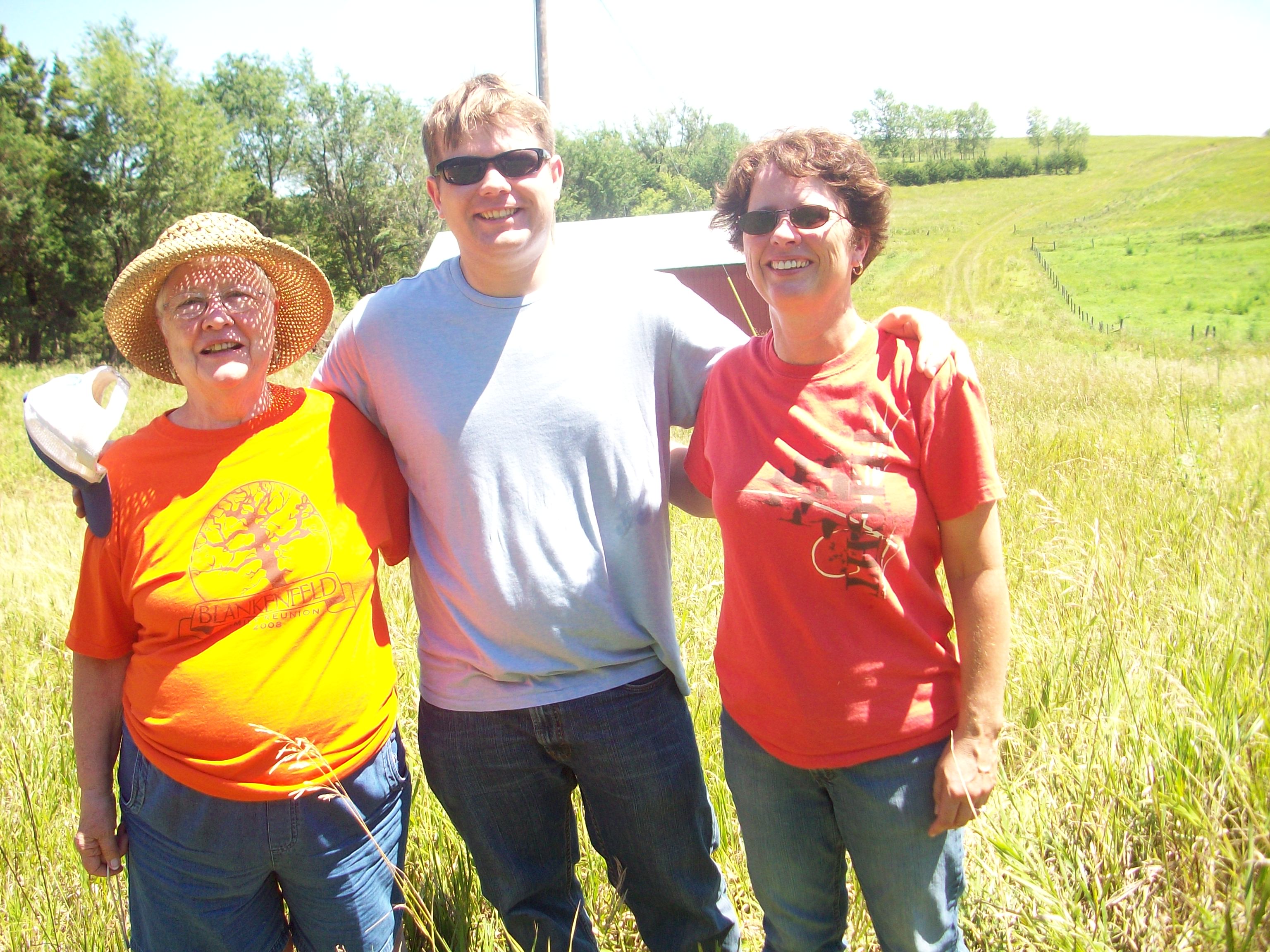
This last weekend we spent some time in Niobrara, Neb. at the Blankenfeld family reunion. As you may know, I’ve been working with my Grandma on some ancestry projects over the past year, and it was nice to share some of the fruits of that labor. I’ve also been using some of the Blankenfeld family lore as a model for Jacob Bressler in my novel-in-progress The Hyphenates of Jackson County. In this regard, the trip was especially significant for me.

On the Blankenfeld homestead with my Grandma Cleo and Mother Marta.

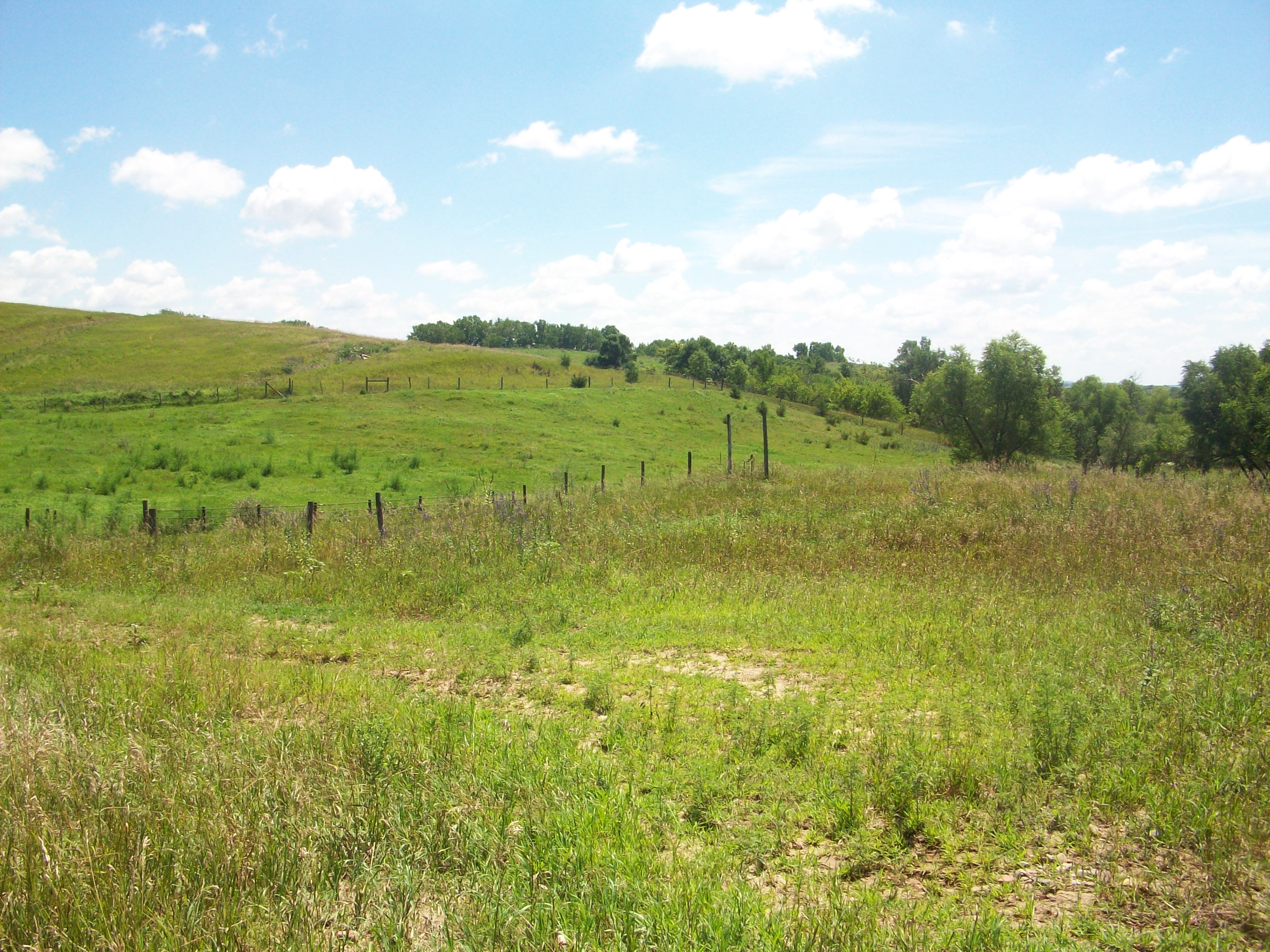
We were able to visit the original Blankenfeld homestead site, where Jacob and Maria settled in 1885. Although no structures remain—there was a hill where the original dugout had been—it was pretty cool to just stand there and appreciate the terrain. The area hadn’t seemed especially rocky and hilly before, in my previous trips to the area, until I imagined trying to cultivate it by hand. Later, we stopped into a museum of sorts that was made from the preserved farm of my Great-Great-Grandfather Henry Blankenfeld. He’s the model for Jacob in the novel–visually, and some of his history as the son of immigrants–so it was really exciting to walk through the house and barn he built himself, to eat an apple from a tree he planted, to descend the staircase his wife descended on the day they were married.

It’s always difficult to appraise how valuable experiences like these will be to my work. For one, who knows where the writing is going to take me. Will I need to know what the grass smells like? The flora? The fauna? Or how the sky there has its own unique blue, the air a particularly humid cloyingness? Also, in Hyphenates, Jacob comes from a different part of the state, one with a terrain closer to Omaha’s than Niobrara’s. So it isn’t like I can just sit down and make a sketch of the landscape to use in the novel.

The Blankenfeld homestead, originally settled in 1885.

Mostly it’s just helpful to be there, to be put in a spot that’s loaded with memories specific to my family, and where events took place that were crucial to my very existence. I’ve always had the kind of memory that retains periphery details well, so it’s a great benefit to just listen to stories, especially while smelling the grass and listening to the leaves in a tree. It isn’t that I necessarily came away with anything specific that I can add to the story—and I’m not saying I didn’t, I just don’t know yet—but it feels like I’ve gained a much better appreciation of what it was like to be alive in a time other than my own, even if it isn’t the exact era I’m writing about. And that’s something that can’t really be replicated in an archive or by looking at old photographs. It’s getting caught up in other people’s memories, and not just that, but doing so while standing on the very ground where things happened.

Dispatch from “Shame Cycle”

“Anna was sixteen when she approached you at a downtown record store and you began seeing her not long after that. This was the summer before your freshman year of college, when she invited you to a party and claimed possession of your body, parading you around the smoky rooms of parties. You considered it a move up in social scene from the part-time Nu Metal rebels you knew in high school to this career class of punks. The hard-drinkers, veteran sludge rockers, and sometimes transients who pocked the city so visibly in those days. These were people Anna exposed you to, her friends. They hitchhiked to New York and ran drugs from the Mexican border for South Omaha gangs, they bought a tattoo gun to save trips to the parlor, they had shaved-in mullets and handlebar mustaches, they screamed swear words into ice cream parlors as protests against capitalism. These people were the real deal as far as you were concerned then—or as close to it as one could get in Omaha.”

Maddie and Cocoa up on a Missouri River vista.

Personal Rejection Notes, Requests for More, and Other Nice Versions of No Thanks

BOMB for “On a Train from the Place Called Valentine”; Zoetrope: All-Story for “The Current State of the Universe”; Cincinnati Review, Hayden’s Ferry Review, and Indiana Review for “The Housekeeper”; Caketrain for “The First Night of My Down-and-Out Sex Life.” My story “Shame Cycle” was a finalist for Matrix Magazine’s LitPop Awards, but it did not end up winning. There was no consolation prize.

Just Finished

What He’s Poised to Do by Ben Greenman. An outstanding collection. Highly recommended. I liked it so much that I’ve written a glowing review of it, one that will hopefully be published soon.

Windmill at dusk.

Now Reading

Black Mamba Boy by Nadifa Mohamed.

Up Next

Death is Not an Option by Suzanne Rivecca.

Weeks of Apr 21 – Jun 6, 2010 (Memorial Day Edition)

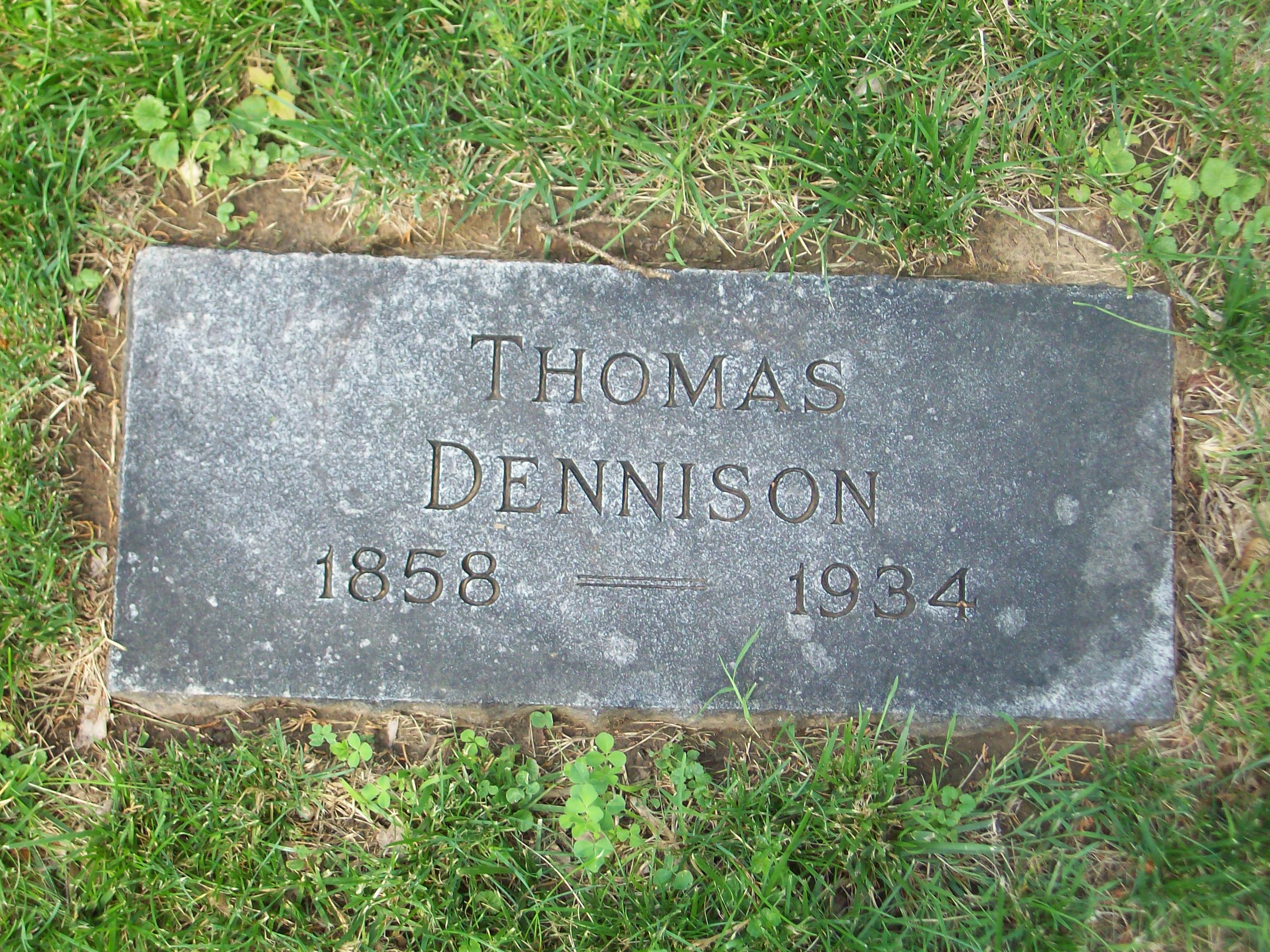
Last week on Memorial Day, on the way home from a Schneider family reunion in East Iowa Amish country (Nicole’s side), we stopped at Forest Lawn Cemetery in north Omaha. For a long while now I’ve been meaning to find the grave of Tom Dennison, who plays a major role in my historical novel-in-progress, The Hyphenates of Jackson County.

Tom Dennison with his second wife, Nevajo Truman.

The Forest Lawn website has an awesome database that helped immensely with this. (There’s also a walking tour of the cemetery, for anyone interested in Omaha history.) Of course, when we followed a whim and decided to stop after a day’s driving, we didn’t have any of the necessary information, but it didn’t really matter. We found it anyway, after an hour of walking and deductive reasoning. (Nicole is especially adept at graveyard searches. We usually end up in cemeteries on our vacations and are seldom disappointed. Some of our favorites include the Cimètiere Notre Dame-des-Neiges in Montreal (in a snow storm!), the Key West Cemetery, and many of the solitary headstones we came across while on our fern-thick honeymoon in the Green Mountains of Vermont.)

Over the months anticipating a visit to Dennison’s grave, I had these ideas in my head of a massive tomb, or an iron-doored, stained-glass mausoleum. As the longtime Boss of a wide-reaching political machine, Dennison was massively wealthy, so it stood to reason that he would have erected a memorial to celebrate himself. Forest Lawn, as the final resting place to many of Omaha’s founding fathers and first families, is home to many extravagant mausoleums and statues. I’d even worked up this day-dream where people would go to Dennison’s grave and take a shot of bourbon in some archaic ceremony of patronage. The reality, however, was much different from what I’d expected, as there is merely a large family headstone denoting the Dennison name, and then three smaller markers for Tom, his first wife Ada, and one shared by two sons who, presumably, died in their infancy. It was all very simple. No last words, no statues, no inscriptions.

I’d like to find out more about this, as there seems to be a story here. On the one hand, Dennison typically dressed simply, he came from very humble beginnings and was by most accounts a quiet, private man. So it isn’t out of the realm of possibilities that he would eschew a flamboyant mausoleum. But on the other hand, there were over a hundred cars in his funeral procession, a fact suggesting that his interment was anything but quiet and private. I hypothesized that perhaps the original gravestones were damaged, destroyed or vandalized—and the simple markers were replacements—but I have no evidence to support this. It was strange, too, that none of his children who survived to adulthood were buried there either, which goes against much of what I’ve learned about his private life. Maybe they’d moved away from the area by then. If anyone knows about this, I’d love to hear from you.

Dispatch from The Hyphenates of Jackson County

“Word among those hanging on along the streets, afterwards, was that Tom Dennison had summoned the enforcers to reestablish control after the uprising, and that he’d been slow to give the order because he was vacationing in California and had to be wired with the news. They said that he was on a yacht off the coast of San Diego and they had to wait until he returned to harbor. Johann didn’t believe these stories, he speculated that Dennison was probably in his office downtown, or his mansion west of Benson, that he’d tried to keep things in control but couldn’t. Johann interpreted the delay as yet another breach in the Old Man’s armor—and, after what they’d witnessed from the bathroom window of the Potsdamer, more than a few of their friends agreed with him.”

Personal Rejection Notes, Requests for More, and Other Nice Versions of No Thanks

New England Review for “The Current State of the Universe”; Mid-American Review, West Branch, and Yale Review for “Attend the Way.”

Just Finished

By Night in Chile by Roberto Bolaño. If you like the following things, this book is probably not for you: quotation marks, paragraph breaks, chapter breaks, short simple sentences. Otherwise, this is really an engrossing read. Some great sections involving European priests who use falconry as a means to stop pigeons from defecating on cathedrals and on the intersection of artistic patronage and military authoritarianism in Chile.

Netherland by Joseph O’Neill. This is one of my favorite books, now, and I highly recommend it. The best writing about cricket I’ve ever encountered, which makes this sound like a lesser accomplishment than it really is, since I don’t recall reading about cricket ever before. There was a lot of talk about this being a post-9/11 novel with echoes of The Great Gatsby, but I didn’t really find these elements that central to the story.

Now Reading

Roscoe by William Kennedy.

Up Next

The Lonely Polygamist by Brady Udall.

Kimmel Harding Nelson: Wrap Up

There isn’t a whole lot more to add to the writing processes I used and the experiences I had during my residency—as I more or less kept on track with my writing during the final days as I had in the beginning, and ate at the same restaurants—so I’d like to give a short overview of my residency. In all, my approximate volume for the ten and a half days I spent at Kimmel Harding Nelson came in at 24,637 words, which adds up to about 84 pages double-spaced.

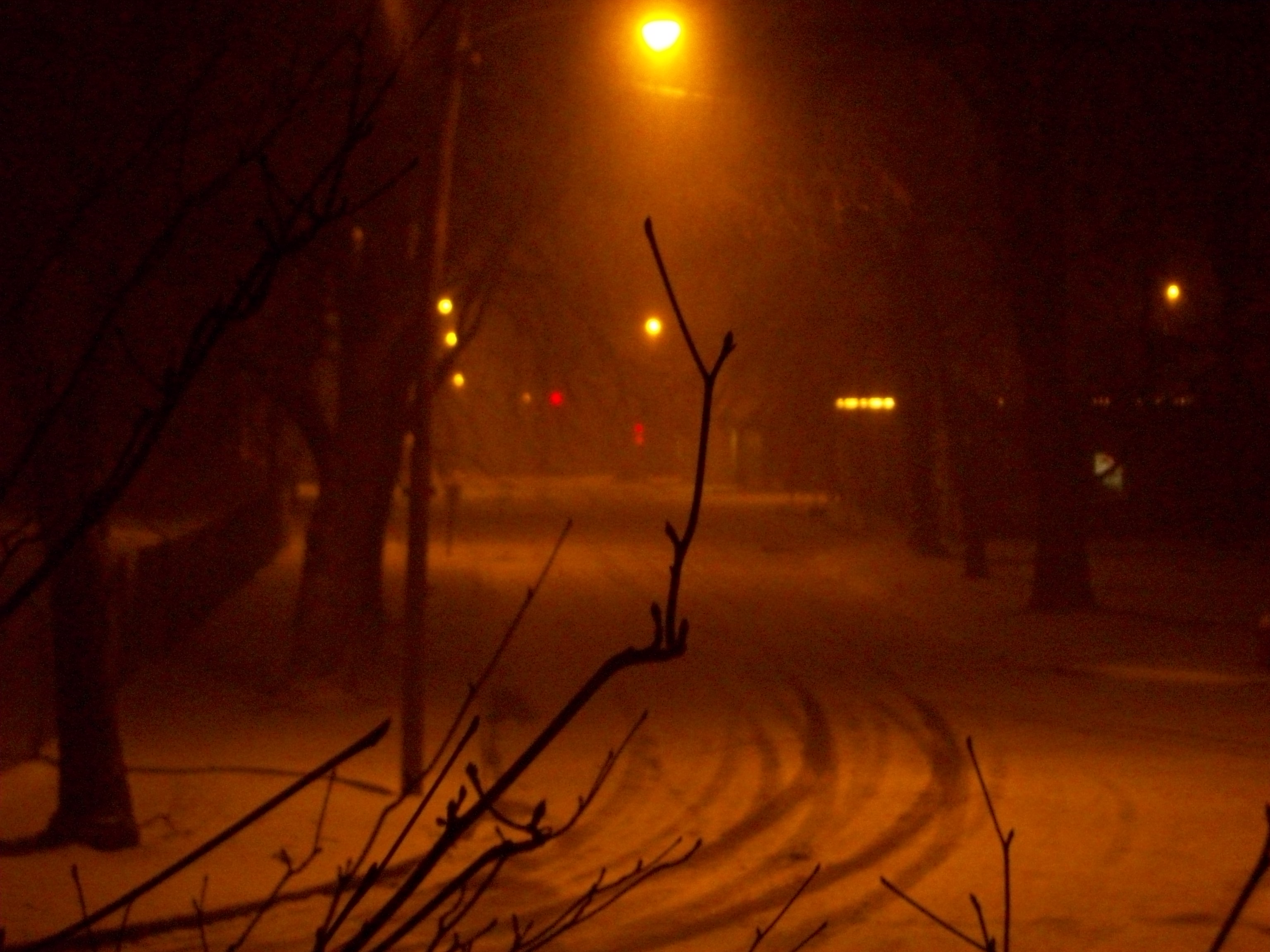
There was a blizzard I walked in for an hour one night. Here's what it looked like from my office window.

This is nearly twice the amount of work I expected to finish while in Nebraska City—the safe estimate I gave myself heading in—so it feels pretty awesome to produce this much work. The rough draft of Part II of my novel-in-progress The Hyphenates of Jackson County is nearly finished, which means that I’m over half done with the entire novel itself. In addition, I rewrote five scenes from Part I in first-person point of view in order to tie them more closely to my main character and polished off three blog posts for good measure.

It was a little difficult to work at a high level the final day, with the end in sight. It wasn’t exactly homesickness at this point, but more of a growing excitement to see my family again. So instead of sticking around for the final half day, I ended up driving back on Thursday night and sleeping in my own bed. Good for me, right?

The levies held!

I was off for four days in Denver at the AWP Conference less than two weeks later, so it was nice to half that little extra home time.

As a final word, I’d like to mention that the next deadline for Artist Residencies at the Kimmel Harding Nelson Center for the Arts is September 1, which is for residencies taking place in the January to June, 2011 period. KHN offers great facilities in a quiet setting, a stipend for expenses, and now even cab fare from the Omaha airport. I highly recommend it!

Kimmel Harding Nelson: Days 4-6

The late March 2010 KHN Residents: Timothy Eshing, T. Wheeler, Matthew Jensen, Jenn Koiter, Ji Eun Kim. This was an awesome installation Ji Eun did in the window of an empty storefront.

This represented about the half-way point of the residency at the close of day six. I was able to get close to forty pages of new writing done, which is really pretty amazing for me. I came in a little skeptical of the residency idea. It didn’t make sense that I’d get a ton more work done in two weeks here than I could over a normal period at home. But it really turned out to be an amazing experience. Typically I’ll write between 500-1500 words in a day. But I consistency quadrupled that at Kimmel Harding Nelson.

I talked a bit about the reasons why I think this is in the previous post, but I want to hone in on that a little more here. The biggest difference, I believe, is simply the matter of time and space to work in. These are the factors mentioned on the brochures for these places, but it wasn’t really something I could understand until I was there. There are usually a few times during each day when I feel like writing, and they don’t come at the same time each day. At home, on a normal schedule, I can’t just drop everything and write. It’s a schedule—one that thankfully allows me regular time to work in the first place. And I’m very lucky to have that. But at KHN I could work whenever I felt like it. On Thursday morning I was more productive in the morning. On Friday I was more productive at night and was able to stay up late to work. I guess the difference never seemed like that much to me. Finding an extra hour in the morning, or an hour late at night. But if you have the space and the energy to work at a high level for that hour, you’re adding a four-page work period into the day. Sometimes two. And that really adds up, even over five days. If I could keep this pace up, I might have been able to finish drafting on Hyphenates Part 2, which would have put me way ahead of schedule.

A favorite of KHN residents. Best huevos rancheros I’ve ever had.

Still, I did take most of Saturday off, as Nicole and Maddie came down to Nebraska City to visit. We played around the apartment a little, as Maddie and my roommate Matt really hit it off, then got lunch at the Arbor Day Lodge. We went back to Omaha for a while after that, even though Maddie really wanted to stay at “Art House.” She and I went to the store and made dinner so Nicole could have nap time. It was nice to see the family again, something I’d been looking forward to from the moment they’d dropped me off.

It’s always such a strange balance to strike between giving yourself enough room to work (time and space, mental space) and keeping the people who are the reason you’re working so hard close by. The balance any working person tries to find, I suppose, particularly working parents. I think back sometimes to my life before Maddie was born, when I had hours and hours of free time each day. It’s easy to become nostalgic for those times—freedom, nights out, artsy-ness. But the fact is that most of that free time was wasted. There were video games then too, and binge drinking and hangovers. The balance was out of whack.

One of the great old homes of Nebraska City.

It wasn’t until Nicole was pregnant that a change came over me, a biological switch was flipped that made it easier to focus—in fact, it made it uncomfortable to not be working because there were people who depended on me.

I think this was a big part of the residency too, and a major reason why I think it was a big success for me. It’s not that the writing was easier to do when I was at KHN, but there was an imperative to do it. There were people at home missing me, counting on me to do well. And I wasn’t going to let them down.

Kimmel Harding Nelson: Days 1-3

I recently was granted an artist’s residency at the Kimmel Harding Nelson Center for the Arts in Nebraska City, from March 15-26, and I’ll be blogging about my experiences there over the next couple weeks.  It’s a little awkward to be doing this in the past tense, I’d originally planned on doing a daily journal while I was there, but it seemed like a bad idea to announce on the Internet that I was away from home. It was hard enough to leave Nicole and Maddie home alone during the start of the spring gang wars.

Anyway, here’s the first installment:

Nicole and Maddie drove me down on Monday morning and dropped me off at the center. We met the residency directors, Pat and Denise (her last day, sadly) and were given a tour of the facilities. The center was built in 1969 by the Nelson family as a luxury retirement residence for them and a few of their friends, and then was turned into the KHNCFTA in 1999 after Mrs. Nelson died. So there was a main apartment, which is now office space and an art gallery, and two attached apartments that each house two residents. There’s also a caretaker’s apartment in the basement for a fifth resident. The three garages have been converted into studio space, and there’s a great courtyard in the center of the complex. It’s really wonderful. Almost everything here appears to be original, the wallpaper, the fixtures, the appliances. My roommate (photographer Matthew Jensen) tells me that this style is all the rage now in New York.

The swanky wallpaper in my bathroom.

It was very hard when Nicole and Maddie drove away, but I’ve been able to talk to them throughout each day. Maddie’s phone skills are improving dramatically and she’s learning so many new words now. Like, “Salt and pecker.” It’s hard to miss that. I had to focus myself and make the most of my time. Even on the first afternoon I was able to write for a few hours, which really set a nice tone for the two-weeks.

Still, a lot of the first few days were spent just kind of figuring out what to do while I’m here. Of course I’d made plans beforehand, and I stuck to them mostly, but it was almost off-putting to have so much time. There was time to sleep in, time to stay up late and work, time to nap, time to eat when it was necessary. It allowed me to get wrapped up in the novel completely. I think generally I do kind of live through whatever I’m working on, half asleep to the world. I carry it with me, thinking about it throughout the day, whether I’m walking into the courthouse, going through security, or taking care of Maddie in the morning. It’s a preoccupation that allows me to work every day—because at least half of my mind is on the project at all times in order to stay within it. But the process of engagement was so much more complete at KHN. There was no metal detector alarm to break me out, no NW Radial traffic to vie for my preoccupation space. For the most part, during the first few days, I wasn’t working a ton more hours than I usually would during the course of a day—jumping from 2-3 to 4-6, maybe more than that. Anyway, the big difference was having time to think about things.

On Day 2, the writing wasn’t happening, so I took a two hour walk over to the Arbor Day Lodge and back. It wasn’t like I had a big breakthrough or anything, but such trips helped clear an awful lot of mental space. I came back and had lunch, laid down for an hour, read for an hour, and then was able to be very productive for three hours. Usually, I’d have the three hours to be productive in, and if it didn’t happen, the day was a waste.That wasn’t the case at KHN. It was about finding the right time of day to work in, the right mental space, the right location—and actually having the freedom to occupy that space and produce. This was the main benefit of the residency. I wrote about twenty new pages in the first three days, which is a little more than a good week’s worth—and a banner week at that.

My office at KHN.

I think the writing is solid, there’s some nice description, a few images that have really announced themselves, more than a few leaders emerging that will help determine the plot. This was Part II of Hyphenates I was working on, and I chose to go in without any kind of guiding outline, basically just knowing a specific place I need it to end—the day after the municipal election in 1918—with seven pages of notes to guide me. There seemed to be a lack of conflict for a while, but it started to emerge during this time. I wrote about half of Part II and also had the second half plotted, which is kind of a week’s worth of work in itself.

Coming Up: Days 4-6

Weeks of Jan 26 – Feb 21, 2010

Novel Work

One of the more fulfilling aspects of writing this book is that it affords me the opportunity to look further into my own family history. Most of the research I’ve done pertains to historical figures and the circumstance of their lives, and to 1918 Omaha itself more broadly, its social functions, clothes, shops, music. But I’ve been filling in a lot of Jacob Bressler’s character (who is entirely fictional) with my family history. And lucky for me, my grandma Cleo Blankenfeld Croson is also very interested in this topic. She’s helped me learn about my great-great-great grandfather Henry Blankenfeld, who was born near Danzig, West Prussia (present-day Gdańsk, Poland) in 1843 and his wife Maria Eigler Blankenfeld, who was born in Rudig, Austria (which is near Innsbruck, I believe) in 1852. We’re hoping to find out more on their arrival to America, but we do know they were married in Geneseo, Illinois in 1869. They did many jobs around Illinois and the Dakotas (and presumably before then too, wherever they landed) before homesteading near Niobrara, Nebraska, where my grandma grew up. We’ll be going there in July for a family reunion, which should be exciting. I’ve been there many times in my life, but never with this kind of active knowledge, I suppose.

For the past two years I’ve been reading up on German history, just to have some background in it, to understand where my title hyphenates were coming from. I wondered what kinds of stories their parents and relatives would have told them about their fatherland, since none of my German-American characters would have ever even been to Germany themselves. Why were so many of their fore-bearers emigrating? What drove their families (and my family for that matter) to America in the first place? There was constant war in Europe during this period, of course, and the Franco-Prussian War would have directly affected Henry. Many young men fled Prussia to escape conscription, which is what I assume Henry’s reason was too, although I can’t really know that for sure. There were many difficulties in those years associated with the Unification of German states. The Kulturkampf came a bit later, so I doubt the Blankenfelds would have been involved in that. It’s unlikely they were Catholic or Socialist anyway.

Frozen family fun at the Douglas County Courthouse.

And Henry would have been too young to be a Forty-Eighter, one of the many failed democratic revolutionaries who came to North America from Europe. So there’s so much I can’t really know. Maybe a trip to Ellis Island would prove lucky, but very few of the databases I’ve found online go back far enough to be helpful. I’d like to go to Europe and root around, but no one kept records in that part of the world, or they were destroyed. Gdańsk itself has been under a dozen different governments in its history—and four of those since Henry Blankenfeld’s birth.

The interesting part for me—coming from the standpoint of a novelist—is that it’s almost better to not know. When I was his student at Creighton, Brent Spencer often referred to the art of fiction as pursuing the mystery, which I’ve always loved. It’s kind of a mystic, Jesuit way of filling in the blanks. On a personal level, I’d love to have all the details of my family history. It would be incredible to know exactly where we come from—to be able to go there and place my hands on that earth. But as a writer, it’s better to avoid that sort of conscriptive knowledge. The character Jacob Bressler is better for my lack of knowledge in this sense, because it gives me enough blanks to come to the story I’m telling, not the history behind it.

Dispatch from The Hyphenates of Jackson County

“’You know they used to call Dennison the King Gambler.’ The Pfarrer was up on the balcony again, a new glass of wine in hand. ‘Did you know this about your boss? He swindled a $100,000 on a boxing match in Louisiana. A fixed fight. He started as a bouncer and a sportsman out west, when he was your age, clearing out whole card halls in Denver playing faro. He hooked on here after winning big on the Louisiana fight, got the Daily Bee and the Perpetual Mayor on his side. Whole books have been written against Dennison and his underworld sewer, but he slips retribution. Nothing sticks to him.’”

Personal Rejection Notes, Requests for More, and Other Nice Versions of No Thanks

Hunger Mountain for “How to Die Young in a Nebraska Winter”; Third Coast for “From Indiana.”

Just Finished

Ragtime by E.L. Doctorow. Along with Edward P. Jones, Doctorow is one of the two most famous historical novelists who claim to have done little to no research for their novels, relying rather on memory and imagination. I’m a little skeptical about this, but can see how it could be true. (For one, there were a few moments when I knew he was off.) Doctorow writes with such authority on well-known figures, but he mostly focuses on private moments that cannot really be refuted as the basis of his work. Who can say what Houdini was thinking at a particular moment, hanging upside-down from a building? And if the writing is entertaining, why would you want to intrude with literal truth anyway? As above, the less you know, the more freedom you have to invent. A great book. The movie adaptation was pretty good too.

Now Reading

Point Omega by Don DeLillo.

Up Next

The Unnamed by Joshua Ferris.

Link of the Month

Don DeLillo’s recent reading at BookCourt in Brooklyn from the blog of BOMB Magazine.

Catch Up Time: November 1 – December 13, 2009

Novel Work

Over the last month I’ve been trying to immerse myself a little deeper in books and movies that take place within the same general time period that my novel is set, using 1900-1935 as a wide range of years to pull from, as the events of my novel occur over 1918-1919. The idea here is to, for one, gain a better understanding of the traditions, practices, and standards of the historical narrative form. I believe this falls under the due diligence umbrella. The second reason for this immersion is to acquire something of an ear for the way people spoke at the time. It’s always struck me strange when characters speak so differently than we do in historical pieces—thinking mostly of characters with vocabulary dominated by slang who speak in nasally, affected tones—but how am I to know how people really spoke in, for example, 1920s Kansas City. My main hesitation then, during the drafting process, has been trusting my intuition against what I see is a practice of accentuating slang in historical forms to give it an “old-timey” feel. (It’s also important to note that typically only teenage or early twenties characters from lower economic classes use this thick slang. In It’s a Wonderful Life we only really see Ernie the cab driver speak in this affected way, certainly not Potter, or the grown version of George Bailey. Or in Robert Altman’s Kansas City, mostly it’s Jennifer Jason Leigh’s character with the period accent, and the black gangsters to a degree, but certainly not the kidnapped Senator’s wife.)

One of the ways I’ve been trying to bridge that information/experience gap is by reading local newspapers from the area on the microfilm collections of Omaha libraries, mostly the Evening World-Herald at this point—an idea I picked up from Ron Hansen. Now, this is a somewhat formal medium, so the language used there isn’t exactly street, but I’m not sure that’s something I want anyway. (If I don’t use a lot of slang in my contemporary stories, why would I do so in my historical ones? Plus, my main character is a country boy from a rural immigrant community and probably wouldn’t have been exposed to too much popular culture anyway.) What I’ve really been struck by in doing this kind of research is how little things have changed in the past ninety years. Surprisingly, the most obvious evolution in tone and style has actually developed in the hard news stories, because the Public Pulse letters are eerily consistent in tone, language, style, and even content if you replaced Germans with Muslims and German-Americans with illegal immigrants. I’m not really sure what I expected to see, but the similarities were striking.

So there is a tension in the writing process between authenticity and expectation. From what I can tell, people in 1918 Omaha didn’t really speak too much differently than we do in 2009 Omaha—or they didn’t write much differently, at least. (Again, this is focused mostly on middle-class white communities who were/are engaged in civic, political, and cultural issues.) However, it doesn’t necessarily follow that my book’s audience would accept dialogue that doesn’t sound “old-timey.” More than likely a balance must be struck between what I decipher as authentic and what the tradition tells me an audience will expect. What that balance means exactly will probably have more to do with my own ear (going with what looks and sounds the best) then anything else in the end.

Dispatch from The Open City

“The United States National Banking Company had been the first place Jacob stopped in at, a white sandstone building with large columns in the heart of downtown. The bank lobby was a bustling place, so unlike the sleepy office of the Jackson Building & Loan, where the farm deed was held. There were several stations here that one must wait in line for in order to be served. Each of them had signs indicating their purpose, Drafts, Pass Books, Deposits, but Jacob didn’t know which one to approach. He’d never had to find a job before; he’d been a family farmer up until this point. The lobby was packed with impatient people—suit-and-tie men with derby hats, holding packets of receipts for inspection, gloved women in ankle-length skirts and fine, flowered hats, clutching small purses—and the stuffy enclosure was stifling with the odor their colognes and perfumes. The bank’s one large room was divided by the cashier’s cages, heavy brass frames that held glass plates, a slot at the counter where documents and money were exchanged. There were cages in the back too, these made of heavy iron wire, containing adding machines and quick-fingered clerks whose only job was to note figures from morning til night. Beyond them was the heavy steel door of the vault, tilted open as a matter of reassurance. In the middle of the lobby stood a pot belly stove with a smoke stack the reached to the top of the twenty foot ceiling. Jacob gravitated towards the stove because it was the only place where people weren’t clustered. The metal was cold against his skin, his hands brushing against it.”

Personal Rejection Notes, Requests for More, and Other Nice Versions of No Thanks

Alaska Quarterly Review for “The Current State of the Universe”; Mid-American Review for “These Things That Save Us”; Hunger Mountain for “Let Your Hair Hang Low”; The Collagist for “You Know That I Loved You”; Grasslimb for “From Indiana”

Just Finished

Olive Kitteridge by Elizabeth Strout. As important as the first stories seemed, the final few seemed just as trivial. The conceit of having each story involve Olive in some way really wore thin on me. I still enjoyed this book and would recommend it, but give me Winesburg, OH any day.

Everything Here is the Best Thing Ever by Justin Taylor. Like the teenage and twenty-something characters who people his work, Taylor seems to be aware of what might be the limited shelf-life of these stories, but he risks irrelevance in the future because of the confidence that what he writes about has a broader significance. That despite the pop culture references and out-of-style fashion, there’s something vital simmering under the surface.

The Best American Comics 2009. My favorites include “Justin M. Damiano” by Daniel Clowes, “Indian Spirit Twain & Einstein” by Michael Kupperman, “The Company” by Matt Broersma, “Berlin” by Jason Lutes, “Jordan W. Lint” by Chris Ware, “Freaks” by Laura Park, “Antoinette” Koren Shadmi, “Glenn Ganges in Pulverize” by Kevin Huizenga, and “Papa” by Gilbert Hernandez. My absolute favorite was Art Spiegelman’s “Portrait of the Artist as a Young %@#*!!”

Now Reading

An American Tragedy by Theodore Dreiser.

Up Next

Kapitoil by Teddy Wayne.

Link of the Week

Nathan Bransford Blog.   A cool blog by a literary agent attempting to demystify the largely secret processes of book publishing. A very nice resource.