Some excellent news to share on this Friday, as the marvelous online journal Five Chapters has selected my short story “Impertinent, Triumphant” for publication!
If you’re not familiar with Five Chapters, it’s a pretty unique publication, as they serialize a single short story every week, running the piece in, you guessed it, five chapters, one per day, Monday to Friday. And they’ve been doing so since October of 2006. (Read an interview of FC Editor David Daley here for more info.) To go along with that impressive consistency, FC’s authors include a who’s-who of young writers, winners of the Pulitzer Prize, National Book Award, PEN/Faulkner award, among others, like Jennifer Egan, Ron Rash, Lauren Groff, Julie Orringer, Nam Le, Rick Moody, Peter Orner, Ben Greenman, Samantha Hunt, Patricia Engel, Lori Ostlund, Dean Bakopoulos, Jami Attenberg, Marcy Dermansky, Teddy Wayne, Jacquira Díaz, Molly Ringwald…really, so many great writers it’s foolish to try and list them all. You get the point: a very high quality fiction publication on a small scale. I couldn’t be happier that “I,T” will find its way into these ranks in a few months, sometime around March.
As for the story itself, “Impertinent, Triumphant” is sort of a newish one. I haven’t put as much time into my short fiction the past few years as I used to, as the novel took more and more of my focus. That being said, I did manage to give a good deal of attention to this a few other stories along the way. This one in particular was fun to write, as it started off as an homage to Chekhov’s “The Lady with the Dog,” a style of drafting I’ve never really tried before.
Here’s an excerpt:
“She looked beautiful, of course. She had a long neck and a small face, lovely gray eyes. That’s why I kept looking. Her hair was wavy from some chemical treatment, and a dull, dull orange meant to be blond. She wore a terrycloth shirt, khaki shorts and leather sandals. She was really quite common. Modest chest, soft legs, a little bump where her stomach rose. I’d never seen a grown-up look so bored before. She was childish. I thought she was stunning.
“There was a toy radio she listened to at her table, a tier below me on the hotel terrace, three patio umbrellas over. I noticed because the radio wasn’t an iPod. It was just a yellow plastic toy with a drawstring that fit over her hand, black rubber grips, and built-in speakers so everyone had to listen to what she played, a political call-in show.
“I couldn’t turn away. Her face was round. Baby fat on her cheeks made her look younger than she was. She was nearly thirty, I’d learn. Her skin was firm and limpid as she sipped an Arnie Palmer with lips imperceptibly open.”
More on this later, of course, when the story starts to go up. Special thanks to David Daley for selecting the story, along with Amber Mulholland and Country Club Bill for their help in pounding this story into shape.
Nicole and I were in Portland last week–so I missed this–but a friend of the blog let me know about a couple recent Tom Dennison news items. First, a new permanent exhibit opened last week at the Roman L. Hruska Federal Courthouse in downtown Omaha that relates the intrigue surrounding the 1932 trial of Tom Dennison, and fifty-eight other members of his syndicate, for alleged Prohibition violations. The exhibit touts this landmark trial as it “brought national attention to the methods used by criminal syndicates of that era to promote bootlegging, gambling, prostitution, money-laundering, extortion, election fraud, jury-rigging, bribery, and political corruption.”
Although Tom Dennison was indicted and tried over the course of two months, the trial ended in a hung jury, and Dennison would never be convicted. Still, this pretty much spelled the end of the Dennison machine. Tom suffered a stroke in early in 1932, and the damage from this was said to show visibly throughout the trial. Later in the year he came down with pneumonia, would be divorced from his teenage bride, and within two years of the trial’s end would be dead. Despite a few attempts to find an heir-apparent Dennison was never able to establish a line of succession and the machine fell apart once he wasn’t there to keep it running.
Pretty interesting stuff. KETV seems to have the story of record here about the exhibit.
Also of note is that Orville D. Menard has a new book coming out in early November from Bison Books. Menard’s Political Bossism in Mid-America, essentially a biography of Tom Dennison that was first published in 1989, is the go-to authority on all matters Dennison. His new book, River City Empire, appears to be a reissue of his previous work, particularly since the page counts only differ by ten, and a foreword has been added. In any event, Menard has mentioned in talks before that he’s still been working on the material since his first came out, so I’m interested to check out the new book. More than anything it’s great to see renewed interest in this fascinating figure of Omaha history–one who just happens to be a main character in my novel!
My contributor copy of the Fall 2013 edition of Boulevardarrived in the mail today, making it official that “River Ward, 1917” (the first excerpted piece from my novel-in-progress) has appeared in print!
Here’s the breakdown from when the story was accepted for publication back in March, with more background on the story. As noted, this is the fourth time my work has been in Boulevard. Special thanks to Editor Richard Burgin and the staff at Boulevard, as always.
This issue also features work from Joyce Carol Oates, Albert Goldbarth, Gerald Stern, and many others. You can subscribe here, fyi.
Here’s a sample of “River Ward, 1917”:
There were tents and lean-tos three deep along the muddy banks of the Missouri River, from the southern tip of the mills under the Douglas Street Bridge to the northern edge of Jobbers Canyon. A bawdy heat radiated from the flats, from open fires and juiced up men, from rosy-cheeked women who circulated the crowd, from the kids with trays tethered over their shoulders who sold tobacco and a drink advertised as mulberry wine, from the mud itself, from the burning solder soot that pumped out mill chimneys and rose above the industrial dusk of the valley. The odor was overwhelming. Jacob didn’t understand how a river so big, that moved so fast, could smell so bad. Most men smoked constantly to mask the stench with cheap tobacco. Others were too drunk to notice. They dipped forward on shaky legs and relieved themselves where they stood. Some were in socks after their shoes were sucked off in the mud. They slopped happily to an open tent flap and peeked in at the occupant. If a man liked who was inside, he entered and the flap fell closed behind him. Every so often there was an enforcer astride a horse with a loaded shotgun broke across his chest. Scuffles erupted constantly in the muck. The enforcers set things straight.
As part of my making acquaintance with the German-language canon, this week I’ve been reading Franz Kafka’sThe Castle. And while my choice of novels isn’t directly in response to the on-going federal government shutdown, Kafka does provide a pretty cathartic read given the recent sanctification of bureaucratic dithering. One brief line in particular (bolded below) from The Castle stuck out this morning that I’d like to share, along with a longer contextual set up.
‘This letter is in no sense an official communication, but only a private letter. That can be clearly seen in the very of address: ‘My dear Sir.’ Moreover, there isn’t a single word in it showing that you’ve been taken on as Land-Surveyor; on the contrary, it’s all about state service in general, and even that is not absolutely guaranteed, as you know; that is, the task of proving that you are taken on is laid on you. Finally, you are officially and expressly referred to me, the Mayor, as your immediate superior, for more detailed information, which, indeed, has in great part been given already. To anyone who knows how to read official communications, and consequently knows still better how to read unofficial letters, all this is only too clear. That you, a stranger, don’t know it doesn’t surprise me. In general the letter means nothing more than that Klamm intends to take a personal interest in you if you should be taken into the state service.’
‘Mr. Mayor,’ said K., ‘you interpret the letter so well that nothing remains of it but a signature on a blank sheet of paper.’
Here are a couple more YouTube videos I found that relate to Akademie Schloss Solitude. I’m not sure how interesting these are to anyone else, but it’s my blog, so, yeah. Enjoy!
—
Der Solitudebolero oder Raskolnikowbesessenheit, a short film by Bulgarian director Javor Gardev that was filmed at and produced by Akademie Schloss Solitude in 1998. I can’t translate the dialogue for you, but I can only assume the film depicts the everyday life of fellows at the venerable Stuttgart institution.
—
Being that the Stuttgart-area is known for its automotive manufacturing and is regarded as the “Cradle of the Automobile” (see Gottlieb Daimler) it isn’t too surprising that Schloss Solitude doesn’t limit itself to just architectural and artistic wonders, but is also the site of Solitude Racetrack. There hasn’t been much racing activity there since the 1950s, I guess. Although there appears to be an annual race, Solitude Revival, with late-model cars. Of all the benefits and opportunities my fellowship to Akademie Schloss Solitude will grant me, this is probably the first that will truly make my brother jealous.
“At the time, I felt nothing but hatred for him, and hatred shines too bright a light on things, depriving them of relief. I saw him merely as a vindictive, wily rat. Now I see him above all as a young man playing a role. The young can’t help playacting; themselves incomplete, they are thrust by life into a completed world where they are compelled to act fully grown. They therefore adopt forms, patterns, models–those that are in fashion, that suit, that please–and enact them.
“Our boy commander too was incomplete, and he suddenly found himself at the head of a group of soldiers he couldn’t possibly understand; if he was able to come to grips with the situation, it was only because so much of what he had read and heard offered him a ready-made mask: the cold-blooded hero of the cheap thrillers, the young man with nerves of steel who outwits the criminal gang, the man of few words, calm, cool, with a dry wit and confidence in himself and the might of his own muscles. The more conscious he was of his boyish appearance, the more fanatical his devotion to the role of superman, the more forced his performance.
[…]
“Youth is terrible: it is a stage trod by children in buskins and a variety of costumes mouthing speeches they’ve memorized and fanatically believe but only half understand. And history is terrible because it so often ends up a playground for the immature; a playground for the young Nero, a playground for the young Bonaparte, a playground for easily roused mobs of children whose simulated passions and simplistic poses suddenly metamorphose into a catastrophically real reality.”
Nothing better than seeing the Royals shut out the Tigers on a 4000 degree day in mid-July, right, grumpy baby?
Things slowed down as summer officially began. Not a lot of news fit to print. (Besides the KC Royals making an honest to God playoff run, that is. That 4% chance of making the post-season they’ve been nursing the past month or so has brought me a not small amount of joy.) [EDIT: We also won 7th place in Dole’s Taste of Spain sweepstakes, which includes a free Bag o’ Salad. So the winning streak continues.] A lot of this was by design to savor a couple things that will be in short supply next summer–cash and family time.
Inkubate did select the winners of their Literary Blockbuster Challenge. Although part of the long-list of finalists my work was not selected as one of the cash winners. Apparently they are sharing my work with a group of participating agents and editors, so there’s that.
I also finished the rewrite of my novel and am now hard at work in the revision of the rewrites. All in all I’d declare the multiple POV experiment a success. A main thread emerged through the character of Karel, a nine year-old boy when the novel begins. I’ve never done much with child characters in my work before–with a notable exception coming when “How to Die Young in a Nebraska Winter” was published in The Kenyon Review in 2011–and it’s turned out well.
An excerpt from The Uninitiated will appear as “River Ward, 1917” in Boulevardsoon, so keep an eye out for that.
Dispatch from The Uninitiated
16th & Farnam Street.
“That night Karel turned on his lamp, just briefly, to take off his shoes and tuck them safely under the mattress. He was a bit drunk and didn’t feel like sleeping right away. At the same time he was too anxious of himself to join the boys at the loud end, so he sat for a while to think about his predicament. He wished that the feeling he created on the baseball diamond when he played ball followed with him once he made it home, but this couldn’t be so. There was too much weight in familiar places. The stuff about his mom he didn’t want to believe. What happened with Braun, the demise of SOSA; and not long after Jacob being ran out of town in disgrace, a thug, a thief, good riddance. And Anna. Karel could do nothing to change what had happened to Anna, and what would.
Instead he was in this dorming house, sitting on the quiet end with his lamp on. He annoyed those around him but they could roll over and grumble, for all he cared. They could order him to douse his lamp. He’d tell them to fuck off. Karel was sitting in the lamplight. That’s all. Something he never did. He’d never wanted to put off the others but he didn’t care now. The room looked strange to him, drunk, the way the shadows were victorious against the lamp in the corners, under beds, up in the airy loft above him when the rafters crossed each other. Sometimes the room reminded Karel of the time he’d visited Anna up at the state home. For she too slept in a long dormitory hall like this one. The two rows of beds. All girls there—as this was all boys—strangers to one another, which made them compatriots in a way. It was always lonely to fall asleep in a row of beds, particularly if you were bracketed by silent neighbors. If he couldn’t hear their breathing, Karel wondered if they’d died in the night, and remembered how it was when he’d shared a bed with his sister, how he fell asleep to her dainty snoring most nights, and the terror of waking up to silence in the middle of the night, Anna’s snoring stopped, and him to speculate why. Karel didn’t like to have a bed to himself, despite believing he did. He’d never slept alone before and wasn’t sure how to do it. He’d stay up late and stare into the rafters. He’d listen to the card players. This night he’d leave the light on.”
Just Finished
The Piano Teacher by Elfriede Jelinek, translated by Joachim Neugroschel. In preparation for my trip to a German arts organization next summer I’ve been acquainting myself a bit with the German-language canon, so as to not appear so much as a self-centered, hegemonic American jerk. The Piano Teacher was really great. I’m not sure that there’s anything so formally striking about it, but the close, close POV (even when split) was remarkably well done, and wonderfully hard to read at times, and the evocation of Vienna in the 1980s very engaging.
Speculations About Jakob by Uwe Johnson, translated by Ursule Molinaro. I’d never heard of this book before, but I’m grateful I came across it and picked it up. Originally published in German in 1959 (the English translation went public in the US in 1963) Johnson provides a striking panorama of what life was like in East Germany in the 1950s, at the time of the Hungarian Revolt–and, more importantly, what East Germans thought of West Germans and why not all East Germans dreamed of becoming refugees in the West. While the style of the narration–multiple, often overlapping points-of-view–can be challenging, the book is a masterpiece. Very highly recommended.
Amerikaby Franz Kafka, translated by Willa Muir. This unfinished novel is kind of known for being factually inaccurate–what? you didn’t know that the Statue of Liberty held a giant stone sword?–as Kafka never traveled to the United States and was kind of writing by the seat of his pants as far as research went. It’s still a pretty good novel, although not always very Kafkaesque, surprisingly. This being one of his earliest works, you can tell he was still feeling out his style by writing what is basically a pretty conventional travel story, at least in the beginning. Things get a lot weirder towards the end.
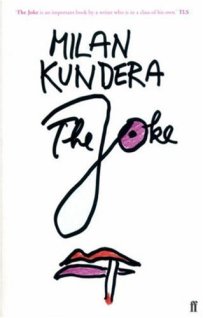
The Joke by Milan Kundera. It’s kind of interesting to read the so-called “lesser” works of such a well-known author, since it can be hard not to give the novel its own treatment, rather than reading everything through the lens (or in comparison) of The Unbearable Lightness of Being, in this case. So while The Joke is a very good book, I seemed to appreciate it less in the beginning because it wasn’t THE Kundera classic. That being said, The Joke offers its own pleasures. It’s a little deeper experience in some ways, more focused on single events and the ironies of the characters as their plots intertwine.
Eat the Document by Dana Spiotta. A finalist for the National Book Award, Spiotta’s 2006 novel is highly entertaining, and pretty spot on in its portrayal of activist and outsider culture in the United States, both in the 1970s and the early 2000s. I kind of cringed reading the sections set in 2003, remembering how some of my friends and I worked so hard to craft political consciousness through fashion. A lot of times I take issue with novels that try to depict aspects of my generation, particularly if they hit close to home, as everyone does, I’m sure. But Spiotta’s writing is so sharp, her points so precise and intuitive, there really wasn’t much to argue about.
Below are some highlights from our family trip to Chicago over the weekend. Maybe tears were shed–some even by the children–but some day we’ll look back fondly on all the fun that we conceivably had.
With MLB entering the stretch run, I’d thought about doing a post on the Royals and what it means to be in a playoff run for the first time in ten years, but decided against it. (Mostly I just pester my wife with my Royals-related musings.)
Instead, here’s something a little more fun: an incredibly entertaining animated short about Dock Ellis throwing a no-hitter while on LSD. I’d never even heard of this before. Whether it’s completely true or not, this still makes for a great story. Big thanks to Brenden McGinn for bringing this to my attention. Enjoy!




 Theodore Wheeler