Kings of Broken Things Cover Reveal!!!

I’m so excited to share with you the front cover of my new novel Kings of Broken Things, out from Little A on August 1!wheeler-kings-of-broken-things-final-front-cover

The cover turned out so well, I couldn’t be more pleased and excited to share the book with you all this summer. Thanks are due to Christina Chung, who did the illustration, and Vivian Lee, my editor at Little A, who painstakingly worked through many versions until this was just right. Their hard work paid off big time, in my opinion. What do you all think?

The book is now available for pre-order in hardcover, paperback, Kindle, and audio editions. The audio edition is a new addition, for all you road warriors and commuters out there. If you’re so inclined, put in your order now and have the book arrive on August 1.


Monroe Work Lynching Archive

Monroe Work Map.pngCheck out this new page and interactive map at MonroeWorkToday that builds off the archive of lynchings originally compiled by sociologist Monroe Work at the Tuskegee Institute.

In addition to giving a pretty succinct history of lynching in the United States, including biographies of heroes like Ida B. Wells, Walter White, James Weldon Johnson, and others, the site includes an impressive interactive map that allows you to click on any of the dots and pull up information on each lynching incident, including the name of the victim, the location where it occurred, and references to source material. It’s good stuff.
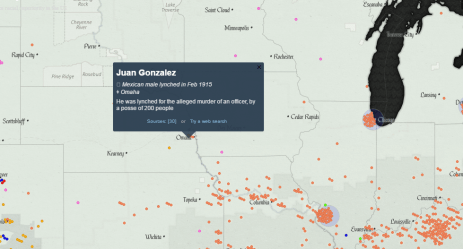
monroe-work-mapOf particular interest is that the archive includes information on Mexican- and Italian-Americans who were murdered in racially-motivated mob killings. After researching lynchings in Omaha for more than a few years now, I can attest that this information is harder to come by. As a case in point (pictured above) I came across reference to the 1915 lynching of Juan Gonzalez in Omaha by a posse of 200 people after he was accused of murdering a police officer. This was only four years before the famous courthouse lynching of Will Brown–which is dramatized in my forthcoming novel. In eight years of reading about the 1919 lynching, I don’t remember seeing mention of the 1915 lynching. Strange. And something else to read up on.

When you get a chance, check out MonroeWorkToday. Very informative and a powerful new research tool for students, historians, and citizens alike.

In the century after the Civil War, as many as 5000 people of color were executed by mobs believing the cause of white supremacy.

On average, mobs killed 9 people per month during the 1890s. The average was 7 people per month over the next 20 years. It was not until 1918 that one member of Congress, a Republican, attempted any action. Yet there were heroes who did not wait for that. How did this happen? What are the details?

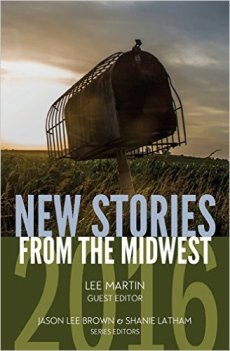
 

New Stories from the Midwest 2016 is Now Available!

51cxgh58lol-_sx326_bo1204203200_Have an Amazon gift card leftover from Christmas laying around? Looking for a fiction anthology to assign to your students for the spring semester? Lately been wondering what the best fiction to come out of the Midwest looks like?
Well, wonder no more, get your copy of New Stories from the Midwest 2016 now!

In addition to my story “On a Train from the Place Called Valentine” (which originally appeared in Boulevard magazine) the anthology features stories from acclaimed authors such as Charles Baxter, Stuart Dybek, Joyce Carol Oates, Laura Van Den Berg, and Christine Sneed. It’s an impressive lineup.

Thanks so much to series editors Jason Lee Brown and Shanie Latham, and guest editor Lee Martin, for putting together such an amazing anthology, and New American Press for seeing it to print. You’ve all done the region proud!

New Stories from the Midwest is an anthology series that presents the best literary writing published in the Midwest during the most recent two-year period. The editors select from a large pool of stories gathered from distinguished journals and magazines like Cincinnati Review, Glimmer Train, Hobart, Mid-American Review, Narrative Magazine, Ploughshares, Tin House, and dozens more. Writers featured in the 2016 volume include such luminaries as Charles Baxter, Peter Ho Davies, and Joyce Carol Oates, as well as new voices and rising stars such as Laura Van Den Berg and Rebecca Makkai. Be sure to watch for New Poetry from the Midwest as well!

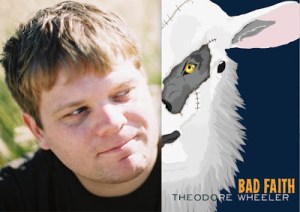
Bad Faith Reassessed for The Story Prize Blog

wheeler-badCheck out my guest blog piece posted today on the blog of The Story Prize: “On Writing Stories from Inside Trump’s America (Before It Was).”

The Story Prize is the biggest book award for short story collections in the US, awarding a $20,000 bounty to an author each spring. In addition, they also open up their blog for authors of new short story collections to write a post about their books or an aspect of their practice, which is where I come into the picture.

Thanks so much to Larry Dark, Director of the prize, for inviting me to write something and for putting up my short essay. Here’s a sample:

Going off my friend’s suggestion, I began to think about who fit into what electoral bucket. Certainly the crotchety Harry Kleinhardt of my opening story, a man who’s forced to face his disappointment of a son while dying from cancer, who spends his afternoons sunning himself in the mudroom listening to Limbaugh and reminisces about how bright life once was, at least before it all went to shit. There’s one vanguard of Trump’s America. Then there’s Anna from “Impertinent, Triumphant,” who met her politician husband while both were congressional interns for Kit Bond, the former Republican Senator from Missouri. It’s easy to see how Anna would coalesce behind the Trump campaign. While not a “build that wall” kind of gal, she wouldn’t be opposed to chanting “lock her up” if others were doing so, say, on the floor of the Republican National Convention, exchanging a loftier political ideal or two in order to take a pantsuit-wearing liberal down a peg.

But there’s some noise in the populous of Bad Faith—as with anywhere, the distance between perception and reality isn’t so clear. Sam and Jacq, also from “Impertinent,” a former travel entrepreneur and an experimental landscape artist, leave Manhattan to settle on a ranch near the Sandhills. And what about the biracial man from Omaha who has to face his fear of being an outsider in a small town (and being exposed to small town police) to attend the funeral of his estranged white mother?

The Uninitiated’s Very Early 2017 Holiday Shopping Guide

Getting an early start on your 2017 holiday shopping list? Lucky for you, my novel Kings of Broken Things is now available for pre-order on Amazon at 25-40% off! The book really will make the perfect gift for family, friends, spouses, speed-daters, and any other folks you might become close with over the next thirteen months. Whether you’re celebrating Christmas or Hanukkah or X-Mas, or even Labor Day or Veterans Day or National Model Railroad Month–Kings of Broken Things will make the perfect gift for that special someone (or hobby enthusiast) in your life.

And if for some reason your didn’t finish shopping for the 2016 season yet, there are still copies of Bad Faith for sale too! BUY NOW!!!

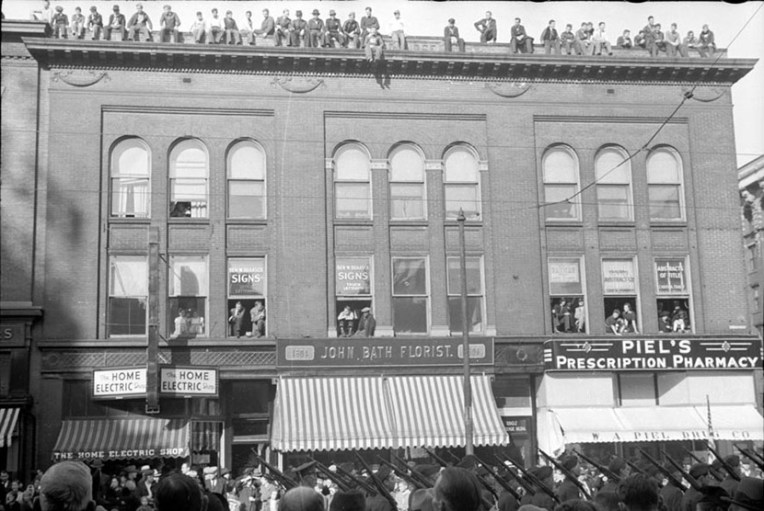
Omaha’s Armistice Day Parade, 1918

I found this photo of the Armistice Day parade in Omaha on the awesome web site Influenza Encyclopedia, which has an extensive archive that details how the Spanish Flu epidemic decimated the US during the height of World War I. It’s really an impressive archive and is beautifully put together. Given that it’s Veterans Day today, it seemed appropriate to share a glimpse of what Omaha’s streets would have looked like about 98 years ago.omaha001


About Writing and Politics in Six Parts

1-4-00-courtesy-of-the-durham-museum-600x491Somehow I missed when this essay was posted in September, but it seems so much more appropriate to post here on the eve of Election Day anyway–an essay on the relation of politics and art within my work. So please finds my contribution–“About Writing and Politics in Six Parts”–in Schlossghost #1, a year book for the 2014-16 fellows of Akademie Schloss Solitude.
The essay is a response to two questions posed by the editors of Schlossghost, Paula Kohlmann and  Clara Herrmann. “Would you say that your (artistic) practice is political? If so, how would you describe its political dimension?”

Find the whole response at the link above, and here’s a sample for now:

In May, earlier this year, I covered a Donald Trump rally that took place in an aircraft hangar near the Omaha airport. At first I was a little worried about even going, as there had been quite a bit of violence at Trump rallies the month before and I wasn’t sure if I wanted to be a party to all that ugliness. But, on the other hand, of course I did. That’s a big part of my job description, the part of the job I like, to be witness to these things.

The rally itself was mostly dull. Trump spoke for a long time about Japanese tariffs without much insight, and the biggest part of his speech was a 20-minute anecdote about this time he handed out trophies at a charity golf tournament. During the rally a few protestors were thrown out. His supporters for the most part looked bored throughout, except at the beginning and end, when his helicopter landed and when they could chant »build that wall.«

I wondered about my feelings of disappointment after the rally. What was I expecting? Wasn’t xenophobia on display enough? Were the protestors dragged out too peacefully? Or did I miss something, the feeling of the event, the undercurrent? Did I feel the way I did because I wasn’t in the crowd? I sat up in the press section – a platform with tables where journalists were corralled behind a fence. By accident I sat between a Fox News anchor and his producer, to comic effect. Seeing their frustration with having to follow Donald Trump made me a little grateful for my obscure lot, for not having to spend all day working a story and then being told to reduce it to a ten-second clip of a long-haired young man shouting »fuck you« at the police.

Bad Faith Reviewed on Ploughshares Blog

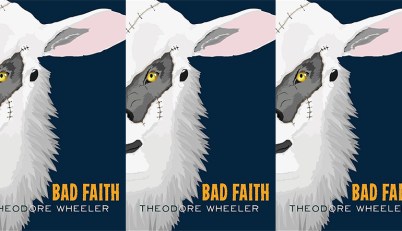
bad-faith_wheelerCheck out this great new review that was posted today on the Ploughshares blog!

Thanks to Denton Loving for his well-considered and spot-on review, and to Ploughshares for publishing it on their blog. (Btw, Ploughshares is currently looking to hire their regular bloggers for 2017. It’s a paid gig!)

Click on over to Ploughshares to read the whole review. Here’s a sample:

One character points out that the Romans believed whoever summoned the Furies “also ended up getting fucked over in the end.” No character in Bad Faith exemplifies that better that Aaron Kleinhardt. A series of heart-in-your-throat moments lead to a startling confrontation when Aaron becomes entangled with Amy, a young woman almost as confused and lonely as Aaron has been.

By anchoring his collection around Aaron Kleinhardt, Wheeler creates subtle connections. The stories feel linked in an understated but solid way, creating a canvas with more depth than any one short story alone could give. Wheeler’s characters are people we know. They are the people who have failed us, as well as the people we have failed. His stories are reminders that few things in this world are completely random. Not luck or grace or pain or violence. Certainly not death or karmic justice.

In the Contributor Spotlight with Midwestern Gothic

issue12Check out a new interview posted today on Midwestern Gothic, as I talk with Allison Reck about vulnerability, Bad Faith, and finding voice among a diverse cast of characters, along with my thoughts on napping and what is an appropriate time to eat supper on the weekend.

Friends of the blog may recall that my story “The Mercy Killing of Harry Kleinhardt” (the opening story in Bad Faith) was published in Midwestern Gothic 8 back in the winter of 2013. At the time I was also featured in their Contributor Spotlight, which makes for an interesting comparison with the latest interview. (It’s particularly funny that when asked what literary figure I would like to meet (living or dead) that I responded with George Saunders–as I had actually met George Saunders before. Maybe I forgot that I’d bumped into him at the Key West Literary Seminar in 2012–or maybe it was that our conversation then was limited to whether or not the pasta salad looked edible–but somehow that must have slipped my mind.) Thanks so much to Allison Reck for conducting the interview, and Midwestern Gothic for posting it.

Read the entire interview here, but in the meantime, here’s a highlight:

AR: In the advanced praise for Bad Faith, fellow authors hailed you for your “nuanced understanding of human nature” and said that your stories revealed the “malice, confusion, and ultimate frailty of us all.” Do you agree with this commentary, that your collection exposes humanity as confused, malicious and frail? What did you hope to convey about humanity in writing these stories?

TW: I didn’t really intend to write a mean-spirited book, and I don’t think it is. There’s something really compelling to me about vulnerability, particular those who are willfully exposed and those who try to cover up weakness by being cruel to others. There are a few malicious characters in Bad Faith — notably Aaron Kleinhardt, a criminal element who appears in two stories and seven between-story vignettes — but for the most part these are people who are vulnerable and different, but not really that interested in covering up their frailty.