Congrats to Eric Sasson, whose book Margins of Tolerance is officially available today from Livingston Press!
Here’s more about the book
Margins of Tolerance focuses on gay men in flux traveling, in transit, or at a crossroads in their lives, seeking to understand their place in the ever-changing landscape of gay identity. This collection also focuses on loyalty and betrayal: between gay lovers, among the gay community itself, and lastly between the gay community and the at-large heterosexual community.
You can read more about Eric, his work, and how his book came to be, at his blog, All Things Sassy.
Incoming: my book review of Christopher Narozny’s Jonah Man has been accepted for publication by The Kenyon Review!
Contracts are still pending, so I’m not sure when the review will appear. Very excited about the new review pub though.
This will be my second appearance with the journal. My short story, “How to Die Young in a Nebraska Winter”, was in their Spring 2011 issue. It’s a pleasure to work with such genuinely nice people who are so enthusiastic about literature.
Jonah Man is new this month from Ig Publishing, a small press to watch out of Brooklyn. In addition to a stellar lineup of literary fiction and noir, their Best Dive Bars series looks like a winner to me.
The following are from Omaha: a Guide to the City and Environs, written and Compiled by The Federal Writers’ Project, Works Progress Administration, State of Nebraska, in 1935. It was part of the American Guide Series.
–
Rudyard Kipling (1889)
“[In Omaha, Kipling] was shocked at the tricks of the embalming trade, the caskets with plate-glass windows, and the burial garments exhibited to him by the obliging undertaker. ‘Bury me,’ he explained, ‘cased in canvas like a fishing-rod, in the deep sea; burn me on a back-water of the Highli with damp wood and no oil; pin me under a Pullman car and let the lighted stove do its worst; sizzle me with a fallen electric wire or whelm me in the sludge of a broken river dam; but may I never go down to the Pit grinning out of a plate-glass window, in a backless dress-coat, and the front half of a black stuff dressing-gown; not though I were ‘held’ against the ravage of the grave for ever and ever. Amen!'”
Mark Twain
“In 1902 the Omaha Public Library banned Mark Twain’s Huckleberry Finn from the juvenile department in the library on the grounds that the book was bad for the impressionable minds of small boys. […] In response to a telegram sent by the Omaha World-Herald regarding the ban, Mark Twain wrote, “I am tearfully afraid this noise is doing much harm. It has started a number of hitherto spotless people to reading Huck Finn, out of a natural human curiosity to learn what this is all about—people who had not heard of him before; people whose morals will go to wreck and ruin now. The publishers are glad but it makes me want to borrow a handkerchief and cry. I should be sorry to think it was the publishers themselves that got up this entire little flutter to enable them to unload a book that was taking too much room in their cellars, but you never can tell what a publisher will do. I have been one myself.”
Bret Harte (1874, to his wife)
“As I rode into Omaha this morning the streets were dumb with snow, and winter, savage and pale, looked into the windows of the cars. […] Imagine a hotel as large and finely appointed as the Occidental in San Francisco, and think of there being such a one in Omaha. Yet here I am—in a very pretty furnished parlor of the ‘Grand Central’ on the very outpost of the West, the cars of the Union Pacific starting on their long overland trip but a few blocks away. […] Verily the West is wonderful.”
Sandburg worked briefly as a coal heaver in Omaha.
Carl Sandburg
Omaha (1920)
Red barns and red heiffers spot the green
grass circles around Omaha–the farmers
haul tanks of cream and wagon-loads of
cheese.
Shale hogbacks across the river at Council
Bluffs–and shanties hang by an eyelash to
the hill slants back around Omaha.
A span of steel ties up the kin of Iowa and
Nebraska across the yellow, big-hoofed Missouri
River.
Omaha, the roughneck, feeds armies,
Eats and swears from a dirty face.
Omaha works to get the world a breakfast.
–
Sunset from Omaha Hotel Window (1918)
Into the blue river hills
The red sun runners go
And the long sand changes
And to-day is a goner
And to-day is not worth haggling over.
Here in Omaha
The gloaming is bitter
As in Chicago
Or Kenosha.
The long sand changes.
To-day is a goner.
Time knocks in another brass nail.
Another yellow plunger shoots the dark.
Constellations
Wheeling over Omaha
As in Chicago
Or Kenosha.
The long sand is gone
and all the talk is stars.
They circle in a dome over Nebraska.
A while back I posted about finally tracking down Tom Dennison’s house in Northwest Omaha at 7510 Military Ave. (Read about it here.) Through the comments section of this post, Dennison’s great-grandson, John Ragan, reached out to me and offered to send a few family photos my way. It was a gracious offer on John’s part, and I appreciate his sending them. He also said it would be okay if I shared them on this blog. So here they are!
Here are the gates to Tom Dennison’s house, probably from the Military side, I’d guess. Most accounts I’ve read report that these gates were always manned by a bodyguard or two, and that floodlights lit the perimeter at night.
The house on Military in the 1930s. It really is a beautiful home. The garden gnome is a nice touch too. Despite tight security around the property, Tom was regarded as a good neighbor. Even though his home was outside city limits, Omaha ran city water and sewage out to his property, and Tom made sure his neighbors shared this special benefit.
The house as it looked in 2006, when it was demolished.
A portrait of Tom’s daughter, Francis Dennison Ragan, on her wedding day.
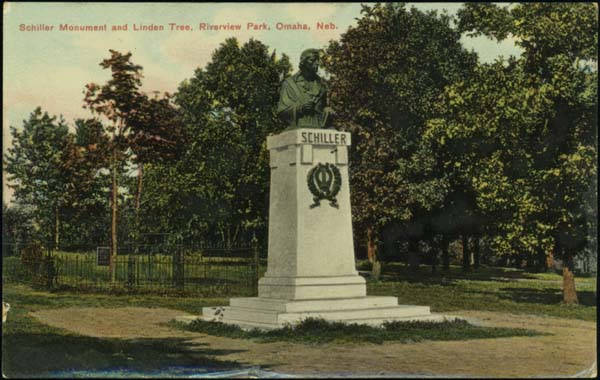
The old von Schiller monument in Riverview Park. This was placed near where the main gates of Henry Doorly Zoo are now. The statue was thrown in a ditch for the duration of World War I (thanks angry mob) but was later pulled out and put back. I'm not sure what happened to it when the zoo expanded, or where it is now. Any guesses?
-My novel (The Uninitiated, for the uninitiated of you reading this) has reached it’s newest stage of done! It’s off to my trusted cadre of readers for feedback and comment. Depending on how soon I hear back from them, I hope to be nearly done-done with the novel early this summer. Then the novel will be off to agents, hoping to find representation. Exciting stuff. I’m rather fond of the book and hope it does well. It’s very exciting to have it completed. Strangely, I kind of care less about publication now that it’s finished than I did when I hardly had any of it written. Maybe I still kind of doubted I could do it. It’s always easier to dream of publishing than it is to write.
-Not much else has been going on, writing-wise. I’ve been working on a few book reviews, and toiling day and night as Web Editor of Prairie Schooner. Some highlights: navigating a reformatting tangle to get our summer issue on Kindle, helping develop a mobile app, and launching (as co-editor with Claire Harlan-Orsi) a monthly book review on Prairie Schooner’s blog. Fun stuff.
-I’m also working on a few photo features for this blog. Mostly historical Omaha stuff, but also contemporary photos of spots where things in my novel happened. I’ll get on this soon.
-Clara has been around for a month now. We’re pretty fond of her as well.
-My grandpa Wheeler died. He was eighty. He was only able to meet Clara once, on Easter, but it was pretty nice. Shouldn’t have rushed around so much. We had four generations of ____ Lynn(e) Wheelers in the same room—Billy Lynn, Dennis Lynn, Theodore Lynn, Clara Lynne. We neglected to snap a photo. Unfortunately, that turned out to be our only opportunity.
Dispatch from The Uninitiated
“It used to be a common thing for a young man to light off secretly in the night, searching for a life different from the one he toiled through at home. Jacob Bressler became an exile in this way. He left under starlight and led his horse over the brawny shoals of what would be his brother’s farm from then on. He didn’t bother with a saddle but merely slid a bridle over the nag’s muzzle and walked out into the buggy paths of the river valley. Even in the dark he found the graveled highway that led to Omaha. There was no need to rush. He knew his brother wouldn’t follow him, not after what happened the week before. It was the kind of thing that happened a lot in Jackson County, and that’s why Jacob had to leave. He slid from his horse when he arrived on the River Ward, easing down to the pavement to land on one foot, the left one raised limp. His foot pulsed dully. He couldn’t worry about it, the Ward had his attention. It was a dark morning but he saw the dim hash marks of intersections on the hills beyond where sanitation wagons crept along knolls that slanted up from river to prairieland. There were tenements to the south, dirt-yard shacks he passed coming in from the north. The River Ward was pinned between the Missouri and downtown Omaha. It was mostly mills and warehouses, tar-topped and sturdy. There were other buildings too. Townhouses puzzled together from curb to curb, brownstones that had been fashionable once but were too close to the pig iron mills now, the constant hammering of steel and tails of factory smoke rising in the mucid morning ether. These were made extravagant, brownstone, sandstone, a blushing peach shade of brick. Jacob knew he would need money right away if he were going to survive. It hadn’t occurred to him in his rush to leave Jackson County. He was too concerned with making his life of great importance—with getting rich—that he forgot about practical things like having enough money for supper and a room. He would have to sell his horse.”
Just Finished
The Cove by Ron Rash. Set in WWI-era North Carolina, this novel deals with a German musician’s struggle to avoid anti-German violence in the rural south and a young woman’s difficulty living down the stigma of a birthmark in a superstitious town. An often beautiful and compelling novel.
The Missing of the Somme by Geoff Dyer. Really a must for anyone interested in the military history or the symbology of war.
 Congrats to Eric Sasson, whose book Margins of Tolerance is officially available today from Livingston Press!




 Theodore Wheeler